

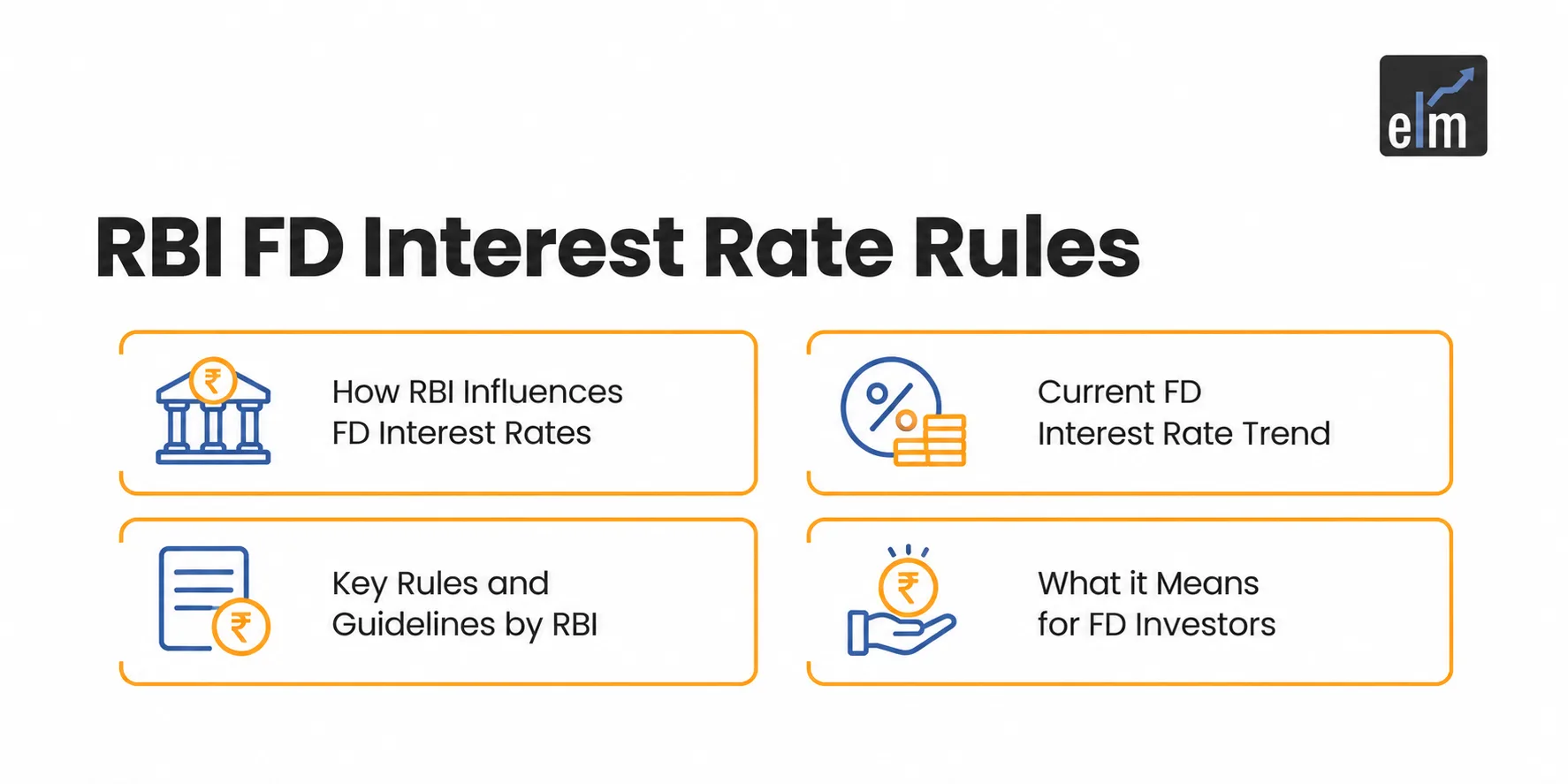

- What Is Changing From 1 October 2026?
- Before vs After: What Changes for Depositors (Comparison Table)
- What the New Rules Do Not Change
- Retail vs Bulk Deposits Explained Simply
- Which Banks and Institutions Do the Rules Apply To?
- Retail Checklist: What to Do Before Booking an FD
- Worked Example: How a 0.25% Rate Difference Compounds Over 3 and 5 Years (Using the FD Calculator)
- Tax on FD Interest: TDS Rules to Know
- What to Watch Next: RBI Policy on 7 October
- Conclusion
From 1 October 2026, banks have to publish their bulk deposit rates at 10:00 am on every business day, with ten minutes of grace. That sounds like a big change for anyone holding a fixed deposit. For most depositors, the new RBI FD rules change very little.
Here is the part that is easy to miss. The RBI FD rules taking effect on 1 October 2026 are mostly about bulk deposits, meaning single rupee term deposits of ₹3 crore and above. The promise that a bank offers the same rate at every branch was already part of RBI’s 2025 Directions. The new amendment names bulk deposits in that promise, adds a daily deadline for publishing bulk rates, and lets banks price bulk deposits differently using a liquidity measure called the Liquidity Coverage Ratio.
This guide goes through the RBI rules for fixed deposits paragraph by paragraph: what is new, what is not, how bulk and retail deposits differ, and what to check before you book an FD. It also covers the TDS limits on FD interest and the RBI policy decision due on 7 October, since both affect what fixed deposit interest rates actually earn you.
What Is Changing From 1 October 2026?
RBI’s Revised Deposit Interest Rate Framework
On 30 July 2026, the Reserve Bank of India issued the Reserve Bank of India (Commercial Banks, Interest Rate on Deposits) Second Amendment Directions, 2026. The reference number is RBI/2026-27/214. The changes take effect on 1 October 2026 and apply to domestic rupee deposits and to rupee deposits of non-residents.
Four paragraphs of the earlier Directions are touched. Paragraphs 7(2) and 7(3) are rewritten. Paragraph 10(4) is new and covers domestic rupee deposits. Paragraph 27(3)(iv) is also new and gives the same freedom for non-resident rupee deposits.
Read together, the amended RBI FD rules do three things. They say the uniform-rate rule covers bulk deposits. They say bulk deposit rates must be posted on the bank’s website at 10:00 am on each business day, with a grace time of ten minutes, so by 10:10 am at the latest. And they allow a bank to offer different rates on bulk deposits by considering the differential run-off rates that apply to deposits or unsecured wholesale funding under the LCR framework.
Background: Amendments to the Interest Rate on Deposits Directions, 2025
The base document is the Reserve Bank of India Directions, 2025. Under these earlier RBI rules, paragraph 7(2) already said that deposit rates must be uniform across branches and customers, with no discrimination between deposits of similar amounts accepted on the same date. Its paragraph 7(3) already tied the interest paid to a schedule of interest rates disclosed in advance. The same Directions define a bulk deposit as a single rupee term deposit of ₹3 crore and above. The Directions for commercial banks cover the large listed lenders that anchor the Nifty Bank index.
RBI put the amendment out for public comment first. A draft of the revised RBI FD rules was released on 5 June 2026, with comments invited until 20 June 2026. The stated aim was to give banks more flexibility in pricing rupee bulk deposits while keeping the disclosure of deposit rates uniform. The final directions followed on 30 July 2026.
Before vs After: What Changes for Depositors (Comparison Table)
The table sets the 2025 position against the position under the RBI FD rules from 1 October 2026, with a focus on fixed deposit interest rates and how they are disclosed. Rows where the two columns look alike are deliberate. For retail FDs, much of the amendment restates a rule that was already in force under the 2025 RBI rules.
| Area | Before (2025 Directions) | From 1 October 2026 |
|---|---|---|
| Same rate across branches | Deposit rates uniform across branches and customers, with no discrimination between deposits of similar amount accepted on the same date. | Same rule, now written to cover bulk deposits as well. |
| Rates on the bank’s website | Interest payable strictly as per a schedule of interest rates disclosed in advance. | Same rule, now stated as a schedule on the bank’s website and covering bulk deposits. Bulk deposit rates must also be disclosed at 10:00 am (grace time to 10:10 am) every business day. |
| Interest paid | As per the disclosed schedule. | As per the disclosed schedule, bulk deposits included. |
| Bulk deposit pricing | No paragraph on differential pricing linked to LCR run-off rates. | New paragraphs 10(4) and 27(3)(iv): banks may offer differential rates on bulk deposits by considering differential run-off rates under the LCR framework. |
| Your existing FD | Earns the rate contracted at booking. | Earns the rate contracted at booking. The amended paragraphs do not touch it. |
In plain terms, a retail depositor gets no new rule from this amendment, because the RBI rules for fixed deposits they rely on were already written in 2025. The new machinery sits on the bulk deposit side.
Same Rate for Same Amount, Same Tenure, Same Day Across All Branches
Paragraph 7(2) says a bank’s deposit rates must be uniform across all branches and for all customers. It adds that there can be no discrimination between one deposit and another deposit of similar amount, accepted on the same date, at any of the bank’s offices. RBI’s wording refers to amount and date. Rate cards are organised by tenure and amount slab, so in practice fixed deposit interest rates for the same tenure, the same slab and the same day should match wherever you walk in. A branch is not meant to quote you a different rate for a similar deposit on the same day.
What the RBI FD rules add to that paragraph is the phrase “including bulk deposits.” For a retail depositor, that confirms an existing right rather than creating a new one.
Deposit Rates, Including Bulk Deposit Rates, Published on Bank Websites in Advance
Paragraph 7(3) now says the interest rates payable on deposits, bulk deposits included, must follow the schedule disclosed in advance on the bank’s website. The new part is a timing rule for bulk deposits. Their rates must be disclosed at 10:00 am on each business day, with ten minutes of grace, so by 10:10 am at the latest. Under the RBI FD rules, a bulk depositor can look at the bank’s website each morning and see that day’s published bulk rates. For regular retail deposits, the RBI rules for fixed deposits already required advance disclosure in the 2025 Directions.
Interest Paid as Per the Published Schedule
The same paragraph says rates payable must be “strictly as per” the published schedule. For you, that means the rate on your FD receipt should match the published rate for that tenure, that slab, and that day. If the two differ, take it up with the bank. It also helps to keep a screenshot of the website rate with the date visible. This is the most practical check the RBI FD rules give a retail depositor.
What the New Rules Do Not Change
Several things stay exactly as they were under the RBI FD rules.
Your Existing FD Keeps Its Current Interest Rate
The four amended paragraphs deal with how banks offer, publish, and price deposits. None of the amended RBI rules for fixed deposits touches the contracted rate on a deposit that is already booked. A fixed-rate FD opened in 2024 or 2025 keeps earning the rate on its receipt until maturity. Explainers published after the announcement say the same: existing deposits are unaffected.
FD Rate Levels Are Not Being Raised or Cut
The RBI FD rules do not set a rate for anyone. Banks continue to decide their own deposit rates, and fixed deposit interest rates tend to follow the RBI’s policy rate over time and each bank’s own funding needs. What changes is how those rates are applied and published, and how much room banks have to price bulk deposits. RBI has not said whether that room will push bulk rates up or down, and nothing in the amended RBI rules changes how rates on ordinary FDs are set.
Retail vs Bulk Deposits Explained Simply
RBI’s 2025 Directions define a bulk deposit as a single rupee term deposit of ₹3 crore and above. Anything below that line is not a bulk deposit, and most individual FDs sit well below it, so the new bulk pricing freedom in the RBI FD rules rarely reaches them. Some older articles quote ₹2 crore as the bulk deposit limit. That was the earlier threshold, and RBI has since raised it to ₹3 crore.
The split matters because of what the RBI FD rules do. A retail depositor gets a published rate card of fixed deposit interest rates. A bulk depositor gets a rate published every morning and, from 1 October, rates that can differ with the run-off rate attached to the deposit.
Why Bulk Deposit Rates Can Differ (Liquidity Coverage Ratio)
The Liquidity Coverage Ratio, or LCR, is a rule that makes banks hold enough high-quality liquid assets to survive a stress scenario lasting 30 days. A run-off is a withdrawal that the bank did not anticipate, and a run-off rate is the share of a deposit the bank assumes could leave in that stress period. The RBI rules assign different run-off rates to different kinds of deposits and wholesale funding.
The new paragraph lets a bank offer different rates on bulk deposits when those deposits carry different run-off rates. The idea is that the rate can reflect how much liquidity the bank has to set aside against the money. Under the RBI rules for fixed deposits, the uniformity rule still applies, and the bulk rates still have to be published each morning. For a retail depositor this matters only indirectly, but it explains why two large deposits may not carry the same rate.
Which Banks and Institutions Do the Rules Apply To?
RBI issued amendment directions for six categories of banks: commercial banks, small finance banks, regional rural banks, payments banks, local area banks and urban co-operative banks. The commercial banks notification, which is the one quoted above, applies the RBI FD rules to domestic rupee deposits and rupee deposits of non-residents. Most of the large listed names, the kind covered in this Bank Nifty explainer, sit in that commercial banks category. A Legal500 banking update for August 2026 notes that urban co-operative banks get the same uniform rate and advance schedule language.
The LCR-based freedom on bulk deposits is written into the commercial banks’ directions at paragraph 10(4). If your deposit sits with another type of bank, read that category’s own direction on the RBI website. These are RBI rules for banks. FDs issued by NBFCs and companies are governed by their own rules, so none of the RBI FD rules described here carry over to them automatically.
Retail Checklist: What to Do Before Booking an FD
A short checklist helps you apply the RBI FD rules in practice.
Compare the Website Rate With the Branch Quote
Open the bank’s rate page before you walk in or open the app. Note the rate for your tenure and amount slab, and note the date on the page. If the branch or the app quotes something different for a similar deposit on the same day, ask why. Under the RBI rules for fixed deposits, rates on similar deposits are supposed to match the published schedule at every office.
Check Tenure, Amount Slab and Booking Date
Rate cards change with tenure and amount slab, and banks revise them from time to time, even under the RBI FD rules. The rate that applies is the one on the day the deposit is accepted. So check three things: the tenure, the slab your amount falls into, and the date the deposit will be booked. If you wait a day and the card is revised, your rate can change with it.

Compare Across Banks, Not Just Within One
Under the RBI rules, uniform rates inside one bank do not mean similar rates across banks. Banks set their own deposit rates, so fixed deposit interest rates for the same tenure can differ from one institution to another. Compare a few banks on the same tenure, and look at the compounding frequency and the premature withdrawal terms along with the headline rate.
Worked Example: How a 0.25% Rate Difference Compounds Over 3 and 5 Years (Using the FD Calculator)
When you compare fixed deposit interest rates, a quarter of a percentage point looks too small to bother with. An FD calculator shows why it is not. Take ₹10,00,000 placed in an FD at 7.00% and the same amount at 7.25%. These rates are illustrative and are not quotes from any bank. The figures assume quarterly compounding and no tax, and they are rounded to the nearest rupee.
| Tenure | Maturity at 7.00% | Maturity at 7.25% | Extra interest at 7.25% |
|---|---|---|---|
| 3 years | ₹12,31,439 | ₹12,40,547 | ₹9,108 |
| 5 years | ₹14,14,778 | ₹14,32,261 | ₹17,483 |
The extra amount looks modest, but it is not trivial. Over three years the higher rate earns about 3.9% more interest. Over five years the gap widens to about 4.2%, because the extra interest keeps compounding. Banks may compound at different intervals, so rerun the numbers with the actual terms of the FD you are considering. The RBI FD rules do not change this arithmetic. They only govern how the rates are published.
Tax on FD Interest: TDS Rules to Know
FD interest is added to your income and taxed at your slab rate. Banks also deduct TDS once the interest crosses a threshold. From 1 April 2026, TDS on interest paid by banks sits under section 393 of the Income-tax Act, 2025, at serial number 5(ii) of its table. The thresholds are ₹1,00,000 in a tax year for a senior citizen and ₹50,000 for everyone else.
TDS is a deduction, not your final tax bill. If your total estimated tax for the year is nil, a resident individual can give the bank a declaration so that TDS is not deducted. Under the Income-tax Act, 2025 that declaration is Form 121, which replaces Forms 15G and 15H from 1 April 2026. It has to be submitted to each bank separately, before the deduction happens.
None of this comes from the RBI FD rules, and the October change does not alter the tax rules. A TDS calculator can estimate the deduction on your own deposits.
What to Watch Next: RBI Policy on 7 October
RBI’s Monetary Policy Committee meets from 5 to 7 October 2026. The policy decision is due at 10:00 am on Wednesday, 7 October, with the Governor’s press conference at 12:00 noon. The repo rate stands at 5.25%, and the committee has kept it unchanged in its last four reviews.
The policy decision and the RBI FD rules are separate things. The decision concerns the policy rate, which banks keep in view when they review their rate cards. The 1 October change to the RBI rules concerns how banks apply and publish rates once they have set them. Watch the decision first. Then watch how fixed deposit interest rates move on bank websites over the following days, because under the RBI FD rules the published schedule is what has to apply. Banks are also among the rate-sensitive sectors that sector rotation data tracks around policy dates.
This section was written on 6 October 2026, before the decision. Check the outcome before relying on it.
Conclusion
The RBI’s new FD interest rate rules are real, but most of what is new lands on bulk deposits. Under the RBI rules for fixed deposits, retail depositors keep what they had under the 2025 Directions: the same rate across branches for similar deposits, and interest paid as per the published schedule. Bulk depositors get a daily publication deadline and a bank’s new freedom to price by LCR run-off rate. For ordinary retail FDs, the RBI FD rules do not by themselves raise or lower rates.
Do: compare the website rate with the branch quote, check the tenure, slab and booking date, and compare at least a few banks before you commit.
Avoid: assuming the RBI FD rules will lift FD rates, using the old ₹2 crore bulk deposit figure, or treating a verbal branch quote as the final word when the published schedule says otherwise.
If you want to go further with structured learning on markets and money, explore the Elearnmarkets courses and the free calculators on the site.
FAQs
1. What are the RBI’s new FD rules from 1 October 2026?
On 30 July 2026, RBI issued amendment directions that take effect on 1 October 2026. Under these RBI rules for fixed deposits, deposit rates, bulk deposits included, must be uniform across branches and customers for similar deposits accepted on the same date. Interest must follow the schedule disclosed in advance on the bank’s website. Bulk deposit rates must be published at 10:00 am on each business day, with a grace time that ends at 10:10 am. Banks may also offer differential rates on bulk deposits by considering LCR run-off rates.
2. Will the new rules change the interest rate on my existing FD?
No. The amended RBI FD rules deal with how banks offer, publish and price deposits. A fixed-rate FD that is already booked keeps the rate it was opened at.
3. Do banks now have to offer the same FD rate in all branches?
Yes, and they already had to under the 2025 Directions. Paragraph 7(2) of the RBI rules for fixed deposits requires uniform rates across branches and customers for similar deposits accepted on the same date. The amendment states that this covers bulk deposits too.
4. Do the new rules raise or cut FD interest rates?
No. The RBI FD rules set no rate. Banks still decide their own fixed deposit interest rates. The changes are about how rates are applied, published and, for bulk deposits, priced.
5. What is a bulk deposit and why can its rate be different?
A bulk deposit is a single rupee term deposit of ₹3 crore and above. Under the RBI FD rules, banks may now offer differential rates on bulk deposits by considering the run-off rates that apply under the Liquidity Coverage Ratio framework, which reflect how much of a deposit a bank assumes could be withdrawn in a stress period.
6. Which banks do the RBI’s new deposit rate rules apply to?
The RBI FD rules apply to deposits with commercial banks, small finance banks, regional rural banks, payments banks, local area banks and urban co-operative banks, each under its own amendment directions. FDs from NBFCs and companies are governed by separate rules.
7. How do I check the correct FD rate before booking?
Open the bank’s website rate page, note the rate for your tenure and amount slab with the date shown, and compare it with the branch or app quote for the same day. If they differ for a similar deposit, ask the bank to explain before you book. The RBI FD rules expect the two to match.