
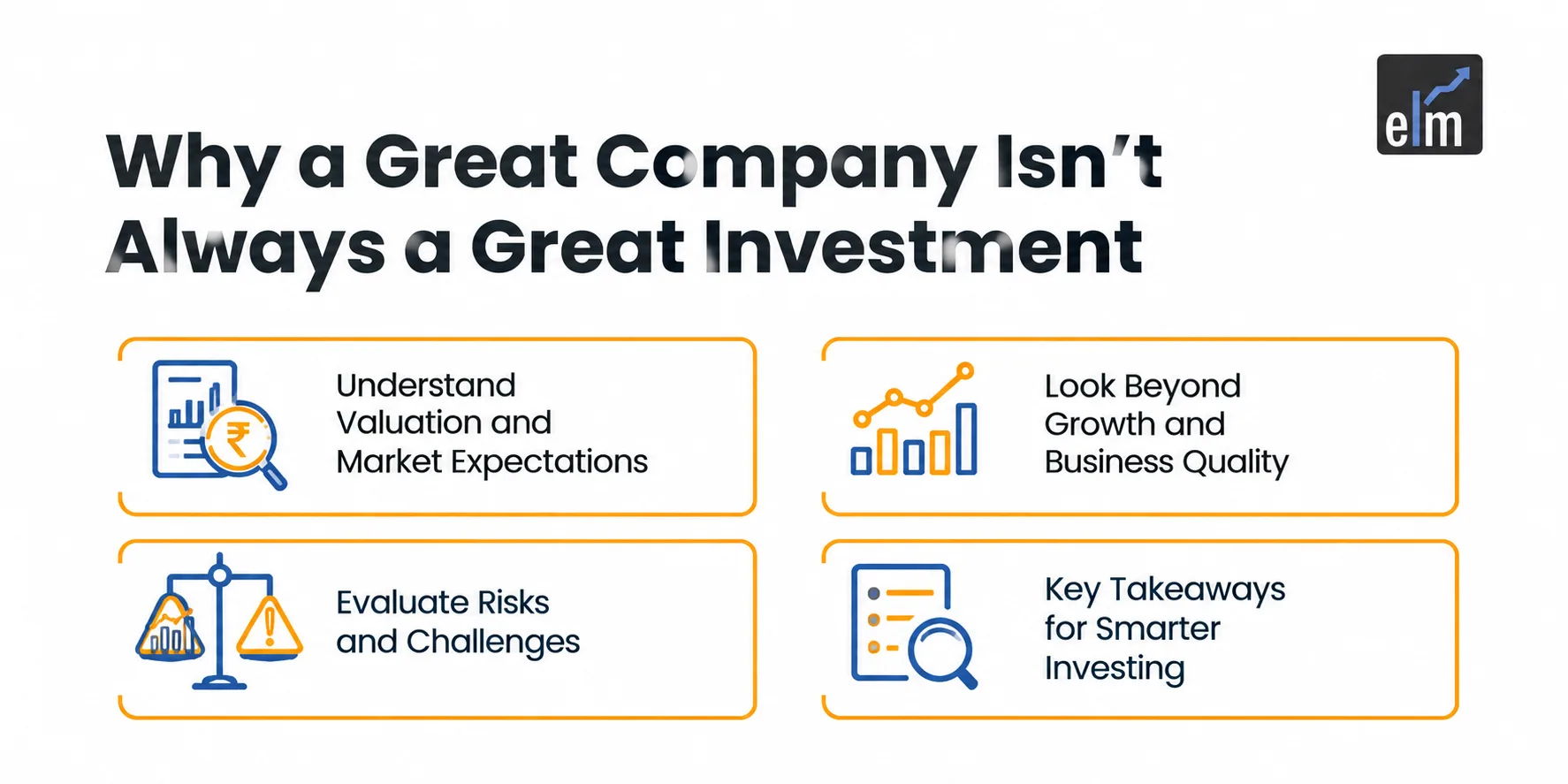

- What Makes a Company Good?
- What Makes a Good Investment?
- Stock Valuation: The Missing Piece
- Expectations Are Already Priced into Stocks
- Growth Can Be a Double-Edged Sword
- A Great Business Bought at the Wrong Price
- The Role of Margin of Safety
- Why Strong Companies Can Deliver Weak Stock Returns
- How Investors Can Avoid This Mistake
- Good Company vs. Good Investment: A Simple Comparison
- Conclusion
“Good company equals good investment.” It sounds perfectly reasonable. If a business has a trusted brand, capable management, clean books and a long runway for growth, why wouldn’t its stock make you money?
A company can do almost everything right and its stock can still go nowhere for years, usually because investors paid too much for qualities everyone could already see. The business compounds. The shareholder waits. Stock valuation is what separates the two outcomes.
That is the idea this article unpacks. Your returns depend on three things together: the quality of the business, the price you pay for it, and the expectations already built into that price. Get the first one right, ignore the other two, and a good company can quietly stop being a good investment.
What Makes a Company Good?
When analysts call a company fundamentally strong, they usually mean some combination of the following, which describes a strong business, but not necessarily a smart stock choice::
- A durable competitive advantage, such as a brand, distribution network, cost edge or high switching costs that rivals struggle to copy
- Consistent revenue and profit growth across business cycles, not just one good year
- Healthy operating cash flows that broadly track reported profits
- A strong balance sheet with manageable debt
- Attractive return on capital, meaning the company earns well on the money invested in it (ROE and ROCE are the usual measures)
- Disciplined capital allocation, where profits are reinvested, paid out or used for acquisitions with care
- Capable and honest management
- A business model that can survive shifts in technology, regulation and consumer behaviour
Every item here describes the business. None of them tells you whether the stock is worth buying at today’s price.
What Makes a Good Investment?
An investment decision starts where business analysis stops. Once you are convinced a company is good, you still have to answer a few more questions before calling it a profitable holding:
- What price am I paying, and what stock valuation does it imply?
- How much future growth is the market already assuming?
- How reliable are the company’s future earnings?
- What risks could damage the business or the stock?
- How much margin of safety do I have if I am wrong?
- Does my time horizon match the time this idea needs to play out?
A simple way to hold the distinction:
Good company = the quality of the business.
Good investment = the relationship between business quality, price, expectations, growth and risk.
A mediocre business bought very cheaply can sometimes work out fine. An excellent business bought at an extreme price can disappoint for a long time. In other words, a good investment is largely decided at the moment of purchase.
Stock Valuation: The Missing Piece
Stock valuation is the process of estimating what a business is worth and comparing that estimate with its share price. Investors lean on a handful of common valuation ratios:
- P/E ratio (price to earnings): the share price divided by earnings per share (EPS). It tells you how many rupees you pay for every rupee of annual profit.
- P/B ratio (price to book): the share price compared with net worth per share on the balance sheet. It suits banks and asset-heavy businesses.
- EV/EBITDA: enterprise value (market value plus debt minus cash) divided by operating profit before depreciation.
- Free cash flow yield: free cash flow per share divided by the share price. It shows how much cash the business throws off relative to what you pay.
- Intrinsic value: an estimate of what the business is worth based on the cash it can generate over its life, discounted back to today.
No single metric works for every business. A P/E that looks expensive for a slow-growing utility may be reasonable for a fast-growing consumer company. Each ratio is a lens, not a verdict. It also helps to compare a stock’s P/E ratio with its own historical range, not only with its peers.
Hypothetical Example: Same Company, Different Price
Take a hypothetical Company A that earns ₹10 per share.
- If the stock trades at ₹200, the P/E ratio is 20.
- If the stock trades at ₹500, the P/E ratio is 50.
Nothing about the company has changed. Only the price has moved, and with it, the bar the business now has to clear.
Now assume, purely for illustration, that Company A grows EPS by 15% a year for five years. Earnings rise from ₹10 to about ₹20.1. Suppose that at the end of those five years the market values the stock at a P/E of 25. The share would trade near ₹503.
- The investor who paid ₹200 has roughly 2.5 times their money, close to a 20% annual return.
- The investor who paid ₹500 is almost exactly where they started, after five years of the company doing well.
Both investors owned the same good company. One of them bought a good investment. The other paid for five years of growth in advance.
That is the plain arithmetic of buying stocks at high valuation. A high P/E ratio does not mean the stock will fall. It means the business must grow faster, for longer, just to justify the price you paid, and it leaves a thinner margin of safety.
Expectations Are Already Priced into Stocks
A share price is not a reward for past performance. It is the market’s collective estimate of future performance, which is why stock valuation always looks forward.
That is why a company can report strong revenue growth, higher profits and healthy margins, and still see its stock fall the next morning, particularly when the P/E ratio already assumed perfection. Great results alone do not make a winning stock.
The reason sits in two sentences that sound alike but mean very different things:
“The company performed well.”
“The company performed better than the market expected.”
Only the second one reliably lifts a stock. If the market was expecting 25% profit growth and the company delivers 20%, the result is good in absolute terms and disappointing relative to what was priced in. The stock reacts to that gap, not to the headline. Expectations, not results alone, decide whether a solid company turns out to be a great purchase.

Growth Can Be a Double-Edged Sword
Investors often accept a premium stock valuation for high-growth companies, and sometimes the premium is justified. A business growing fast enough can grow into a high P/E ratio over time.
The trouble is that high growth rarely stays high forever. Several forces tend to pull it back:
- Competition increases as others notice a profitable market
- Margins normalise after an unusually good phase
- The remaining market opportunity shrinks relative to the company’s size
- Regulation or technology changes the economics of the industry
Size alone makes the maths harder. A company growing 30% on ₹500 crore of revenue needs ₹150 crore of new sales. At ₹5,000 crore, the same 30% needs ₹1,500 crore.
When growth slows from 30% to 18%, the business is still growing strongly. But if the stock was priced for 30%, the market reprices it for 18%. This is called valuation compression, or de-rating, and it can absorb years of earnings growth. A good company bought at a growth-priced multiple can then stop being a good investment.
A Great Business Bought at the Wrong Price
A second hypothetical illustration, not a prediction about any company or sector: suppose an investor buys Company B at ₹600 when its EPS is ₹10. That is a P/E ratio of 60, a multiple the market is willing to pay because it expects earnings to grow about 30% a year.
Over the next three years, Company B grows earnings at 15% a year. By most standards that is a solid performance. EPS rises to about ₹15.2, an increase of more than 50%.
But the market no longer believes in 30% growth, and it now values the stock at a P/E ratio of 35.
₹15.2 × 35 = roughly ₹532
The company’s profits are up by half. The investor is down about 11%. A strong company, but a poor financial move at that price.
Had earnings grown at the expected 30% and the P/E ratio held at 60, the stock would have been near ₹1,318. The difference between those two outcomes had nothing to do with the quality of the business. It came entirely from the gap between what the price assumed and what the business delivered.
This is the core quality-versus-price problem in its simplest form. Price and stock valuation matter even when the business is excellent, and they matter most when everyone already knows the business is excellent. A margin of safety exists to absorb exactly this kind of gap.
The Role of Margin of Safety
Benjamin Graham, whose book The Intelligent Investor shaped value investing, treated margin of safety as the central concept of sound investment. The idea is simple: buy only when the market price sits meaningfully below your estimate of intrinsic value. A margin of safety is what helps a good company become a good investment.
If you estimate a business is worth ₹400 per share and you buy at ₹300, you have a 25% margin of safety. That cushion offers some protection against:
- Assumptions that turn out to be wrong
- Growth that arrives slower than expected
- Risks you did not see coming
- A fall in the valuation multiple the market is willing to pay, such as the P/E ratio
One caution matters here. Intrinsic value is an estimate, not a fact, and every stock valuation carries that uncertainty. Two careful analysts can reach very different numbers for the same company. The margin of safety exists precisely because your estimate might be off.
Warren Buffett’s often-quoted line from his 1989 letter to Berkshire Hathaway shareholders argues that buying a wonderful company at a fair price beats buying a fair company at a wonderful price. Even this famous case for quality still depends on a fair price. In practice, a fair price is what makes a wonderful company a good investment.
Why Strong Companies Can Deliver Weak Stock Returns
Stock valuation is the most common culprit, but not the only one. A good business can still turn into a disappointing holding because of:
- Excessively high stock valuation that leaves no margin of safety or room for error
- Slowing earnings growth after years of strong expansion
- Cyclical businesses bought near peak earnings, when a low P/E ratio can hide profits that are about to fall
- Regulatory or industry changes that alter pricing, margins or market access
- Excessive debt taken on to fund expansion
- Poor capital allocation despite strong operations
- Corporate governance concerns, such as questionable related-party transactions
- Overdependence on one product, customer or market
- Changing competitive dynamics
- Investor expectations drifting far beyond what the business can realistically deliver
None of these automatically makes a business unviable. Each is a question worth answering before you decide a stock is worth adding to your portfolio.
How Investors Can Avoid This Mistake
One of the most common investment mistakes is buying a stock because the company is good, without checking what the price demands. Before investing, ask yourself the following to test whether the share price is justified:
- Is the business fundamentally strong?
- How fast are revenue and earnings growing?
- Is that growth sustainable?
- What stock valuation am I paying?
- What growth expectations are already reflected in the price?
- What could cause the valuation to fall?
- Is there a reasonable margin of safety?
- What are the major business and industry risks?
- Am I buying the business or simply chasing past performance?
- What would make my investment thesis wrong?
The last question is the most useful of the ten. If you cannot say what would prove you wrong, you do not yet have an investment thesis. You have a hope. Tools such as valuation scans can help you check a stock’s P/E ratio and other multiples against its sector before you build a thesis.
Good Company vs. Good Investment: A Simple Comparison
| Good Company | Good Investment |
|---|---|
| Strong business model | Attractive risk-reward |
| Good management | Reasonable valuation |
| Strong financials | Sustainable earnings potential |
| Competitive advantage | Price leaves room for error |
| Consistent growth | Expectations are realistic |
A company can tick every box in the left column while its stock fails the right column at a particular price. Business analysis tells you what you own. Stock valuation tells you whether today’s price makes sense for it.
Conclusion
A great business is only one part of what makes a good investment. The price you pay, the stock valuation it implies, the growth the business can realistically deliver, the expectations already in the stock and the risks along the way together decide whether business quality turns into investment returns.
None of this means good companies make bad investments. Often they make excellent ones, when bought at sensible prices and held with patience. It means quality on its own is not the full analysis, and a good investment needs a sensible price and a margin of safety as well.
So the next time a stock looks attractive because the company is outstanding, ask two questions instead of one. Is this a good company? And, at this price, is it a good investment: what P/E ratio am I paying for it, and what does the current price already assume?
To apply these valuation principles effectively, studying fundamental analysis framework step-by-step helps bridge the gap between business quality and stock pricing.
FAQs
1. Can a great company turn into a poor investment choice?
Yes. If you pay a price that already assumes years of strong growth, the business can perform well while your returns remain flat or negative. Total returns depend on business quality, the entry price, and the expectations already built into the market valuation.
2. Why does a stock fall after good results?
A share price reflects what the market expects. If a company delivers 20% profit growth when the market expected 25%, the result is good in absolute terms but disappointing against expectations, and the stock can fall.
3. Does a high P/E mean a stock will fall?
No. A high P/E means the business must grow faster, for longer, to justify the price paid. If growth delivers, the stock can grow into its valuation. If growth slows, the P/E can shrink.
4. What is valuation compression?
Valuation compression, also called de-rating, is a fall in the multiple the market pays for a stock, usually because growth expectations have come down. It can absorb years of earnings growth, as in the Company B example above.
5. What does “priced in” mean?
“Priced in” means the market has already built a piece of expected news, such as strong growth, into today’s share price. Only results that beat those expectations reliably move the stock higher.