

Intro
Understanding how to read market conditions before trading is essential for every trader. On July 8, 2026, India VIX jumped nearly 30% in a single session, from around 11.65 to 14.68, while the Nifty 50 fell over 2% and the Sensex dropped roughly 1,677 points. Any options strategy that worked the week before would have behaved very differently once volatility repriced that sharply.
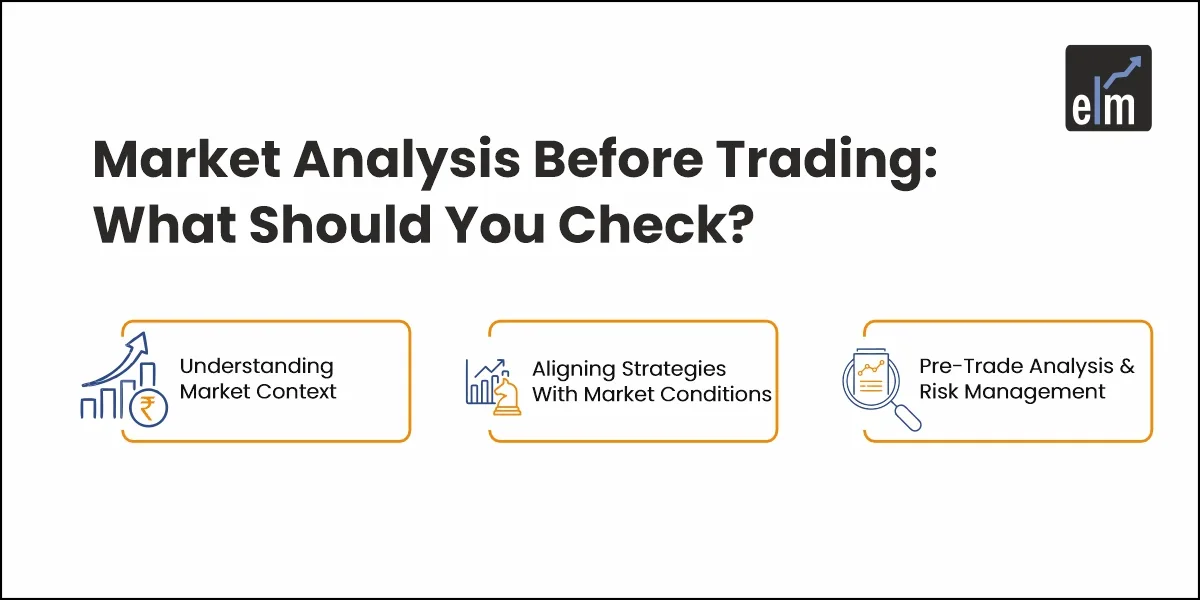
Learning how to read market conditions before trading is essential because the same setup, indicator, or entry rule can produce opposite outcomes depending on what the broader market is doing underneath it. This piece walks through what market context means, why strategies fail on certain days, five specific things to check, and common mistakes to avoid.
What Does Market Context Mean in Trading?
Market context is the backdrop against which any individual trade takes place: the direction of the broader index, how volatile the market currently is, which sectors are leading or lagging, and whether overall conditions favor the kind of trade you are about to take.
A trading strategy, whether it is a breakout system, an options-selling approach, or a simple moving average crossover, is not a standalone formula that works in isolation. It is a bet on a certain type of market behavior, trending, range-bound, high-volatility, or low-volatility, and its success rate depends heavily on whether that behavior is actually present when you place the trade. Reading market conditions before trading means checking whether the conditions your strategy needs are actually there, rather than assuming they always are because the setup looks clean on the chart in front of you.
Why the Same Trading Strategy Can Work One Day and Fail the Next
Most retail traders learn a strategy in isolation: a specific candlestick pattern, a specific indicator crossover, or a specific options structure. What is rarely taught alongside it is that every strategy has conditions under which it works well and conditions under which it doesn’t. A trend-following breakout strategy performs well when the market is actually trending and volume confirms the move and performs poorly in a choppy, range-bound market where breakouts repeatedly fail and reverse.
An options-selling strategy that profits from time decay works best when volatility is elevated relative to what actually materializes. Understanding how to read market conditions before trading helps options traders recognize when sudden volatility spikes could move the underlying sharply against their positions. The strategy itself did not change between the day it worked and the day it failed. The market context around it did. This is precisely the gap that the Elearnmarkets webinar “Reading the Market Before Moves,” led by full-time index options trader Chetan Panchamia, is built around: traders often have a strategy but no system for evaluating market conditions before trading, leaving them unaware of whether the index is actually cooperating with their setup.
5 Things to Check to Evaluate Market Conditions Before Trading
Before placing any position, running through a structured checklist helps you analyze how to read market conditions before trading so you avoid low-probability environments.
What Is the Broader Market Trend?
Before looking at any individual stock or option setup, analyzing the direction of the Nifty or Sensex is a critical step when learning how to read market conditions before trading. A stock breaking out above resistance means something different when the broader index is in a strong uptrend than when the index itself is struggling below its own resistance level. Trading against the broader trend is not automatically wrong, but it usually needs a stronger, more specific reason than trading with it, since a rising index tends to lift most stocks along with it, and a falling one tends to drag even fundamentally sound stocks lower regardless of their individual setup.
Which Sectors Are Showing Strength?
Markets rarely move as one uniform block. On most trading days, some sectors are outperforming the index and some are lagging behind it, and that rotation carries information. A breakout in a stock belonging to a sector that is broadly under pressure is a weaker signal than the identical breakout in a stock from a sector currently showing leadership. Checking sector-level strength to evaluate market conditions before trading helps confirm whether a setup is supported by a broader theme or is an isolated move that may not have the same follow-through.
What Is Volatility Telling You?
The India VIX measures the market’s expectation of Nifty volatility over the next 30 days, based on option prices, and it is often called a fear gauge because it tends to rise sharply when uncertainty increases. As of mid-August 2026, India VIX was trading in the 11-12 range, well below its 52-week high of 28.90 recorded earlier in the year, according to HDFC Sky’s tracking of the index.
A low, stable VIX generally favors strategies that rely on steady, gradual moves and can make premium-selling options strategies more attractive, since options are cheaper to sell when implied volatility is low relative to history. A high or rapidly rising VIX signals bigger expected swings, making volatility tracking an essential part of learning how to read market conditions before trading, particularly for options positions where volatility itself drives pricing. Checking where VIX currently sits and whether it is rising or falling tells you something about the kind of trade the market is likely to reward right now.
Is the Setup Supported by Volume?
A price move without volume behind it is a weaker signal than the same move on above-average volume. When evaluating how to read market conditions before trading, volume provides necessary confirmation of institutional interest. Volume reflects genuine participation; a breakout on thin trading can reverse quickly once the handful of buyers driving it runs out, while a breakout accompanied by volume meaningfully above the recent average suggests broader conviction behind the move. This applies whether you are looking at an individual stock or at index-level moves used to time options trades; checking volume alongside price is one of the simplest ways to separate a setup with real backing from one that is likely to fade.
Is This a Good Time to Trade at All?
This is the check traders skip most often, largely because it means considering the possibility of not trading. Some market conditions genuinely do not favor any clean setup: a market caught between a major resistance and support level with no clear direction, a session immediately before a major scheduled event like a central bank policy decision or a big earnings release, or a period of unusually thin, holiday-adjusted liquidity. In these conditions, even a technically correct setup can behave unpredictably simply because the broader environment is unsettled. Asking “should I even be trading right now?” before asking “what should I trade?” is a genuine part of reading market context, not a failure of nerve.
Common Mistakes Traders Make When Reading the Market
The most common mistake is treating a strategy as universally applicable rather than conditional, taking the exact same setup regardless of whether the broader trend, volatility regime, or sector backdrop actually supports it. A closely related mistake is applying how to read market conditions before trading only after a position goes wrong, using market context as a post-trade excuse rather than a pre-trade filter, using context as a post-trade excuse rather than a pre-trade filter, which turns context into an excuse rather than a filter. Some traders check only one piece of context, say, the index trend, while ignoring volatility or volume entirely, which leaves real gaps.
A trending market with collapsing volume, or a low-volatility market suddenly showing a volume spike, both carry information that a single-factor check would miss. Overreacting to a single data point is another frequent error: one volatile session does not necessarily mean a full regime change, and traders who abandon a working process after one bad day or chase a completely different strategy after one good one tend to end up jumping between setups without ever building a consistent track record with any of them.
Finally, many traders skip the “should I trade at all” question entirely, showing up to every session determined to place a trade, which is itself a context-reading failure, since not every session offers a setup worth taking.
Conclusion
None of the five checks in this piece are complicated on their own; Nifty trend, sector strength, India VIX, volume, and a basic gut check on whether conditions are even tradeable are all things most traders already know how to look at. What separates a trader who knows how to read market conditions before trading from one who doesn’t is not knowledge, it’s discipline: actually running through these checks before every trade rather than only when a setup looks unusually clean or a previous trade has just gone wrong.

A strategy that ignores context will keep working sometimes and failing other times, for reasons that will look mysterious in hindsight but were visible beforehand to anyone checking. Master how to read market conditions before trading so your trades are backed by broader market momentum rather than guesswork.
To build this into a structured, repeatable process for index options specifically, Elearnmarkets’ webinar “Reading the Market Before Moves,” led by veteran index options trader Chetan Panchamia, walks through a rule-based framework for entries, strike selection, and exits built around exactly this kind of market-context check.
FAQs
1. What should you check before entering a trade?
When reviewing market conditions before trading, Check the index trend (Nifty/Sensex), sector strength, India VIX, and volume support. Also confirm that no major economic events or news catalysts are likely to trigger erratic moves.
2. How do you know when not to trade?
Avoid trading when the index is range-bound without direction, liquidity is low, India VIX is spiking rapidly, or major events like RBI policy announcements or earnings releases are imminent.
3. How can market context help options traders?
Market context reveals volatility levels and trend strength. A low VIX favors range-bound or premium-selling strategies, while a rising VIX signals larger swings that require wider stops and strict risk management.