

- 1. What Is MSCI and Why Does It Matter?
- 2. Understanding the MSCI India Index
- 3. How Does MSCI Select Stocks?
- 4. What Is MSCI Rebalancing?
- 5. November 2026 MSCI Review: What Changed for Indian Stocks?
- 6. How Does MSCI Rebalancing Affect Indian Stock Prices?
- 7. Is MSCI Inclusion a Good Long-Term Investment Signal?
- 8. What Should Indian Investors Check Before Investing?
- Conclusion
What happens when a global index provider decides which Indian stocks deserve a place in its index and which ones don’t?
The answer could significantly affect stock prices, institutional investment, and market movements.
Every few months, investors closely track announcements from MSCI, or Morgan Stanley Capital International, one of the world’s leading index providers. Why? Because its decisions can trigger significant investment flows across global markets, including India.
And the November 2026 review is particularly interesting. Four Indian companies have made it to the MSCI Global Standard Index, along with changes in the weightings of several stocks.
But here’s the bigger question: Does getting added to the MSCI index automatically make a stock a good investment? And what happens to stocks that get removed?
Let’s understand how MSCI works, why MSCI rebalancing decisions matter and what Indian investors should watch out for.
1. What Is MSCI and Why Does It Matter?
MSCI is a global financial services company that provides stock market indices used by mutual funds, exchange-traded funds (ETFs), institutional investors and portfolio managers worldwide.
Its indices help global investors track the performance of different countries and markets.
For example, an international fund looking to invest in Indian equities may use the MSCI India Index as its benchmark. Similarly, global emerging-market funds use the MSCI Emerging Markets Index to determine their investments across countries such as India, China and Brazil.
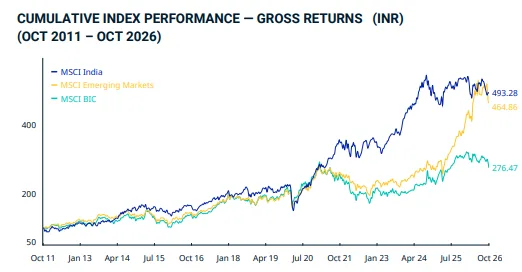
Note: Gross returns in INR. Past performance is not indicative of future returns.
The chart compares the cumulative gross returns (in INR) of the MSCI India, MSCI Emerging Markets and MSCI BIC indices from October 2011 to October 2026. MSCI India delivered the strongest performance, reaching 493.28, compared with 464.86 for Emerging Markets and 276.47 for MSCI BIC. This highlights the relatively strong long-term performance of Indian equities compared with these global market benchmarks.
Why does this matter to Indian investors?
When an Indian company is added to an MSCI index or its weightage increases, funds tracking that index may have to purchase more shares of that company. This can increase institutional demand, trading volumes, and short-term price activity.
Therefore, MSCI rebalancing decisions can influence how international money flows into and out of Indian stocks.
2. Understanding the MSCI India Index
The MSCI India Index is designed to track the performance of large-cap and mid-cap companies in the Indian stock market.
According to MSCI’s factsheet dated October 30, 2026, the index had 165 companies and covered approximately 85% of India’s equity universe.
The top 10 constituents are as follows :
| Rank | Company | Index Weightage |
| 1 | HDFC Bank | 6.28% |
| 2 | ICICI Bank | 5.91% |
| 3 | Reliance Industries | 5.33% |
| 4 | Bharti Airtel | 4.41% |
| 5 | Infosys | 2.87% |
| 6 | Axis Bank | 2.23% |
| 7 | Larsen & Toubro | 2.08% |
| 8 | Kotak Mahindra Bank | 2.01% |
| 9 | Mahindra & Mahindra | 1.97% |
| 10 | Bajaj Finance | 1.86% |
The top 10 companies together accounted for approximately 34.94% of the index.
What does this tell investors?
The index is not equally distributed across all its constituents. Large companies carry higher weightages, meaning their performance can have a greater influence on the overall index.
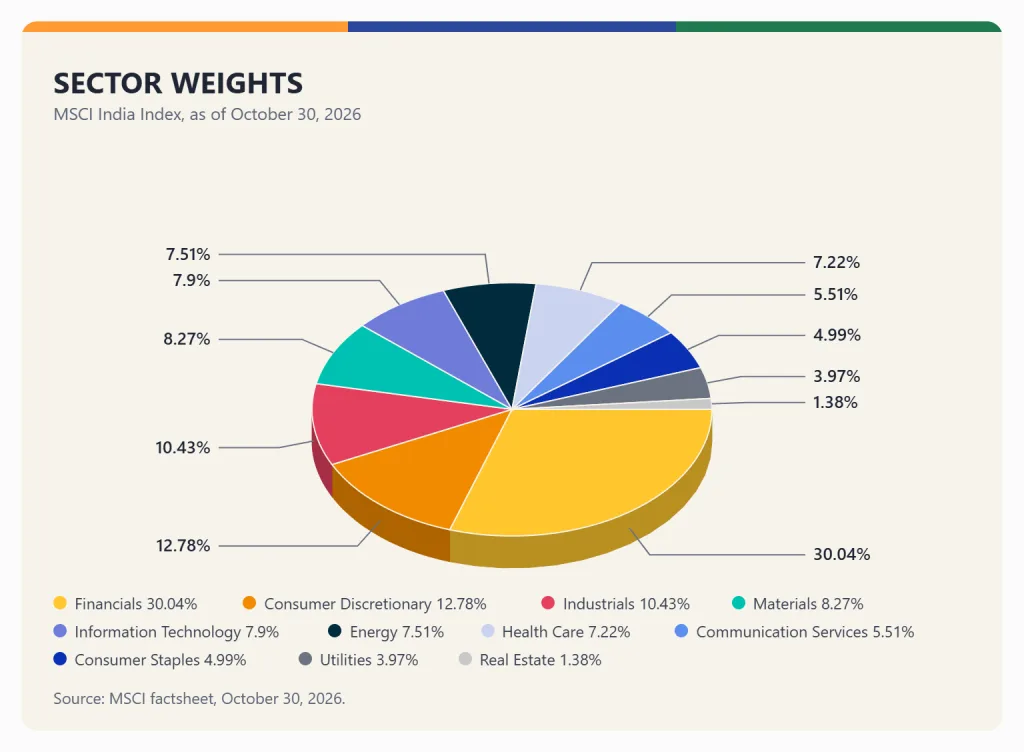
Sector concentration is another important factor to consider around MSCI rebalancing. As of October 30, 2026, financial services accounted for 30.04% of the MSCI India Index, followed by consumer discretionary at 12.78% and industrials at 10.43%.
This means developments in the banking and financial services sector can have a considerable influence on the index’s overall performance.
3. How Does MSCI Select Stocks?
MSCI follows a rule-based methodology to determine which companies qualify for its indices. The selection process considers several factors:
1. Market Capitalisation: Companies are classified into different segments based on their market value. The MSCI Global Standard Index primarily covers large-cap and mid-cap stocks, while smaller eligible companies may be included in the Small Cap Index.
2. Free-Float Market Capitalisation: MSCI considers the shares available for public trading rather than the company’s entire market capitalisation. Promoter holdings, strategic investments and other restricted shareholdings are generally excluded.
For example, a company with a market capitalisation of ₹20,000 crore and a public shareholding of 40% would have a free-float market capitalisation of approximately ₹8,000 crore, before other applicable adjustments.
3. Liquidity: Stocks must meet minimum trading activity requirements to ensure international investors can buy and sell shares without significantly affecting their prices.
4. Foreign Investment Limits: MSCI also considers the availability of foreign investment room. Companies with limited room for additional foreign investment may face restrictions on their eligibility or index weightage.
These factors determine whether a company qualifies for MSCI inclusion, retains its position or gets removed during MSCI rebalancing.
4. What Is MSCI Rebalancing?
MSCI rebalancing is the periodic process of reviewing and updating index constituents and their respective weightages.
During this process, companies may be added or removed, while existing constituents may see their weightages increase or decrease.
MSCI generally conducts four index reviews every year:
| Review | Announcement Period | Effective Period |
| February | Early February | End of February |
| May | Mid-May | Late May |
| August | Early August | End of August |
| November | Mid-November | End of November |
The May and November reviews are semi-annual reviews, while February and August generally involve quarterly updates.
For investors, two dates are important:
- Announcement Date: When MSCI officially communicates the changes.
- Effective Date: When the revised index composition comes into effect.
Institutional funds typically adjust their portfolios around the effective date to match the revised index.
5. November 2026 MSCI Review: What Changed for Indian Stocks?
The November 2026 review brought changes to India’s representation in MSCI indices, including the MSCI India Index.
Some important developments include:
- Four new additions: Four Indian companies qualified for inclusion in the MSCI Global Standard Index.
- Stock exclusions: Certain companies that no longer met the eligibility criteria were removed from the Standard segment or shifted to another index category.
- Weightage changes: Existing constituents also witnessed changes in their index weightages due to adjustments in free-float market capitalisation and other eligibility factors.
- Institutional portfolio adjustments: Global funds tracking these indices had to realign their holdings to reflect the revised composition.
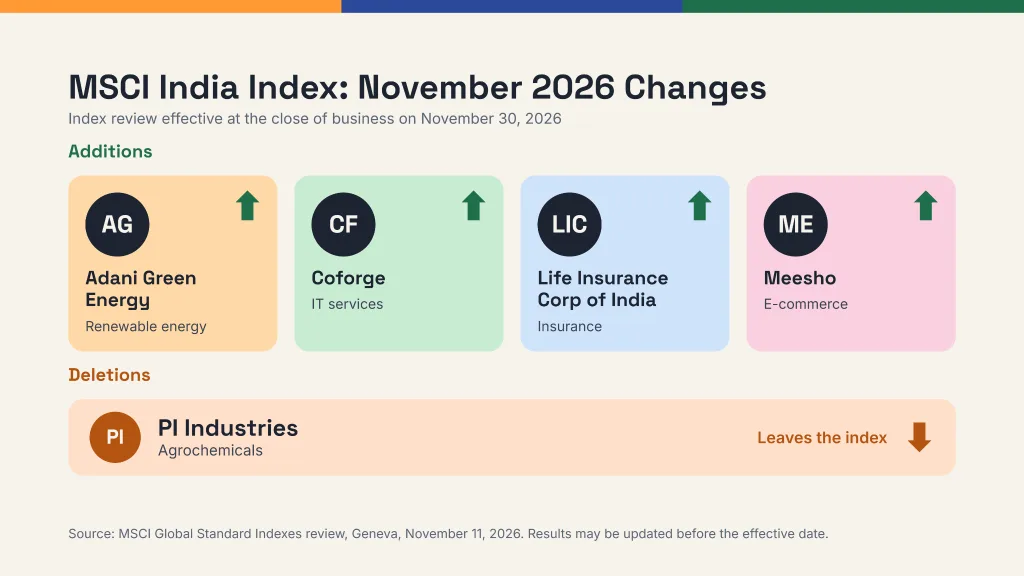
These MSCI rebalancing changes can influence institutional buying and selling activity in Indian stocks.
However, investors should not focus only on the number of additions. The revised weightage and estimated fund flows are equally important.
6. How Does MSCI Rebalancing Affect Indian Stock Prices?
MSCI rebalancing can influence stock prices primarily through institutional buying and selling.
1. Increased Institutional Buying
When a company enters an MSCI index such as the MSCI Global Standard Index, passive funds tracking that index may need to purchase its shares. This creates additional demand and can support its stock price in the short term.
2. Higher Trading Volumes
Institutional funds often execute large orders to align their portfolios with the revised index. Consequently, trading volumes can increase significantly, particularly around the effective date.
3. Improved Global Visibility
MSCI inclusion can bring a company to the attention of international asset managers, foreign institutional investors and global research teams.
4. Changes in FPI Flows
Changes in India’s overall weightage in global emerging-market indices can influence foreign portfolio investment allocations. An increase in India’s weightage may encourage benchmarked funds to allocate more money to Indian equities, while a reduction can have the opposite effect.
7. Is MSCI Inclusion a Good Long-Term Investment Signal?
MSCI inclusion can be a positive development because it improves a company’s visibility among global investors and may broaden its institutional shareholder base.

However, investors must understand that passive inflows from MSCI rebalancing are generally a one-time portfolio adjustment.
Once index-tracking funds purchase the required shares to match the revised weightage, the buying demand arising from that particular MSCI rebalancing largely stops.
Moreover, this buying takes place in the secondary market. The money goes to existing shareholders selling their shares, not directly to the company.
For long-term investors, business performance, earnings growth, management quality, financial strength and valuations should remain the primary considerations.
MSCI inclusion does not guarantee a stock rally. Traders often buy shares in anticipation of inclusion, pushing prices up before the official announcement. Once the news is confirmed, early investors may book profits, limiting further upside. Moreover, weak earnings, sectoral weakness or negative market sentiment can outweigh institutional buying. Therefore, investors should treat MSCI inclusion as a potential short-term trigger, not an independent buy signal.
8. What Should Indian Investors Check Before Investing?
Instead of buying a stock simply because it has entered the MSCI India Index or another MSCI index, investors should evaluate the following factors:
- Estimated Fund Inflows: Check how much buying or selling is expected from passive funds.
- Change in Weightage: A higher weightage can generate additional institutional demand, even for existing index constituents.
- Average Daily Trading Volume: Compare expected institutional flows with the stock’s normal trading activity. Large inflows relative to average daily volume can have a greater price impact.
- Recent Stock Performance: Check whether the stock has already rallied ahead of the announcement.
- Company Fundamentals: Evaluate revenue growth, profitability, debt, cash flows and valuations before making an investment decision.
- Effective Date: Track the date when the revised index composition becomes effective, as institutional trading activity may increase around market close during MSCI rebalancing.
Traders dealing in futures and options should also be careful about sudden volatility, wider bid-ask spreads and price fluctuations around MSCI rebalancing dates.
Conclusion
MSCI rebalancing plays an important role in shaping institutional fund flows in the Indian stock market. The November 2026 review, with four Indian additions to the MSCI Global Standard Index, highlights the growing representation of Indian companies in global equity benchmarks.
For traders, these events can create short-term opportunities through institutional buying, selling and increased trading volumes. However, investors should avoid chasing stocks purely based on MSCI inclusion announcements.
The better approach to MSCI rebalancing is to analyse estimated fund flows, changes in weightage, trading volumes and recent price movements alongside company fundamentals.
FAQs
1. What is MSCI rebalancing in the Indian stock market?
MSCI rebalancing is the periodic process of adding, removing or changing the weightages of Indian companies in MSCI indices.
2. How often does MSCI rebalance its indices?
MSCI generally reviews its indices four times a year, in February, May, August and November.
3. Does MSCI inclusion increase a stock’s price?
Not necessarily. Inclusion can create buying demand from passive funds, but the actual price movement depends on prior price appreciation, institutional flows, profit booking and broader market conditions.
4. What happens when a stock is removed from an MSCI index?
Passive funds tracking the index may sell their holdings to match the revised composition. This can create temporary selling pressure and higher trading volumes around the effective date.
5. How can retail investors benefit from MSCI rebalancing?
Retail investors can monitor MSCI India Index additions, deletions, weightage changes and estimated institutional flows to identify potential trading opportunities. However, they should also evaluate valuations, liquidity and company fundamentals before investing.