

Elearnmarkets - Financial Market Learning
  • Courses
  • Webinars
  • Stories
  • Language
    • English
    • Hindi
    • Bengali
No Result
View All Result
Get Free Course
  • Basic Finance
  • Derivatives
    • Futures
    • Options
  • Financial Planning
  • Fundamental Analysis
  • Technical Analysis
  • Mutual Funds
  • Marketshala
  • Miscellaneous
Elearnmarkets - Learn Stock Market, trading, investing for Free
  • Courses
  • Webinars
  • Stories
  • Language
    • English
    • Hindi
    • Bengali
No Result
View All Result
Get Free Course
Elearnmarkets - Learn Stock Market, trading, investing for Free
No Result
View All Result
Home Basic Finance
Fed interest rates

How Do Fed Interest Rates Impact the Stock Market? What Indian Investors Should Know

Vivek Bajaj by Vivek Bajaj
October 29, 2026
in Basic Finance, Bonds & Fixed Income
Reading Time: 10 mins read
0
Share on FacebookShare on XShare on WhatsApp
This article explains how Fed interest rates affect the stock market, covering how rate hikes and cuts influence valuations, company profits, foreign flows and the rupee, and what Indian investors should track, with lessons from the 2022–23 hiking cycle and the sectors most sensitive to rate changes.
Table Of Contents
  1. Who Really Sets Fed Interest Rates? Meet the Fed
  2. How Do Higher Fed Interest Rates Affect Stocks and Companies?
  3. Fed Rate Hikes vs Fed Rate Cuts: What Changes?
  4. What Do the Fed's Projections Say About Fed Interest Rates?
  5. What History Tells Us: The 2022–23 Hiking Cycle
  6. The Rupee Effect: Why Import Costs Matter
  7. Which Sectors May Be More Sensitive to Fed Interest Rates?
  8. What Should Investors Track?
  9. Latest Fed Rate Decision: 28 October 2026
  10. Conclusion
    • FAQs

A Federal Reserve decision taken in Washington can move markets in Mumbai. When US interest rates are high, some foreign investors prefer US bonds over emerging markets like India. That can mean selling in Indian equities, a weaker rupee and pressure on stock prices, although company earnings, valuations and expectations also play a big part.

Here is why investors are watching Fed interest rates closely right now:

  • Fed interest rates: raised to 3.75%–4.00% on 16 September 2026.
  • FPI outflows: foreign investors reportedly pulled about ₹48,688 crore from Indian equities so far in October.
  • Nifty: fell 6.43% in September.

The Fed announces its next decision on 28 October 2026. Here is how changes in Fed interest rates reach Indian markets and what to track.

Who Really Sets Fed Interest Rates? Meet the Fed

The Federal Reserve is the US central bank. Its goals are stable prices (inflation near 2% over the longer term) and maximum employment.

Decisions on Fed interest rates are made by the Federal Open Market Committee (FOMC), which meets eight times a year. It has 12 voting members: seven Fed governors, the New York Fed president and four other regional Fed presidents who vote on a rotating basis.

The FOMC sets a target range for the federal funds rate, the rate at which banks lend to each other overnight.

At its 16 September 2026 meeting, the committee voted unanimously to raise the range by 0.25 percentage points, saying inflation remained elevated while the economy kept growing at a solid pace.
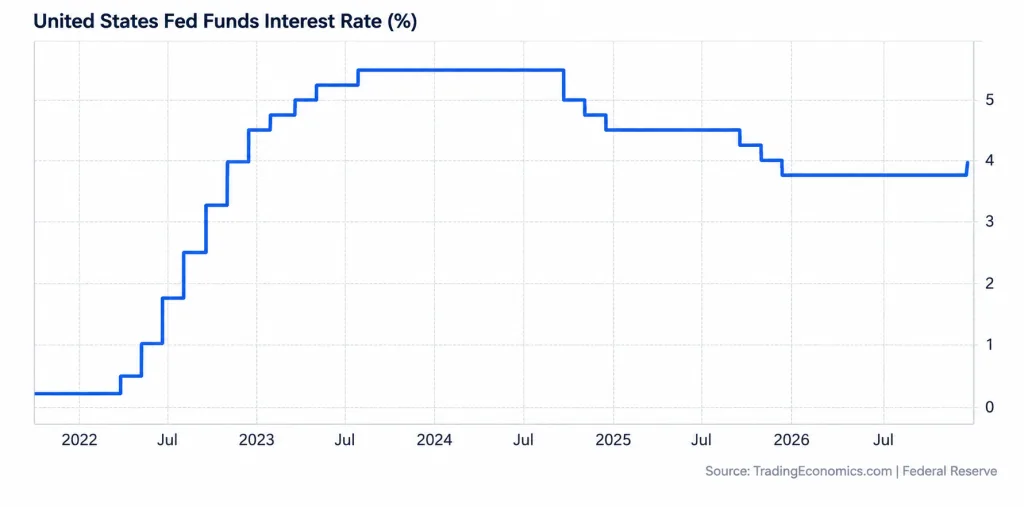
US Fed Funds Interest Rate
US Fed funds rate, 2022–2026. Source: Trading Economics | Federal Reserve

How Do Higher Fed Interest Rates Affect Stocks and Companies?

Federal Reserve interest rate changes generally move in the opposite direction of the stock market, influencing valuations, borrowing costs, and investor choices
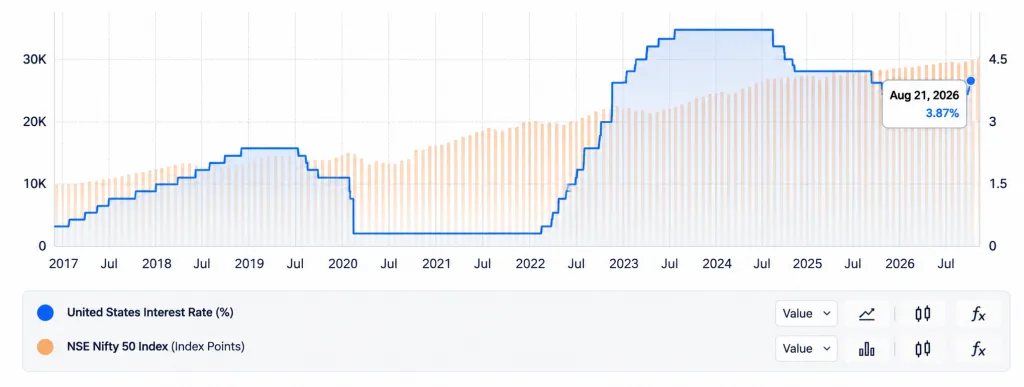
US Fed Funds Interest Rate and NSE Nifty 50 comparison

Rising interest rates work through two channels.

Valuations. When US government bonds pay more, some investors move away from riskier stocks. Higher interest rates also reduce the present value of a company’s future earnings, so expensive growth stocks are more vulnerable to corrections.

Profits. Companies with heavy debt pay more interest when they borrow or refinance. Costlier credit can also delay expansion and dampen customer spending.

Fed Rate Hikes vs Fed Rate Cuts: What Changes?

FactorRate hikeRate cut
Borrowing costsGenerally increaseGenerally decrease
Stock valuationsMay face pressureMay receive support
Company earningsInterest costs may rise and demand may slowFinancing may get cheaper and demand may improve
Bonds vs stocksHigher yields may attract money to bondsLower yields make stocks relatively more attractive
Foreign flows into IndiaMay face pressureMay improve if global conditions support risk-taking

The effect is not always straightforward. A Fed rate cut can worry investors if it signals a sharply weakening US economy, and a Fed rate hike may barely move markets if it was widely expected. Markets react to the gap between expectation and reality, so the Fed’s guidance on future decisions can matter as much as the decision itself.

What Do the Fed’s Projections Say About Fed Interest Rates?

In September, the median FOMC projection put the federal funds rate at 4.1% at the end of 2026 and 4.1% in 2027, easing to 3.9% in 2028 and 3.6% in 2029. These medians are higher than the June projections (3.8%, 3.6%, and 3.4% for 2026 to 2028), which suggests policymakers expect Fed interest rates to stay elevated for longer.

FOMC Summary of Economic Projections September 2026

These are projections, not promises, so watch how they shift from meeting to meeting.

What History Tells Us: The 2022–23 Hiking Cycle

In 2022 the Fed raised interest rates from near zero in March to 4.25%–4.50% by December, yet the Nifty 50 ended the year higher.

India’s own cycle tells the same story. The RBI began raising its repo rate in May 2022 and, by February 2023, had taken it from 4.00% to 6.50%, a rise of 250 basis points in nine months. Even so, the Nifty 50 Total Returns Index (which includes dividends) posted gains in both years.

IndicatorFigure
RBI repo rate, April 20224.00%
RBI repo rate, February 20236.50%
Total increase250 basis points
Nifty 50 TRI return, 20225.69%
Nifty 50 TRI return, 202321.30%

So why did the market hold up?

  • The economy stayed resilient. The RBI cited strong consumption and investment, and real GDP growth for FY2022–23 was estimated at 7.0%.
  • Inflation began easing. CPI inflation moderated to 5.7% in December 2022, although core inflation stayed elevated.
  • Markets look ahead. Investors weigh expected earnings and growth, and whether hikes are already priced in.
Global Equity Indices
Sensex, Nifty 50 and global equity returns, 2022–23. Source: BSE, NSE and Bloomberg (as published by the RBI)

Hikes are not harmless: the impact is stronger when they surprise investors, valuations are stretched or companies are heavily indebted, and softer when the move is priced in.

The Rupee Effect: Why Import Costs Matter

India imports more than 85% of its crude oil, so the rupee matters a great deal. When it weakens, imported crude and other dollar-priced goods cost more in rupee terms, even if global prices have not moved. Importers face higher input costs and thinner margins, and price increases can push up inflation, complicating RBI decisions.

But a weaker rupee is not bad for everyone. Exporters who earn in dollars may benefit, so each company’s currency exposure is worth checking.
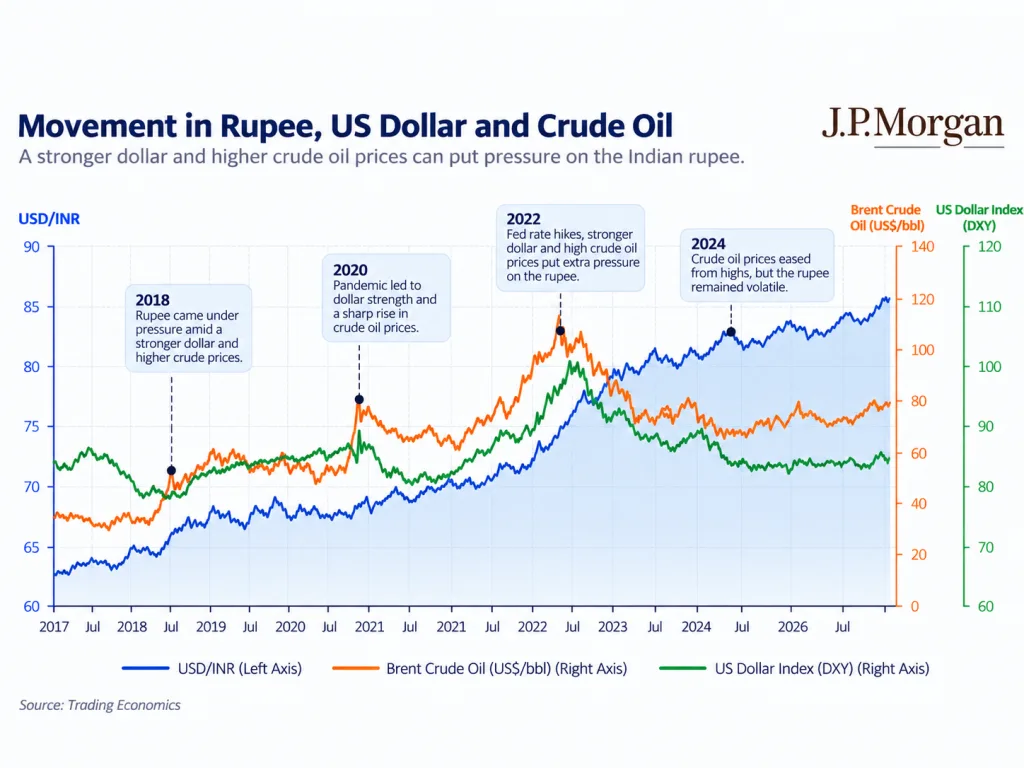
Rupee, US dollar and Crude Oil comparison
Rupee, US dollar index, crude oil and EM currencies, April 2022–March 2023. Source: Bloomberg (as published by the RBI)

Which Sectors May Be More Sensitive to Fed Interest Rates?

  • Banking and financial services: funding costs, loan demand and asset quality all shift. Strong credit growth helps, but higher rates can strain some borrowers.
  • Information technology: a weaker rupee lifts the rupee value of dollar earnings, but higher US interest rates can slow tech spending and hurt demand.
  • Automobiles and consumer goods: costlier loans can dent demand for vehicles and discretionary items. Everyday staples are steadier, though input costs can squeeze margins.
  • Real estate: developers need funding and buyers need home loans, so higher rates can reduce affordability and demand.
  • Capital goods and infrastructure: government spending and domestic investment support them, but debt-heavy firms face higher financing costs.

In FY2022–23, the RBI’s Annual Report noted that industrials, capital goods, FMCG, automobiles and banking outperformed, while IT faced pressure from a slowing global economy. Past leaders are no guarantee for the next cycle.

What Should Investors Track?

  • Fed statements: changes in language on inflation, jobs and future Fed interest rates.
  • US inflation data: persistent inflation can keep US interest rates higher for longer.
  • US Treasury yields: rising yields make US assets more attractive than emerging markets.
  • FPI flows: whether foreign investors are buying or selling Indian equities.
  • USD/INR: a weaker rupee raises import costs for companies with foreign-currency exposure.
  • Company fundamentals: earnings growth, debt, interest coverage and valuations.

Latest Fed Rate Decision: 28 October 2026

The FOMC held Fed interest rates steady at 3.75%–4.00% on 28 October 2026, after raising them in September. The vote was 10 to 2, with Lisa D. Cook and Beth M. Hammack preferring another 0.25 percentage point increase. The statement described economic activity as expanding at a strong pace and inflation as elevated.

Conclusion

Fed interest rates influence the Indian stock market through foreign flows, the rupee, bond yields and company earnings, but higher rates are not simply bad and lower rates are not simply good. Understand why the Fed is moving, watch inflation, yields, FPI flows and RBI policy, and stay focused on earnings, valuations and debt. The Fed is an important influence on Indian markets, but not the only one. For long-term investors, business fundamentals and risk management matter more than predicting every rate move.

FAQs

Q1. What are Fed interest rates?

They are the benchmark interest rates set by the US Federal Reserve that influence borrowing costs across the economy.

Q2. How do Fed rate hikes affect the Indian stock market?

Higher US interest rates can attract money towards US assets, potentially triggering FII outflows and pressure on Indian stocks.

Q3. Do Fed rate cuts always lift stocks?

No. If rate cuts signal economic weakness, markets may fall despite lower borrowing costs.

Q4. Why do Fed interest rates affect the rupee?

Fed decisions influence the dollar’s strength and global capital flows, which can put pressure on or support the rupee.

Tags: advancecandlestick patternelearnmarketsfed ratesinvestment basicsstock markettechnical analysis
ShareTweetSend
Previous Post

Emergency Fund Planning: How Much to Save and Where to Keep It in India

Vivek Bajaj

Vivek Bajaj

Mr Vivek Bajaj has over 20 years of experience in Multi-Asset Trading, Momentum Investor and student of Mark Minervini. He is the co-founder of StockEdge and Elearnmarkets and is passionate about data, analytics, and technology. He serves on various exchange committees and has played a significant role in the evolution of India's derivative market. He has been a speaker at various colleges and higher institutions, including IIT and IIMs.

Related Posts

RBI FD rules
Market Updates

RBI’s New FD Interest Rate Rules From 1 October 2026: What Changes for You

October 7, 2026
128
how to read quarterly results
Basic Finance

How to Read Quarterly Results Like an Analyst: Beyond Revenue Growth and Headline Earnings

September 8, 2026
149
How to invest in real estate in India guide
Financial Planning

You Don’t Need to Buy a House to Invest in Indian Real Estate Anymore

August 27, 2026
109
Understanding Bitcoin Trends for Crypto Market
Cryptocurrency

Understanding Bitcoin Trends and What They Mean for the Crypto Market

April 24, 2026
267

Leave a Reply Cancel reply

Your email address will not be published. Required fields are marked *

Disclaimer

Elearnmarkets (StockEdge Fintech Private Limited – formerly known as Kredent InfoEdge Private Limited) is a SEBI-registered Research Analyst (RA) entity (SEBI Registration No.: INH300007493). The information provided in this article is for educational and informational purposes only and should not be considered as an offer to buy or sell any securities or investment products.

The stocks, securities, and investment instruments mentioned herein are not recommendations under SEBI (Research Analysts) Regulations, 2014. Readers are advised to conduct their own due diligence and seek independent financial advice before making any investment decisions.

Investments in securities markets are subject to market risks. Please read all related documents carefully before investing. Investing in Equity Shares,
Derivatives, Mutual Funds, or other instruments carry inherent risks, including potential loss of capital. Elearnmarkets (StockEdge Fintech Private Limited – formerly known as Kredent InfoEdge Private Limited) does not provide any guarantee or assurance of returns on any investments. Past performance is not indicative of future performance.

Elearnmarkets Logo

Follow Us

Facebook-f X-twitter Instagram Linkedin-in Youtube Telegram

Register on Elearnmarkets

Continue your financial learning by creating your own account on Elearnmarkets.com

Register Free Account

Download App

Playstore logo
Download on app store

Categories

  • Basic Finance
  • Derivatives
  • Financial Planning
  • Fundamental Analysis
  • Technical Analysis
  • Mutual Funds
  • Miscellaneous

Popular On Elearnmarkets

  • Market Superheroes:
  • Vivek Bajaj
  • Chetan Panchamia
  • Ashish Kyal
  • Premal Parekh
  • Abhijit Paul
  • Jegan
  • Sivakumar Jayachadran
  • Jyoti Budhia
  • Vivek Gadodia
  • Vishal Mehta
  • Piyush Chaudhry
  • Santosh Pasi
  • Gomathi Shankar
  • Market Superheroes:
  • Vivek Bajaj
  • Chetan Panchamia
  • Ashish Kyal
  • Premal Parekh
  • Abhijit Paul
  • Jegan
  • Sivakumar Jayachadran
  • Jyoti Budhia
  • Vivek Gadodia
  • Vishal Mehta
  • Piyush Chaudhry
  • Santosh Pasi
  • Gomathi Shankar
  • Courses:​
  • Options Trading
  • Dow Theory
  • Momentum Trading
  • Stock Investing
  • Harmonic Chart Patterns
  • Algo Trading
  • Elliot Wave Theory
  • Advanced Excel
  • Cryptocurrency
  • NSE Certification Course
  • Courses:​
  • Options Trading
  • Dow Theory
  • Momentum Trading
  • Stock Investing
  • Harmonic Chart Patterns
  • Algo Trading
  • Elliot Wave Theory
  • Advanced Excel
  • Cryptocurrency
  • NSE Certification Course
  • Webinars:
  • Bank Nifty Scalping
  • Intraday Trading Strategies
  • Options Trading Strategies
  • Options selling
  • Price Action
  • Relative Strength
  • Tax Planning
  • Options Buying
  • Growth Stocks
  • Portfolio Management
  • Risk Management
  • Renko Charts
  • Crude Oil
  • Traders Psychology
  • Moving Average
  • Multibagger Stocks
  • Free Learning Modules:
  • Intraday Trading
  • Options Scalping
  • Swing Trading
  • Financial Modelling
  • RSI Indicator
  • Bollinger Bands
  • Pricing of Futures
  • Personal Finance
  • Initial Public Offerings (IPO)
  • Value Investing
  • Technical Indicators
  • Candlesticks
  • Chart Patterns
  • Option Greeks
  • ELSS Funds
  • Banking and Insurance
  • Real Estate
  • Gold
  • Book Summaries:
  • Rich Dad Poor Dad
  • Psychology of Money
  • The Intelligent Investor
  • The Richest Man in Babylon
  • Think and Trade Like a Champion
  • Value Investing and Behavioural Finance
  • Trading in the Zone
  • Learn to Earn
  • Book Summaries:
  • Rich Dad Poor Dad
  • Psychology of Money
  • The Intelligent Investor
  • The Richest Man in Babylon
  • Think and Trade Like a Champion
  • Value Investing and Behavioural Finance
  • Trading in the Zone
  • Learn to Earn
  • Tools:
  • CAGR Calculator
  • SIP Calculator
  • eLearnOptions
  • Future Value Calculator
  • Present Value Calculator
  • Atal Pension Yojana
  • Cost of Delay Calculator
  • Become a Crorepati
  • Tools:
  • CAGR Calculator
  • SIP Calculator
  • eLearnOptions
  • Future Value Calculator
  • Present Value Calculator
  • Atal Pension Yojana
  • Cost of Delay Calculator
  • Become a Crorepati

© 2026 Elearnmarkets. All Rights Reserved

  • Visit Elearnmarkets
  • Courses
  • Webinars
  • Financial Guides
  • Get Free Counselling
  • Visit Elearnmarkets
  • Courses
  • Webinars
  • Financial Guides
  • Get Free Counselling

Download Our App

Deliver breaking news, insightful commentary, and exclusive reports. Targeting readers who rely on our platform to stay ahead.

Contact Benzinga
No Result
View All Result
  • Article Categories
    • Basic Finance
    • Derivatives
    • Financial Planning
    • Fundamental Analysis
    • Technical Analysis
    • ETFs & Mutual Funds
    • Marketshala
    • Miscellaneous
  • Language
    • Hindi
    • Bengali
    • English
  • Courses
  • Webinars
  • Stories
Get Free Course

© 2024 Elearnmarkets All Rights Reserved

Guide to Basics of Stock Investing
Learn to interpret the financial performance and health of a company.
Download Guide For FREE
Guidebook on Savings and Investment
A comprehensive guide book to start your investment journey
Download Guide For FREE