

- What are Hedge Funds?
- How do Hedge Funds Work?
- What are the Types of Hedge Funds?
- What are the Common Strategies of Hedge Fund Investing?
- What are the Risks & Limitations of Hedge Funds?
- How are Hedge Funds Taxed?
- Why are Hedge Funds Different from Mutual Funds?
- Common Mistakes to Avoid Before Investing in Hedge Funds
- Conclusion
- Frequently Asked Questions (FAQs)
George Soros made billions betting against the British pound.
Paul Tudor Jones predicted the 1987 crash and profited massively. If you’ve watched Billions, you know Bobby Axelrod, based on real hedge fund manager Steve Cohen.
But the interesting fact is, in India, we barely hear about hedge funds making headlines.
Why is that? Let’s understand what they are and why they work so differently here.
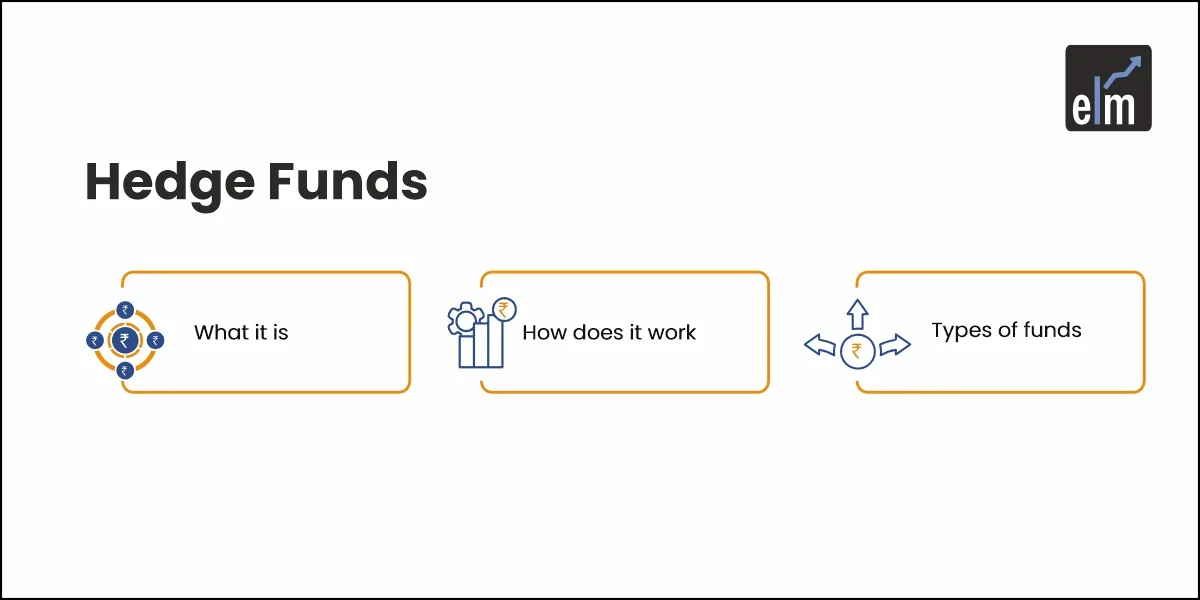
What are Hedge Funds?
A hedge fund pools money from wealthy investors and uses advanced strategies to profit whether markets rise or fall.
Unlike regular mutual funds:
- They bet against falling stocks (short selling)
- They borrow money to amplify returns (leverage)
- They trade everything – stocks, bonds, currencies, commodities
Back in 1949, journalist Alfred Winslow Jones was researching an article for Fortune magazine when he had an idea. He collected $100,000 and tried something new. He bought stocks he thought would rise while betting against stocks he thought would fall, using borrowed money to do more of both.
That experiment became the world’s first hedge fund, and the same strategy drives the multi-trillion dollar industry today.
Here’s the difference from mutual funds. When you invest ₹1 lakh in a mutual fund, the manager buys stocks hoping they’ll rise. Your ₹1 lakh stays as ₹1 lakh.
Hedge funds play differently. They bet against overpriced stocks, too, and borrow money to increase positions. So your ₹1 lakh could control ₹3-5 lakh worth of positions.
How do Hedge Funds Work?
Think of them as flexible investment vehicles that can play in almost every corner of the market – stocks, bonds, real estate, currencies, and a whole lot of derivative products too.
Because they invest across different asset types, hedge funds use a variety of trading approaches. Sometimes they buy and sell in public markets, sometimes they take stakes directly in companies through private placements. The toolbox depends on the asset and the manager’s idea.
Derivatives are a big part of the picture.
Two common examples are futures and options. A futures contract is basically an agreement to buy or sell an asset at a set price on a set date. It can carry an obligation. An option gives you the right to buy or sell at a predetermined price, but you’re not forced to go through with it.
Using these instruments lets managers hedge risks or place directional bets without owning the underlying asset outright.
Where does the money come from? Hedge funds mostly accept capital from larger investors. High-net-worth individuals, endowments, banks, pension plans, and institutional firms. In many markets, these funds are structured under alternative investment fund rules (for example, AIF Category III in some jurisdictions), which allows them to access national and international markets and use a broader set of strategies.
Hedge funds are pooled investment vehicles with wide latitude; they mix different securities and techniques to chase returns (and manage risk) across public and private markets.
What are the Types of Hedge Funds?
Long/Short Equity: Jones’s original strategy. Buy undervalued stocks, short overvalued ones. Still the most common type.
Global Macro: Place bets on national economic trends. In 1992, Soros made $1 billion in a single day by trading against the British pound. These managers make significant directional bets while researching policies, interest rates, and currencies.
Event-Driven: Make money off of business transactions like mergers, acquisitions, and bankruptcies. These funds evaluated the acquisition of Flipkart by Walmart and positioned it appropriately.
Quantitative (Quant): Utilize mathematical models and computer programs to identify opportunities in thousands of securities.
Distressed Securities: Invest in troubled companies’ stocks or bonds with the hope that they will rebound. High risk but enormous rewards when businesses succeed.

What are the Common Strategies of Hedge Fund Investing?
Beyond fund types, hedge funds use aggressive tactics. Leverage means borrowing to control larger positions, amplifying everything. Short selling profits from falling stocks.
Bill Ackman bought credit default swaps for $27 million during COVID’s March 2020 crash and sold them weeks later for $2.6 billion – showing the power of derivatives.
Arbitrage exploits price gaps. If Infosys trades differently on NSE versus NYSE after exchange rates, arbitrageurs profit from the difference.
Concentration means some funds hold just 10-15 stocks instead of 50-100, like mutual funds.
What are the Risks & Limitations of Hedge Funds?
Leverage is dangerous. Long-Term Capital Management, run by Nobel winners, borrowed 25 times their capital. When bets went wrong in 1998, they lost $4.6 billion in months and nearly triggered a global crisis needing Federal Reserve intervention.
Your money gets locked for 1-3 years initially. Even after, you can only withdraw quarterly with 30-90 days notice. During 2008, many investors needed cash desperately but couldn’t access funds.
The fee structure hurts returns. Hedge funds charge “2 and 20” – 2% of assets annually plus 20% of profits. A fund making 10% gross returns leaves you with roughly 6.4% after fees. The manager takes a big chunk.
Complexity creates risk. Some strategies are so intricate that even sophisticated investors can’t fully understand what’s happening with their money.
How are Hedge Funds Taxed?
Taxation separates India from America dramatically, explaining why we don’t see the same hedge fund culture.
In the US, hedge funds are structured as pass-through entities. The fund pays minimal tax. Profits flow to investors, who pay based on personal tax brackets. This keeps more money working in the fund.
India takes a different approach. Our AIFs face severe taxation – roughly 42.74% at the fund level before reaching investors.
If an AIF makes ₹1 crore in profits, the government takes about ₹43 lakh in taxes first. Investors get only ₹57 lakh to distribute. This massive tax bite makes it extremely tough for Indian fund managers to generate the spectacular returns you hear about from America. Combined with leverage restrictions, this essentially prevents celebrity fund managers from emerging here.
Why are Hedge Funds Different from Mutual Funds?
Investment flexibility: Mutual funds only take long positions (buy stocks hoping they rise). Hedge funds go both long and short, betting on rises and falls together.
Leverage limits: Mutual funds use minimal leverage. Indian AIFs can borrow up to 2x their capital. American hedge funds sometimes borrow 10-25 times their money, creating massive risk.
Investor access: You can start a mutual fund SIP with ₹500. Indian AIFs need ₹1 crore minimum. US hedge funds typically require $100,000 to several million.
Liquidity: You can redeem mutual funds any trading day. Hedge funds lock money for years with limited quarterly windows.
Fees: In India, mutual funds charge between 0.5 and 2.5% a year. Hedge funds charge 2% plus 20% of profits, which could be as much as 3-4% annually.
Regulation: Indian AIFs are subject to stringent regulations from SEBI regarding operations, risk disclosure, and leverage. The SEC mainly regulates managers, so there is little structure-related regulation for US hedge funds.
India doesn’t produce investment superstars like America, which can be explained by this framework and the country’s high taxes.
Common Mistakes to Avoid Before Investing in Hedge Funds
Don’t chase past winners. A 40% return last year guarantees nothing. Many spectacular performers crash the next year.
Calculate fee impact carefully. After paying all fees, you might earn less than a simple index fund. Run the numbers first.
Never invest money you might need soon. Your capital gets locked for at least three years, often longer. Don’t invest emergency funds or money needed for children’s education or house payments.
Don’t assume “hedge” means “safe.” These funds can lose money catastrophically. The word hedge refers to strategy, not protection.
If the manager can’t explain their strategy simply, don’t invest. Complexity often masks excessive risk or mediocre ideas.
Conclusion
Beginning with Jones’s 1949 experiment and continuing into the multitrillion-dollar industry of today, hedge funds have revolutionized investing with their ability to make money in any market condition.
Due to strict regulations and high taxes, true hedge funds are rare in India, but the concepts are still helpful. By understanding how hedge funds use long and short positions, manage risk, and evaluate opportunities, you can enhance your investment strategy.
Use StockEdge’s screening tools, portfolio tracking, and market analysis to apply these professional strategies on your own and make better decisions in the Indian market.
Frequently Asked Questions (FAQs)
1. Can hedge funds guarantee higher returns?
No. While some like Soros made billions, many hedge funds underperform simple index funds after fees. There are no guarantees – some do well, many don’t.
2. Do hedge funds always use risky strategies?
Not always. Some use conservative strategies to reduce risk, others take massive risks with heavy leverage. It depends on the fund’s approach. Always ask about risk levels.
3. What is the typical lock-in period for hedge funds?
Usually 1-3 years initially. After that, you can withdraw quarterly with 30-90 days notice. Indian AIFs lock money for 3 years minimum. Only invest money you won’t need for 3-5 years.