
Elearnmarkets - Financial Market Learning
  • Courses
  • Webinars
  • Stories
  • Language
    • English
    • Hindi
    • Bengali
No Result
View All Result
Get Free Course
  • Basic Finance
  • Derivatives
    • Futures
    • Options
  • Financial Planning
  • Fundamental Analysis
  • Technical Analysis
  • Mutual Funds
  • Marketshala
  • Miscellaneous
Elearnmarkets - Learn Stock Market, trading, investing for Free
  • Courses
  • Webinars
  • Stories
  • Language
    • English
    • Hindi
    • Bengali
No Result
View All Result
Get Free Course
Elearnmarkets - Learn Stock Market, trading, investing for Free
No Result
View All Result
Home Financial Planning
Portfolio Rebalancing

Portfolio Rebalancing: Why You Need It & How To Do It?

Vivek Bajaj by Vivek Bajaj
November 12, 2025
in Financial Planning
Reading Time: 7 mins read
0
100
VIEWS
Share on FacebookShare on XShare on WhatsApp

Key Takeaways

  • Controls Risk: Portfolio Rebalancing keeps it aligned with your chosen asset mix (like 60:40) so your risk level doesn’t change as markets move.
  • Sell High, Buy Low: It forces disciplined profit-booking from overgrown assets and adds to undervalued ones without emotional decision-making.
  • Don’t Overdo It: Review every 6 months or when allocation drifts by ±5% instead of reacting to every market movement.
  • Use Cash Flow Smartly: Rebalance through new inflows (SIP/bonus) or STPs to avoid taxes that may occur when you sell.
  • Improves Stability: It might not always boost returns, but it improves long-term consistency, reduces volatility, and keeps your portfolio goal-focused.

Table Of Contents
  1. Key Takeaways
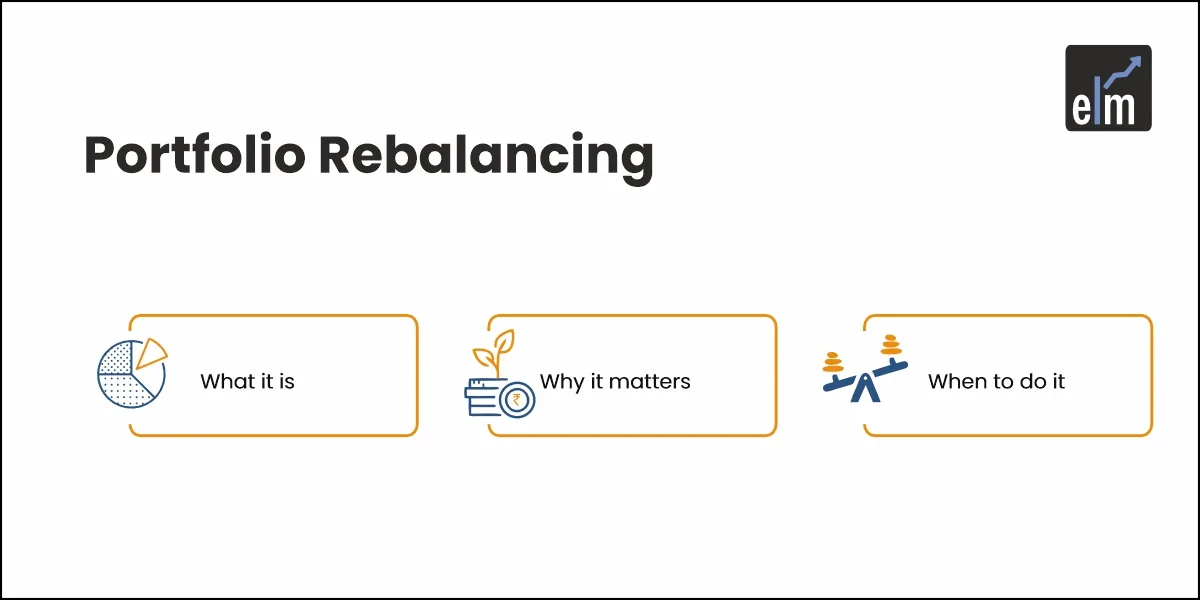
  2. What is Portfolio Rebalancing?
  3. Why Portfolio Rebalancing Matters?
  4. When Should You Rebalance Your Portfolio?
  5. How to Rebalance Your Portfolio?
  6. Benefits of Portfolio Rebalancing
  7. Common Mistakes of Portfolio Rebalancing
  8. Conclusion
  9. Frequently Asked Questions (FAQs)

Let’s start with a quick story!

Imagine two colleagues, Priya and Rahul, who both began investing on 31 December 2005 with the same plan: 60 per cent equity and 40 per cent debt. 

Priya checks her allocation each year and rebalances when it drifts; Rahul sets it up once and leaves it. 

By the end of 2020, the gap between them is striking. Priya’s disciplined rebalancing turns ₹100 into roughly ₹462, while Rahul’s buy-and-hold approach reaches about ₹385. A difference that works out to roughly 1.3 percentage points a year across 15 years. 

That is not a mysterious edge; it is the arithmetic of disciplined selling and buying at systematic intervals. 

That example matters for India now more than ever. The country’s SIP ecosystem has grown dramatically. Recent industry reporting shows millions of new SIPs and monthly SIP contributions repeatedly breaching the ₹20,000-crore mark in 2024.

At the same time, many retail investors set up SIPs and rarely revisit allocations once the initial plan is in place. 

Portfolio rebalancing is the routine that keeps an allocation faithful to the risk you signed up for; without it, your portfolio can slowly become something you no longer recognise.

What is Portfolio Rebalancing?

At its core, rebalancing is simple. You decide on an asset mix that reflects your goals and risk tolerance. For example, 60 per cent equity, 40 per cent debt, and you periodically restore those proportions when market moves push them away.

If equities run hard and become 70 per cent of your portfolio, rebalancing requires trimming equities and adding debt until you’re back to the target.

It is not a market-timing scheme; it is an act of risk control.

Why Portfolio Rebalancing Matters?

Portfolio rebalancing does three practical things. First, it enforces a disciplined “sell high, buy low” behaviour that investors rarely follow instinctively.

Second, it keeps the portfolio’s risk exposure aligned with your stated profile. What started as a moderate-risk allocation doesn’t morph into a high-risk portfolio simply because a bull market persisted.

Third, rebalancing tends to reduce portfolio volatility over time. Large empirical studies and institutional analysis have shown that rebalanced portfolios experience lower effective equity exposure and therefore lower realised volatility than comparable never-rebalanced portfolios, even if nominal returns can sometimes be higher in long trending bull markets.

In short, rebalancing is a tool to manage risk exposure, not a guaranteed method to maximize raw returns.

When Should You Rebalance Your Portfolio?

There are three practical approaches that most investors adopt, and each fits different temperaments. 

A calendar approach (quarterly, semi-annually, or annually) is simple and predictable. A threshold approach rebalances only when any asset class drifts beyond a chosen band, for example, ±5 percentage points, and avoids trivial trades.

Most prudent investors use a hybrid periodic review (say, every six months) but trade only when drift exceeds a tolerance threshold. 

For Indian investors, aligning rebalancing with known cash inflows, bonuses, salary hikes, or SIP increases reduces the need to sell and therefore reduces tax frictions.

How to Rebalance Your Portfolio?

Begin with a clear target allocation and a reliable ledger of holdings. Use your broker or mutual fund statements to calculate current weights.

If a drift has occurred beyond your agreed tolerance, plan execution with tax and cost in mind.

Rather than a string of checkboxes, here is a short narrative of execution choices. If you frequently receive new money (SIP increments, a year-end bonus), use those inflows to add to underweighted buckets. This is the lowest-cost, most tax-efficient route.

If you hold mutual funds and want to move cash from debt to equity gradually, set up an STP (Systematic Transfer Plan). If you prefer hands-off, many advisory platforms and robo-advisors can monitor drift and rebalance automatically according to your rules. If you choose manual trades, remember to document trade dates and expected tax outcomes before you execute.

Tax deserves special attention in India because the rules have changed in recent years. Long-term capital gains on equity instruments are subject to revised rates and exemption thresholds (the exemption slab and applicable rates were updated in recent budgets), and taxation of debt funds also underwent structural changes.

In practice, that means selling an equity or debt holding to rebalance may create a taxable event where possible, prefer inflows or STPs, and consult your tax adviser for large portfolio changes.

Benefits of Portfolio Rebalancing

Over long horizons, disciplined rebalancing improves the portfolio’s risk-adjusted characteristics.

It dampens concentration risks and can materially reduce drawdowns in stress years by ensuring the portfolio is not accidentally overweight in the most volatile asset class.

The trade-offs are real: transaction costs, potential taxes, and the occasional missed upside when an asset you trimmed continues an extended rally. Experienced investors weigh those costs and adopt the cadence that fits their goals and tax situation.

Common Mistakes of Portfolio Rebalancing

Investors commonly make two opposite errors. Portfolio rebalancing too frequently is reacting to every market wobble and paying heavy costs, and portfolio rebalancing too rarely is allowing drift to create a risk profile you did not approve. 

Another frequent mistake is mechanically rebalancing into underperforming funds without assessing quality. Portfolio rebalancing restores your allocation, but the holdings themselves still deserve periodic review.

Conclusion

Portfolio rebalancing is modest in action but consequential in effect. It is an operational discipline that preserves your chosen balance between growth and stability.

For most long-term Indian investors, a practical plan is to review allocations semi-annually, use a ±5% drift band as the trigger for action, prioritise inflows or STPs to correct imbalances, and keep tax impact front of mind.

That quiet routine will not produce headlines, but it will make your long-term portfolio behaviour far more predictable and far easier to live with.

Frequently Asked Questions (FAQs)

1. How often should you rebalance the portfolio?

Most investors rebalance once every 6-12 months. You can also rebalance when asset allocation moves 5-10% from your target. Don’t do it too often, or you’ll increase costs and taxes.

2. Is portfolio rebalancing taxable in India?

Yes, selling stocks or mutual funds while rebalancing can trigger capital gains tax. Equity held over 1 year is taxed at 12.5% (LTCG), and under 1 year at 20% (STCG).

3. Can mutual funds or ETFs rebalance automatically?

Some funds, like balanced advantage or target-date funds, rebalance internally. But most mutual funds and Indian ETFs don’t auto-rebalance your personal portfolio. You’ll need to adjust it manually.

ShareTweetSend
Previous Post

How to Choose the Right Mutual Funds in India to Invest in 2025

Next Post

Nifty Total Market Index vs Nifty 50: What are the Differences?

Vivek Bajaj

Vivek Bajaj

Mr Vivek Bajaj has over 20 years of experience in Multi-Asset Trading, Momentum Investor and student of Mark Minervini. He is the co-founder of StockEdge and Elearnmarkets and is passionate about data, analytics, and technology. He serves on various exchange committees and has played a significant role in the evolution of India's derivative market. He has been a speaker at various colleges and higher institutions, including IIT and IIMs.

Related Posts

gold investment
Miscellaneous

The Role of Gold Investment in Multi-Asset Portfolio Optimization

May 29, 2025
926
Best Personal loan Rates
Miscellaneous

5 Strategies for Finding the Best Personal Loan Rates

May 5, 2025
387
National Pension Scheme
Financial Planning

National Pension Scheme- Retirement Scheme for all

January 9, 2025
6.3k
Shares or Mutual Funds - Which one is better for Investment? 1
Financial Planning

Shares or Mutual Funds – Which one is better for Investment?

January 9, 2025
2.1k

Leave a Reply Cancel reply

Your email address will not be published. Required fields are marked *

Disclaimer

Elearnmarkets (Kredent InfoEdge Pvt. Ltd.) is a SEBI-registered Research Analyst (RA) entity (SEBI Registration No.: INH300007493). The information provided in this article is for educational and informational purposes only and should not be considered as an offer to buy or sell any securities or investment products.

The stocks, securities, and investment instruments mentioned herein are not recommendations under SEBI (Research Analysts) Regulations, 2014. Readers are advised to conduct their own due diligence and seek independent financial advice before making any investment decisions.

Investments in securities markets are subject to market risks. Please read all related documents carefully before investing. Investing in Equity Shares,
Derivatives, Mutual Funds, or other instruments carry inherent risks, including potential loss of capital. Elearnmarkets (Kredent InfoEdge Pvt. Ltd.) does not provide any guarantee or assurance of returns on any investments. Past performance is not indicative of future performance.

Elearnmarkets Logo

Follow Us

Facebook-f X-twitter Instagram Linkedin-in Youtube Telegram

Register on Elearnmarkets

Continue your financial learning by creating your own account on Elearnmarkets.com

Register Free Account

Download App

Playstore logo
Download on app store

Categories

  • Basic Finance
  • Derivatives
  • Financial Planning
  • Fundamental Analysis
  • Technical Analysis
  • Mutual Funds
  • Miscellaneous

Popular On Elearnmarkets

  • Market Superheroes:
  • Vivek Bajaj
  • Chetan Panchamia
  • Ashish Kyal
  • Premal Parekh
  • Abhijit Paul
  • Jegan
  • Sivakumar Jayachadran
  • Jyoti Budhia
  • Vivek Gadodia
  • Vishal Mehta
  • Piyush Chaudhry
  • Santosh Pasi
  • Gomathi Shankar
  • Market Superheroes:
  • Vivek Bajaj
  • Chetan Panchamia
  • Ashish Kyal
  • Premal Parekh
  • Abhijit Paul
  • Jegan
  • Sivakumar Jayachadran
  • Jyoti Budhia
  • Vivek Gadodia
  • Vishal Mehta
  • Piyush Chaudhry
  • Santosh Pasi
  • Gomathi Shankar
  • Courses:​
  • Options Trading
  • Dow Theory
  • Momentum Trading
  • Stock Investing
  • Harmonic Chart Patterns
  • Algo Trading
  • Elliot Wave Theory
  • Advanced Excel
  • Cryptocurrency
  • NSE Certification Course
  • Courses:​
  • Options Trading
  • Dow Theory
  • Momentum Trading
  • Stock Investing
  • Harmonic Chart Patterns
  • Algo Trading
  • Elliot Wave Theory
  • Advanced Excel
  • Cryptocurrency
  • NSE Certification Course
  • Webinars:
  • Bank Nifty Scalping
  • Intraday Trading Strategies
  • Options Trading Strategies
  • Options selling
  • Price Action
  • Relative Strength
  • Tax Planning
  • Options Buying
  • Growth Stocks
  • Portfolio Management
  • Risk Management
  • Renko Charts
  • Crude Oil
  • Traders Psychology
  • Moving Average
  • Multibagger Stocks
  • Webinars:
  • Bank Nifty Scalping
  • Intraday Trading Strategies
  • Options Trading Strategies
  • Options selling
  • Price Action
  • Relative Strength
  • Tax Planning
  • Options Buying
  • Growth Stocks
  • Portfolio Management
  • Risk Management
  • Renko Charts
  • Crude Oil
  • Traders Psychology
  • Moving Average
  • Multibagger Stocks
  • Free Learning Modules:
  • Intraday Trading
  • Options Scalping
  • Swing Trading
  • Financial Modelling
  • RSI Indicator
  • Bollinger Bands
  • Pricing of Futures
  • Personal Finance
  • Initial Public Offerings (IPO)
  • Value Investing
  • Technical Indicators
  • Candlesticks
  • Chart Patterns
  • Option Greeks
  • ELSS Funds
  • Banking and Insurance
  • Real Estate
  • Gold
  • Free Learning Modules:
  • Intraday Trading
  • Options Scalping
  • Swing Trading
  • Financial Modelling
  • RSI Indicator
  • Bollinger Bands
  • Pricing of Futures
  • Personal Finance
  • Initial Public Offerings (IPO)
  • Value Investing
  • Technical Indicators
  • Candlesticks
  • Chart Patterns
  • Option Greeks
  • ELSS Funds
  • Banking and Insurance
  • Real Estate
  • Gold
  • Book Summaries:
  • Rich Dad Poor Dad
  • Psychology of Money
  • The Intelligent Investor
  • The Richest Man in Babylon
  • Think and Trade Like a Champion
  • Value Investing and Behavioural Finance
  • Trading in the Zone
  • Learn to Earn
  • Book Summaries:
  • Rich Dad Poor Dad
  • Psychology of Money
  • The Intelligent Investor
  • The Richest Man in Babylon
  • Think and Trade Like a Champion
  • Value Investing and Behavioural Finance
  • Trading in the Zone
  • Learn to Earn
  • Tools:
  • CAGR Calculator
  • SIP Calculator
  • eLearnOptions
  • Future Value Calculator
  • Present Value Calculator
  • Atal Pension Yojana
  • Cost of Delay Calculator
  • Become a Crorepati
  • Tools:
  • CAGR Calculator
  • SIP Calculator
  • eLearnOptions
  • Future Value Calculator
  • Present Value Calculator
  • Atal Pension Yojana
  • Cost of Delay Calculator
  • Become a Crorepati

© 2025 Elearnmarkets. All Rights Reserved

  • Visit Elearnmarkets
  • Courses
  • Webinars
  • Financial Guides
  • Get Free Counselling
  • Visit Elearnmarkets
  • Courses
  • Webinars
  • Financial Guides
  • Get Free Counselling

Download Our App

Deliver breaking news, insightful commentary, and exclusive reports. Targeting readers who rely on our platform to stay ahead.

Contact Benzinga
No Result
View All Result
  • Article Categories
    • Basic Finance
    • Derivatives
    • Financial Planning
    • Fundamental Analysis
    • Technical Analysis
    • ETFs & Mutual Funds
    • Marketshala
    • Miscellaneous
  • Language
    • Hindi
    • Bengali
    • English
  • Courses
  • Webinars
  • Stories
Get Free Course

© 2024 Elearnmarkets All Rights Reserved

Guidebook on Savings and Investment
A comprehensive guide book to start your investment journey
Download Guide For FREE