
Elearnmarkets - Financial Market Learning
  • Courses
  • Webinars
  • Stories
  • Language
    • English
    • Hindi
    • Bengali
No Result
View All Result
Get Free Course
  • Basic Finance
  • Derivatives
    • Futures
    • Options
  • Financial Planning
  • Fundamental Analysis
  • Technical Analysis
  • Mutual Funds
  • Marketshala
  • Miscellaneous
Elearnmarkets - Learn Stock Market, trading, investing for Free
  • Courses
  • Webinars
  • Stories
  • Language
    • English
    • Hindi
    • Bengali
No Result
View All Result
Get Free Course
Elearnmarkets - Learn Stock Market, trading, investing for Free
No Result
View All Result
Home Basic Finance
Types of Cheques in India

Know Everything About Different Types of Cheques & Their Purpose

Elearnmarkets by Elearnmarkets
November 24, 2025
in Basic Finance, Banking
Reading Time: 7 mins read
10
122.1k
VIEWS
Share on FacebookShare on XShare on WhatsApp

Key Takeaways

  • Cheque is a Safe Payment Tool: A cheque allows you to transfer money from your bank account without carrying cash and works as a legal payment document.
  • Fill Cheque Carefully: Avoid overwriting, add the correct date, write the amount in words and numbers, add payee name, and sign properly to prevent rejection.
  • Types of Cheques Matter: Bearer, self, account payee, post-dated, banker’s cheque and traveller’s cheque are used for different payment needs.
  • Account Payee is the Safest: Crossed or account payee cheques ensure money is deposited only in the receiver’s bank account, reducing risk.
  • Cheque Bounce is a Serious Issue: Cheques can bounce due to low balance or errors, and it can lead to legal penalties or even jail time.

Table Of Contents
  1. Key Takeaways
  2. What is a Cheque?
  3. Different Types of Cheques
    • 1. Bearer Cheques or Open Cheques
    • 2. Self-Cheques
    • 3. Account Payee Cheques
    • 4. Post-dated Cheque
    • 5. Banker’s Cheque
    • 6. Traveler’s Cheque
    • 7. Crossed Cheque
  4. Why Does Dishonour of Cheques Happen?
  5. Frequently Asked Questions(FAQs)

A cheque is an important document that individuals, companies, governments, and others use to transact their business. There are various types of cheques used in our banking system, which have certain protocols that we need to follow while writing a cheque. For example, overwriting on the cheque is not permitted.

What is a Cheque?

A cheque is a very common form of a negotiable instrument. You need a savings bank account or current account in a bank, in order to issue a cheque in your own name or in favor of others, thereby directing the bank to pay the predetermined amount to the individual named in the cheque. This transaction has to be handled very delicately as it may lead to some serious banking fraud.

A cheque is a document that ensures the payment of a particular amount of money on demand to a certain individual or to the bearer of the instrument. It is a printed form that you can use to make payments from your bank account. When you write a cheque you enter the amount of money that you want to send to the person and who is to be paid to, sign and hand it over to the individual you want to make payment to. Your bank then pays the money to that individual (payee) from your account.

It is one of the safest and most convenient modes of making payments and is transferred by mere delivery.

One of the benefits of the cheque is that you can transfer a high-value transaction without any hassle, which would be very difficult if hard cash were used instead.

The issuer of the cheque has an account (savings or current) with the bank to which it is connected. Various types of checkbooks depend on the type of account you have.

Download to safeguard your account  – Banking awareness book

Some of the important details which should be present in a cheque are as follows-

  • A cheque should be dated.
  • A cheque should mention the amount of money in figures and words.
  • A cheque must be signed by the person (Drawer) issuing the cheque
  • A cheque must be drawn from a specified bank (Drawee).
  • A cheque must have the name of the recipient (Payee) of the cheque.

Different Types of Cheques
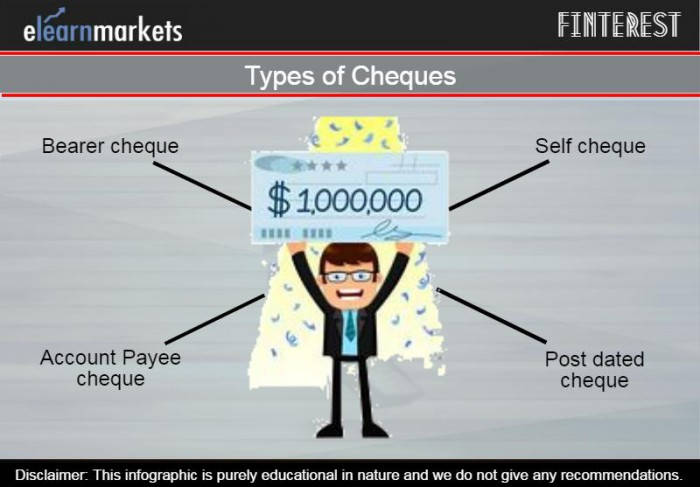
Types of cheques

1. Bearer Cheques or Open Cheques

It is also known as an open cheque or an uncrossed cheque. This cheque can be transferred by mere delivery and needs no endorsement.

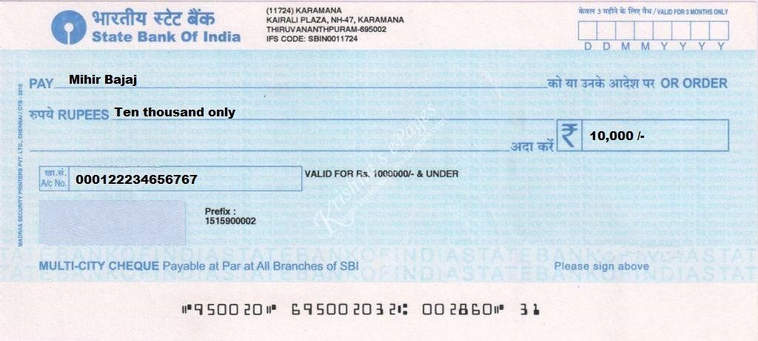
open cheque

The cheque is negotiable from the date of issue up to three months. It turns stale after the completion of three months and needs to be revalidated before presenting to the bank.

However,  these types of cheques are very risky and once misplaced can lead to the loss of the amount stated in the cheque.

2. Self-Cheques

It comes under bearer cheque where instead of writing the name, the account holder writes “self” to receive money physically from the branch where he holds the account.
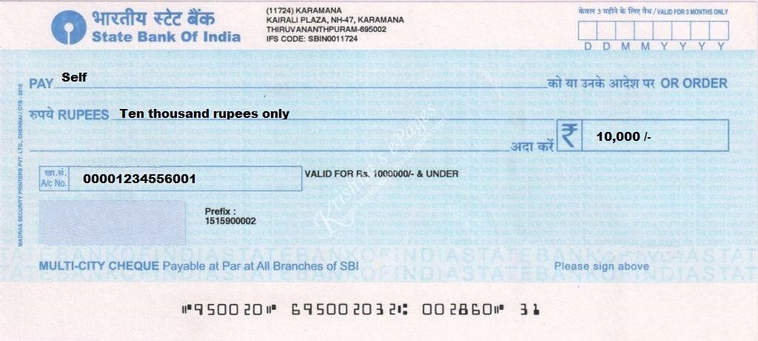
self cheques

3. Account Payee Cheques

A bearer cheque becomes an account payee cheque by writing “Account Payee” or crossing it twice with two parallel lines on the left-hand side top corner.
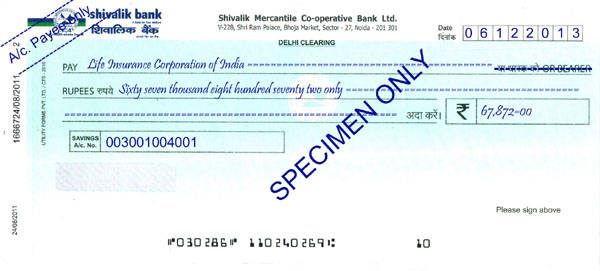
Account payee cheques

The amount will be transferred to the account of the person specified on the cheque.

It is considered the safest type of cheque and is also known as a crossed cheque.

4. Post-dated Cheque

It is a type of crossed or accounts payee cheque but it is post-dated to meet the obligation at a future date. It is valid from the date of the issue up to three months.

5. Banker’s Cheque

Such cheques are issued by the bank itself and guarantee payment.

6. Traveler’s Cheque

You can use such cheques for the withdrawal of money while traveling. It is equal to carrying cash but you can travel safely without carrying a huge amount. These cheques can be encashed abroad where foreign currency is normally acceptable.

7. Crossed Cheque

When we cross a bearer cheque twice with two parallel lines on the left-hand top corner, it becomes a crossed cheque. Only the name written on it can get the amount transferred to his account.

With the growing popularity of net banking and ATM usage,  types of crossed cheques are gradually becoming obsolete.

Why Does Dishonour of Cheques Happen?

The dishonor of cheques may happen due to multiple reasons. However, the insufficiency of funds in the account of the drawer of the cheque is the key reason if your cheque has been dishonored.

It is very important to understand the reasons for the dishonor of cheques because it is considered a criminal offense and is punishable by imprisonment up to two years or with a monetary penalty, or with both.

To get the latest updates on Stock Markets, visit StockEdge.

Keep learning !!!

Frequently Asked Questions(FAQs)

1. How much time does it take to clear a cheque?

It uses two business days for a cheque to get cleared and it takes no longer than 5 days for cheques to get cleared by the bank.

2. Can I withdraw cash from any bank by cheque?

Yes, you can cash a cheque at any bank without being an account holder.

3. What steps are involved in clearing a cheque?

The steps involved in the clearing of cheques are:
Step 1: BANK where cheques are presented by the payee for deposit in his or her A/C.
Step 2: Regional collecting center to collect all cheques from their presenting branch.
Step 3: To collect cheques from RCC and for settlement of cheque
Step 4: Again they collect cheques from the clearing house and send them to their drawee bank.
Step 5: It collects cheques from their RCC and debits the customer A/C.
ShareTweetSend
Previous Post

Various Types of Bank Deposits

Next Post

Principle of Polarity

Elearnmarkets

Elearnmarkets

Elearnmarkets (ELM) is a complete financial market portal where the market experts have taken the onus to spread financial education. ELM constantly experiments with new education methodologies and technologies to make financial education effective, affordable and accessible to all. You can connect with us on Twitter @elearnmarkets.

Related Posts

Indexation in mutual funds
Basic Finance

Indexation in Mutual Funds: Meaning, Benefits & Calculation

October 28, 2025
96
Sharpe Ratio
Basic Finance

Sharpe Ratio: Meaning, Formula & Example

November 3, 2025
736
amortisation
Basic Finance

Amortisation: What It Is & How To Calculate?

September 26, 2025
213
Monopoly Market
Basic Finance

Monopoly Market: Definition, Types & Impact on Market

September 19, 2025
453

Comments 10

  1. Madeeha Tabassum says:
    5 years ago

    Thanks for the proper information!

    Reply
    • Sakshi Agarwal says:
      5 years ago

      Hi,

      We are glad that you liked our blog post.

      Thank you for Reading!

      Reply
  2. Ornella says:
    5 years ago

    So sweet, straight forward notes and understandable!!

    Reply
    • Sakshi Agarwal says:
      5 years ago

      Hi,

      We are glad that you liked our blog post.

      Thank you for Reading!

      Reply
  3. clarah says:
    5 years ago

    Thanks alot for the information….well undertood

    Reply
    • Sakshi Agarwal says:
      5 years ago

      Hi,

      Thank you for Reading!

      Keep Reading

      Reply
  4. Aruna Jayasinghe says:
    5 years ago

    This is really good and also if you can explain what it happens in each of its places that the cheque passes while being cleared … Thanks a lot for your education.

    Reply
    • Sakshi Agarwal says:
      5 years ago

      Hi,

      Thank you for reading our blog!!

      Keep Reading!

      Reply
  5. Ruhinda Alex says:
    5 years ago

    understandable to everyone

    Reply
    • Sakshi Agarwal says:
      5 years ago

      Hi,

      We are glad that you liked our post.

      Thank you for Reading!

      Reply

Leave a Reply Cancel reply

Your email address will not be published. Required fields are marked *

Disclaimer

Elearnmarkets (Kredent InfoEdge Pvt. Ltd.) is a SEBI-registered Research Analyst (RA) entity (SEBI Registration No.: INH300007493). The information provided in this article is for educational and informational purposes only and should not be considered as an offer to buy or sell any securities or investment products.

The stocks, securities, and investment instruments mentioned herein are not recommendations under SEBI (Research Analysts) Regulations, 2014. Readers are advised to conduct their own due diligence and seek independent financial advice before making any investment decisions.

Investments in securities markets are subject to market risks. Please read all related documents carefully before investing. Investing in Equity Shares,
Derivatives, Mutual Funds, or other instruments carry inherent risks, including potential loss of capital. Elearnmarkets (Kredent InfoEdge Pvt. Ltd.) does not provide any guarantee or assurance of returns on any investments. Past performance is not indicative of future performance.

Elearnmarkets Logo

Follow Us

Facebook-f X-twitter Instagram Linkedin-in Youtube Telegram

Register on Elearnmarkets

Continue your financial learning by creating your own account on Elearnmarkets.com

Register Free Account

Download App

Playstore logo
Download on app store

Categories

  • Basic Finance
  • Derivatives
  • Financial Planning
  • Fundamental Analysis
  • Technical Analysis
  • Mutual Funds
  • Miscellaneous

Popular On Elearnmarkets

  • Market Superheroes:
  • Vivek Bajaj
  • Chetan Panchamia
  • Ashish Kyal
  • Premal Parekh
  • Abhijit Paul
  • Jegan
  • Sivakumar Jayachadran
  • Jyoti Budhia
  • Vivek Gadodia
  • Vishal Mehta
  • Piyush Chaudhry
  • Santosh Pasi
  • Gomathi Shankar
  • Market Superheroes:
  • Vivek Bajaj
  • Chetan Panchamia
  • Ashish Kyal
  • Premal Parekh
  • Abhijit Paul
  • Jegan
  • Sivakumar Jayachadran
  • Jyoti Budhia
  • Vivek Gadodia
  • Vishal Mehta
  • Piyush Chaudhry
  • Santosh Pasi
  • Gomathi Shankar
  • Courses:​
  • Options Trading
  • Dow Theory
  • Momentum Trading
  • Stock Investing
  • Harmonic Chart Patterns
  • Algo Trading
  • Elliot Wave Theory
  • Advanced Excel
  • Cryptocurrency
  • NSE Certification Course
  • Courses:​
  • Options Trading
  • Dow Theory
  • Momentum Trading
  • Stock Investing
  • Harmonic Chart Patterns
  • Algo Trading
  • Elliot Wave Theory
  • Advanced Excel
  • Cryptocurrency
  • NSE Certification Course
  • Webinars:
  • Bank Nifty Scalping
  • Intraday Trading Strategies
  • Options Trading Strategies
  • Options selling
  • Price Action
  • Relative Strength
  • Tax Planning
  • Options Buying
  • Growth Stocks
  • Portfolio Management
  • Risk Management
  • Renko Charts
  • Crude Oil
  • Traders Psychology
  • Moving Average
  • Multibagger Stocks
  • Webinars:
  • Bank Nifty Scalping
  • Intraday Trading Strategies
  • Options Trading Strategies
  • Options selling
  • Price Action
  • Relative Strength
  • Tax Planning
  • Options Buying
  • Growth Stocks
  • Portfolio Management
  • Risk Management
  • Renko Charts
  • Crude Oil
  • Traders Psychology
  • Moving Average
  • Multibagger Stocks
  • Free Learning Modules:
  • Intraday Trading
  • Options Scalping
  • Swing Trading
  • Financial Modelling
  • RSI Indicator
  • Bollinger Bands
  • Pricing of Futures
  • Personal Finance
  • Initial Public Offerings (IPO)
  • Value Investing
  • Technical Indicators
  • Candlesticks
  • Chart Patterns
  • Option Greeks
  • ELSS Funds
  • Banking and Insurance
  • Real Estate
  • Gold
  • Free Learning Modules:
  • Intraday Trading
  • Options Scalping
  • Swing Trading
  • Financial Modelling
  • RSI Indicator
  • Bollinger Bands
  • Pricing of Futures
  • Personal Finance
  • Initial Public Offerings (IPO)
  • Value Investing
  • Technical Indicators
  • Candlesticks
  • Chart Patterns
  • Option Greeks
  • ELSS Funds
  • Banking and Insurance
  • Real Estate
  • Gold
  • Book Summaries:
  • Rich Dad Poor Dad
  • Psychology of Money
  • The Intelligent Investor
  • The Richest Man in Babylon
  • Think and Trade Like a Champion
  • Value Investing and Behavioural Finance
  • Trading in the Zone
  • Learn to Earn
  • Book Summaries:
  • Rich Dad Poor Dad
  • Psychology of Money
  • The Intelligent Investor
  • The Richest Man in Babylon
  • Think and Trade Like a Champion
  • Value Investing and Behavioural Finance
  • Trading in the Zone
  • Learn to Earn
  • Tools:
  • CAGR Calculator
  • SIP Calculator
  • eLearnOptions
  • Future Value Calculator
  • Present Value Calculator
  • Atal Pension Yojana
  • Cost of Delay Calculator
  • Become a Crorepati
  • Tools:
  • CAGR Calculator
  • SIP Calculator
  • eLearnOptions
  • Future Value Calculator
  • Present Value Calculator
  • Atal Pension Yojana
  • Cost of Delay Calculator
  • Become a Crorepati

© 2025 Elearnmarkets. All Rights Reserved

  • Visit Elearnmarkets
  • Courses
  • Webinars
  • Financial Guides
  • Get Free Counselling
  • Visit Elearnmarkets
  • Courses
  • Webinars
  • Financial Guides
  • Get Free Counselling

Download Our App

Deliver breaking news, insightful commentary, and exclusive reports. Targeting readers who rely on our platform to stay ahead.

Contact Benzinga
No Result
View All Result
  • Article Categories
    • Basic Finance
    • Derivatives
    • Financial Planning
    • Fundamental Analysis
    • Technical Analysis
    • ETFs & Mutual Funds
    • Marketshala
    • Miscellaneous
  • Language
    • Hindi
    • Bengali
    • English
  • Courses
  • Webinars
  • Stories
Get Free Course

© 2024 Elearnmarkets All Rights Reserved

Guide to Basics of Stock Investing
Learn to interpret the financial performance and health of a company.
Download Guide For FREE
Guidebook on Banking
A comprehensive handbook to enhance your banking awareness
Download Guide For FREE