
Elearnmarkets - Financial Market Learning
  • Courses
  • Webinars
  • Stories
  • Language
    • English
    • Hindi
    • Bengali
No Result
View All Result
Get Free Course
  • Basic Finance
  • Derivatives
    • Futures
    • Options
  • Financial Planning
  • Fundamental Analysis
  • Technical Analysis
  • Mutual Funds
  • Marketshala
  • Miscellaneous
Elearnmarkets - Learn Stock Market, trading, investing for Free
  • Courses
  • Webinars
  • Stories
  • Language
    • English
    • Hindi
    • Bengali
No Result
View All Result
Get Free Course
Elearnmarkets - Learn Stock Market, trading, investing for Free
No Result
View All Result
Home Basic Finance
Indian Capital Market

Indian Capital Market – How It Works

Vineet Patawari by Vineet Patawari
August 22, 2025
in Basic Finance, Macroeconomics
Reading Time: 10 mins read
7
5.7k
VIEWS
Share on FacebookShare on XShare on WhatsApp

Key Takeaways

  • Indian Capital Market: Acts as the backbone of the economy by channeling savings into productive investments and powering growth.
  • Components of Capital Markets: Includes equity, bonds, money markets, derivatives, exchanges, and intermediaries that keep the system running.
  • Securities Markets: Divided into primary market (IPOs/FPOs where companies raise funds) and secondary market (where investors trade listed securities).
  • Money Markets: Deals with short-term funds through instruments like T-bills, CPs, and CDs, helping companies manage liquidity needs.
  • How Money Moves: Savers invest → companies raise capital → securities trade on exchanges → regulators & intermediaries ensure smooth functioning.

Table of Contents

  • Why Capital Markets Matter
    • Learn about the Types of Financial Markets here!
  • Components of Capital Markets
  • What is a Capital Market?
  • What is a Securities Market?
    • Two Halves of the Securities Market
      • 1. Primary Market: Where Companies Ask for Money
      • 2. Secondary Market: Where Investors Trade Existing Securities
  • What is a Money Market?
  • Regulators & Rule Changes: Why They Matter?
  • How the Market Actually Moves Money
  • Quick, Modern Examples:
  • Bottomline
  • Frequently Asked Questions (FAQs)
    • What is a capital market?
    • How does the capital market function?
    • What are the primary components of the capital market?

Understanding the capital market isn’t optional if you want your money to work while you sleep. Think of the capital market as a giant, very efficient money elevator: it picks up savings from people and institutions, and drops that capital where companies and governments need it to build, grow or reboot. Below is a crisp, conversational tour, now with real names and recent, fact-checked examples.

Why Capital Markets Matter

Savings sitting in lockers don’t create jobs, factories or apps. When you park money in a bank, buy a bond, or subscribe to an IPO, that capital flows into businesses and government projects powering growth and creating returns for investors.

Retail participation has been surging: total demat accounts in India recently crossed the 20-crore mark, showing how many more people are now plugged into markets.

Learn about the Types of Financial Markets here!

Components of Capital Markets

Financial markets are majorly divided into the following components:
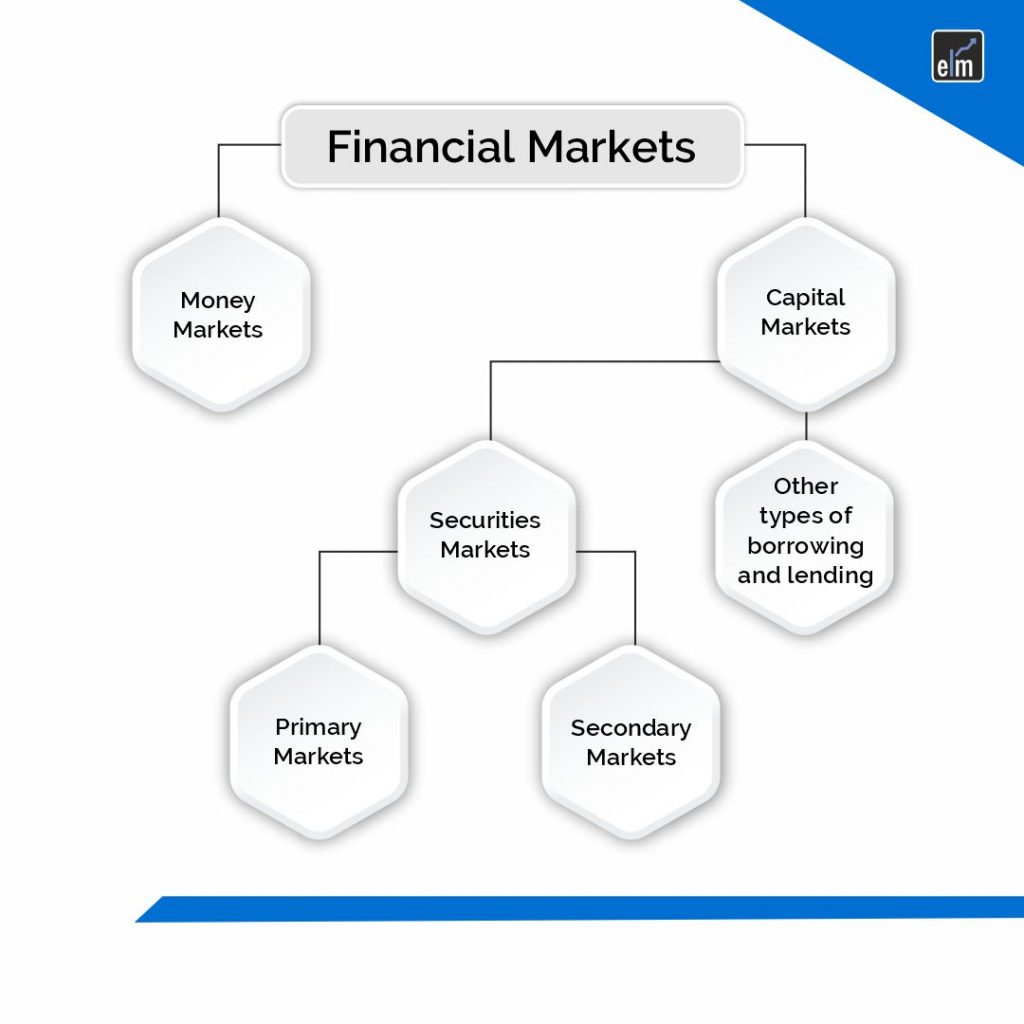
Financial market
  • Capital markets — long-term capital (equity, bonds).
  • Money markets — short-term liquidity (T-bills, commercial paper).
  • Derivatives — futures/options on indices, stocks, commodities.
  • Exchanges & intermediaries — NSE, BSE, brokers, depositories, regulators.

What is a Capital Market?

A marketplace where securities (shares, bonds, debentures) are issued and traded. It channels savings into productive investment, gives companies a way to raise long-term finance, and provides investors with liquidity and price discovery. Modern electronic trading connects investors from Mumbai to Melbourne in milliseconds.

The capital market and in particular the stock exchange is referred to as the barometer of the economy. – ICSI study material              

What is a Securities Market?

The securities market provides the platform for those financial instruments that are transferable by sale. It further comprises two important components: the primary market and the secondary market. Primary markets deal with newly issued stocks and securities, whereas secondary markets deal with already issued ones.

Two Halves of the Securities Market

1. Primary Market: Where Companies Ask for Money

This is where fresh capital is raised. IPOs and FPOs live here. For example, Tata Capital has been preparing a large IPO as NBFCs and finance houses rethink funding and listings, a reminder that big financial sector listings can reshape investor flows.

Other big candidates on the IPO radar (policy permitting) include high-profile listings such as parts of the Reliance/Jio ecosystem or even the NSE, as regulators have cleared roadblocks that could allow mega-listings. These are the kind of events that deepen markets and draw fresh capital.

2. Secondary Market: Where Investors Trade Existing Securities

Once a security is listed, investors buy and sell it on exchanges like NSE and BSE. Liquidity, the ability to turn assets into cash quickly is a key benefit.

Real-sector snapshots:

  • IT sector: Large IT names like TCS and Infosys have seen pressure in 2025 (Nifty IT was one of the weakest sectors in 2025), highlighting cyclical demand and AI/open-automation concerns for services firms. That’s the sort of sector-level risk that moves indices and investor sentiment.
  • Autos / EVs: Tata Motors, facing regular gasoline/ICE cycles while also pushing EVs reported mixed monthly sales trends as EV momentum builds. These shifts show how structural themes (EV adoption) can co-exist with short-term demand swings.
  • Banking / Financials: Big banks like HDFC Bank and ICICI Bank remain central to credit cycles; their quarterly results and deposit growth data are watched as proxies for domestic demand and lending health. HDFC Bank’s Q1 FY26 presentation shows strong deposit traction — a reminder that banks are the plumbing of credit.

What is a Money Market?

Need funds for a few weeks or months? Instruments such as T-bills, commercial paper and certificates of deposit handle short-term liquidity. These are lower-risk, lower-return tools important for treasury desks and large corporations.

Unlock the secrets of the Indian Capital Market with our Futures Trading Course. Start your journey today!

Regulators & Rule Changes: Why They Matter?

SEBI regularly updates rules to balance market growth and investor protection. One recent example: implementation timelines for margin obligations via pledge/re-pledge were extended to give stakeholders more time, showing regulators aim for orderly transitions rather than abrupt shocks. Rules like these can affect liquidity, broker operations and how leveraged positions are handled.

How the Market Actually Moves Money

  1. You (the saver) open a demat account and buy shares or bonds.
  2. Primary market: Companies raise money via IPO/FPO (example: Tata Capital preparing an IPO)
  3. Secondary market: Investors trade those securities on exchanges; sector news (like IT weakness or Tata Motors’ EV updates) moves prices.
  4. Intermediaries & regulators (brokers, depositories, SEBI) keep the system running and adapt the rules.

Quick, Modern Examples:

  • Retail participation up — demat accounts >20 crore, led by young investors.
  • Big IPOs brewing — Tata Capital and structural changes that might allow Reliance Jio / NSE listings. These could be market-making events.
  • Sector rotations — IT underperformance in 2025 and the parallel EV push in autos (Tata Motors) show why sector selection matters.

Bottomline

The capital market channels savings into growth. It gives companies capital, investors opportunities, and the economy fuel. The plumbing exchanges, depositories and regulators keeps everything moving, and it’s changing as participation and products evolve. If you want to be more than a spectator: learn the basics, pick a plan (long-term vs short-term), and respect both volatility and the rules that keep markets honest.

Frequently Asked Questions (FAQs)

What is a capital market?

 A financial market where long-term securities like stocks and bonds are issued and traded.

How does the capital market function?

Companies raise funds in the primary market; investors trade in the secondary market; intermediaries and regulators provide infrastructure and protections.

What are the primary components of the capital market?

Stock exchanges (NSE, BSE), primary markets (IPOs/FPOs), secondary markets (trading), debt markets, derivatives, and money market instruments.
Tags: basiccapital marketenglishprimary marketsecondary marketstock market
ShareTweetSend
Previous Post

Options Trading Vs Intraday Trading – Which is Right For You?

Next Post

Understanding the Public Provident Fund (PPF) Scheme: A Comprehensive Guide

Vineet Patawari

Vineet Patawari

Vineet is the co-founder of Elearnmarkets. He assumes the role of CEO and his job is to help the team get their job done. Vineet drives the growth strategy and its execution through product innovation, product marketing and brand building. He is dedicated to building high performance teams and enjoys being actively involved in problem solving for business growth. Vineet, an IIM Indore Alumnus is also a Chartered Accountant and his interests include digital marketing, blogging on recreational mathematics, travelling and has a passion for teaching. When not at work, he loves spending time with his two lovely sons Arham & Vihaan and his wife Preeti.

Related Posts

Indexation in mutual funds
Basic Finance

Indexation in Mutual Funds: Meaning, Benefits & Calculation

October 28, 2025
96
Sharpe Ratio
Basic Finance

Sharpe Ratio: Meaning, Formula & Example

November 3, 2025
736
amortisation
Basic Finance

Amortisation: What It Is & How To Calculate?

September 26, 2025
213
Monopoly Market
Basic Finance

Monopoly Market: Definition, Types & Impact on Market

September 19, 2025
453

Comments 7

  1. Sukanya says:
    9 years ago

    Hello Shruti! This blog explains about the Indian capital market in great depth..For someone like me, who is new to this market, it was very helpful..Thanks for sharing your knowledge..

    Reply
    • Shruti Agarwal says:
      9 years ago

      @Sukanya – Hi, Thank you for reading through and appreciating.
      We will be further coming up with blogs on related topics. Let us know in case of any similar topics you wish us to add further.
      Happy Learning

      Reply
  2. Mudra says:
    9 years ago

    Hi, Thanks for sharing the basic details around Indian capital market and I was searching for details on it. Actually I am currently pursing CFA level 1 exam and am going through all the educational site to give basic insight around finance anf found it very useful

    Reply
  3. Shruti Agarwal says:
    9 years ago

    Hi Mudra,
    Thank you for appreciating. Let us know in case you need to know about any similar topics.
    We would be glad to provide details on same.

    Reply
  4. ram das says:
    8 years ago

    Thank you for the information. We can also add Currency markets being the largest market in the world. This includes all aspects of buying, selling and exchanging currencies at current or determined prices. Currency markets is a global decentralized or over-the-counter (OTC) market for the trading of currencies. Foreign Institutional Investors (FIIs) to participate in Indian Currency Exchange platform to trade and/or hedge with lower costs and higher leverage in an organized regulated environment as compared to the OTC market.

    Reply
  5. Mubarak nura usman says:
    8 years ago

    I had been freed from the bracket of ambiguity that I involved in. Your blog gives explicit insight about money and capital market. Thank enormously. Improve on

    Reply
    • Tista Sengupta says:
      8 years ago

      Welcome

      Reply

Leave a Reply Cancel reply

Your email address will not be published. Required fields are marked *

Disclaimer

Elearnmarkets (Kredent InfoEdge Pvt. Ltd.) is a SEBI-registered Research Analyst (RA) entity (SEBI Registration No.: INH300007493). The information provided in this article is for educational and informational purposes only and should not be considered as an offer to buy or sell any securities or investment products.

The stocks, securities, and investment instruments mentioned herein are not recommendations under SEBI (Research Analysts) Regulations, 2014. Readers are advised to conduct their own due diligence and seek independent financial advice before making any investment decisions.

Investments in securities markets are subject to market risks. Please read all related documents carefully before investing. Investing in Equity Shares,
Derivatives, Mutual Funds, or other instruments carry inherent risks, including potential loss of capital. Elearnmarkets (Kredent InfoEdge Pvt. Ltd.) does not provide any guarantee or assurance of returns on any investments. Past performance is not indicative of future performance.

Elearnmarkets Logo

Follow Us

Facebook-f X-twitter Instagram Linkedin-in Youtube Telegram

Register on Elearnmarkets

Continue your financial learning by creating your own account on Elearnmarkets.com

Register Free Account

Download App

Playstore logo
Download on app store

Categories

  • Basic Finance
  • Derivatives
  • Financial Planning
  • Fundamental Analysis
  • Technical Analysis
  • Mutual Funds
  • Miscellaneous

Popular On Elearnmarkets

  • Market Superheroes:
  • Vivek Bajaj
  • Chetan Panchamia
  • Ashish Kyal
  • Premal Parekh
  • Abhijit Paul
  • Jegan
  • Sivakumar Jayachadran
  • Jyoti Budhia
  • Vivek Gadodia
  • Vishal Mehta
  • Piyush Chaudhry
  • Santosh Pasi
  • Gomathi Shankar
  • Market Superheroes:
  • Vivek Bajaj
  • Chetan Panchamia
  • Ashish Kyal
  • Premal Parekh
  • Abhijit Paul
  • Jegan
  • Sivakumar Jayachadran
  • Jyoti Budhia
  • Vivek Gadodia
  • Vishal Mehta
  • Piyush Chaudhry
  • Santosh Pasi
  • Gomathi Shankar
  • Courses:​
  • Options Trading
  • Dow Theory
  • Momentum Trading
  • Stock Investing
  • Harmonic Chart Patterns
  • Algo Trading
  • Elliot Wave Theory
  • Advanced Excel
  • Cryptocurrency
  • NSE Certification Course
  • Courses:​
  • Options Trading
  • Dow Theory
  • Momentum Trading
  • Stock Investing
  • Harmonic Chart Patterns
  • Algo Trading
  • Elliot Wave Theory
  • Advanced Excel
  • Cryptocurrency
  • NSE Certification Course
  • Webinars:
  • Bank Nifty Scalping
  • Intraday Trading Strategies
  • Options Trading Strategies
  • Options selling
  • Price Action
  • Relative Strength
  • Tax Planning
  • Options Buying
  • Growth Stocks
  • Portfolio Management
  • Risk Management
  • Renko Charts
  • Crude Oil
  • Traders Psychology
  • Moving Average
  • Multibagger Stocks
  • Webinars:
  • Bank Nifty Scalping
  • Intraday Trading Strategies
  • Options Trading Strategies
  • Options selling
  • Price Action
  • Relative Strength
  • Tax Planning
  • Options Buying
  • Growth Stocks
  • Portfolio Management
  • Risk Management
  • Renko Charts
  • Crude Oil
  • Traders Psychology
  • Moving Average
  • Multibagger Stocks
  • Free Learning Modules:
  • Intraday Trading
  • Options Scalping
  • Swing Trading
  • Financial Modelling
  • RSI Indicator
  • Bollinger Bands
  • Pricing of Futures
  • Personal Finance
  • Initial Public Offerings (IPO)
  • Value Investing
  • Technical Indicators
  • Candlesticks
  • Chart Patterns
  • Option Greeks
  • ELSS Funds
  • Banking and Insurance
  • Real Estate
  • Gold
  • Free Learning Modules:
  • Intraday Trading
  • Options Scalping
  • Swing Trading
  • Financial Modelling
  • RSI Indicator
  • Bollinger Bands
  • Pricing of Futures
  • Personal Finance
  • Initial Public Offerings (IPO)
  • Value Investing
  • Technical Indicators
  • Candlesticks
  • Chart Patterns
  • Option Greeks
  • ELSS Funds
  • Banking and Insurance
  • Real Estate
  • Gold
  • Book Summaries:
  • Rich Dad Poor Dad
  • Psychology of Money
  • The Intelligent Investor
  • The Richest Man in Babylon
  • Think and Trade Like a Champion
  • Value Investing and Behavioural Finance
  • Trading in the Zone
  • Learn to Earn
  • Book Summaries:
  • Rich Dad Poor Dad
  • Psychology of Money
  • The Intelligent Investor
  • The Richest Man in Babylon
  • Think and Trade Like a Champion
  • Value Investing and Behavioural Finance
  • Trading in the Zone
  • Learn to Earn
  • Tools:
  • CAGR Calculator
  • SIP Calculator
  • eLearnOptions
  • Future Value Calculator
  • Present Value Calculator
  • Atal Pension Yojana
  • Cost of Delay Calculator
  • Become a Crorepati
  • Tools:
  • CAGR Calculator
  • SIP Calculator
  • eLearnOptions
  • Future Value Calculator
  • Present Value Calculator
  • Atal Pension Yojana
  • Cost of Delay Calculator
  • Become a Crorepati

© 2025 Elearnmarkets. All Rights Reserved

  • Visit Elearnmarkets
  • Courses
  • Webinars
  • Financial Guides
  • Get Free Counselling
  • Visit Elearnmarkets
  • Courses
  • Webinars
  • Financial Guides
  • Get Free Counselling

Download Our App

Deliver breaking news, insightful commentary, and exclusive reports. Targeting readers who rely on our platform to stay ahead.

Contact Benzinga
No Result
View All Result
  • Article Categories
    • Basic Finance
    • Derivatives
    • Financial Planning
    • Fundamental Analysis
    • Technical Analysis
    • ETFs & Mutual Funds
    • Marketshala
    • Miscellaneous
  • Language
    • Hindi
    • Bengali
    • English
  • Courses
  • Webinars
  • Stories
Get Free Course

© 2024 Elearnmarkets All Rights Reserved

Guide to Basics of Stock Investing
Learn to interpret the financial performance and health of a company.
Download Guide For FREE