


- What Is Retirement Planning?
- Why Is Retirement Planning Important?
- When Should You Start Retirement Planning?
- How Much Retirement Corpus Do You Need?
- Step-by-Step Retirement Planning Strategy
- Best Investment Options for Retirement in India
- Common Retirement Planning Mistakes
- Retirement Planning vs. Pension Plans
- Tools That Can Help You Plan Your Retirement
- Conclusion
Retirement is a stage of life when you stop working full-time and begin living on the money you have saved and invested over the years. While retirement may seem far away, planning for it should begin much earlier. The sooner you start, the more time your money has to grow.
Retirement planning is about building a financial plan that helps you maintain your lifestyle, manage rising expenses, and remain financially independent after your regular income stops. Whether you have just started earning or are already in the middle of your career, having a retirement plan can help you prepare for the future with confidence.
This guide explains retirement planning in India, why it matters, how to calculate your retirement corpus, and the investment options that can help you work towards your retirement goals.
What Is Retirement Planning?
Retirement planning is the process of preparing financially for the years after you stop working. It involves estimating your future expenses, calculating how much money you will need, choosing suitable investments, and reviewing your plan regularly.
Many people confuse a retirement plan with retirement planning. A retirement plan is the financial roadmap you create, while retirement planning is the ongoing process of building and managing that roadmap. Your financial goals, income, expenses, and investment choices may change over time, so your retirement strategy should also evolve.
Why Is Retirement Planning Important?
Retirement planning is important because your financial responsibilities do not end when you stop working. In many cases, retirement may last 20 to 30 years, making it essential to build sufficient savings before your regular income stops.
Inflation Reduces the Value of Money
Inflation increases the cost of goods and services over time. This means that the amount you spend today may not be enough to cover the same expenses in the future.
For example, if your monthly household expenses are ₹50,000 today, they may be more than ₹1 lakh per month after 20–25 years, depending on inflation. Planning early allows your investments to grow alongside rising living costs.
Healthcare Costs Continue to Rise
Medical expenses generally increase with age. Doctor consultations, medicines, surgeries, and long-term treatments can significantly affect your retirement savings if they are not planned for in advance.
Building a retirement corpus while maintaining adequate health insurance can help manage these costs more effectively.
People Are Living Longer
Advances in healthcare have increased life expectancy. While this is positive, it also means your retirement savings need to last longer. Someone retiring at 60 may need financial support for another 25 to 30 years. Retirement planning ensures your savings are better prepared to meet these long-term needs.
It Helps You Maintain Financial Independence
Financial independence is one of the biggest goals of retirement planning. A well-planned retirement allows you to make financial decisions confidently without relying on family members for everyday expenses.
It Gives You Peace of Mind
Financial uncertainty is one of the major causes of stress during retirement. Having a clear retirement strategy helps you focus on enjoying life instead of worrying about whether your savings will last.
When Should You Start Retirement Planning?
The best time to start retirement planning is when you begin earning. Starting early gives your investments more time to benefit from compounding, where your earnings also start earning returns.
For example, two people may invest the same monthly amount, but the person who starts ten years earlier is likely to build a much larger retirement corpus because of the additional time their investments remain in the market.
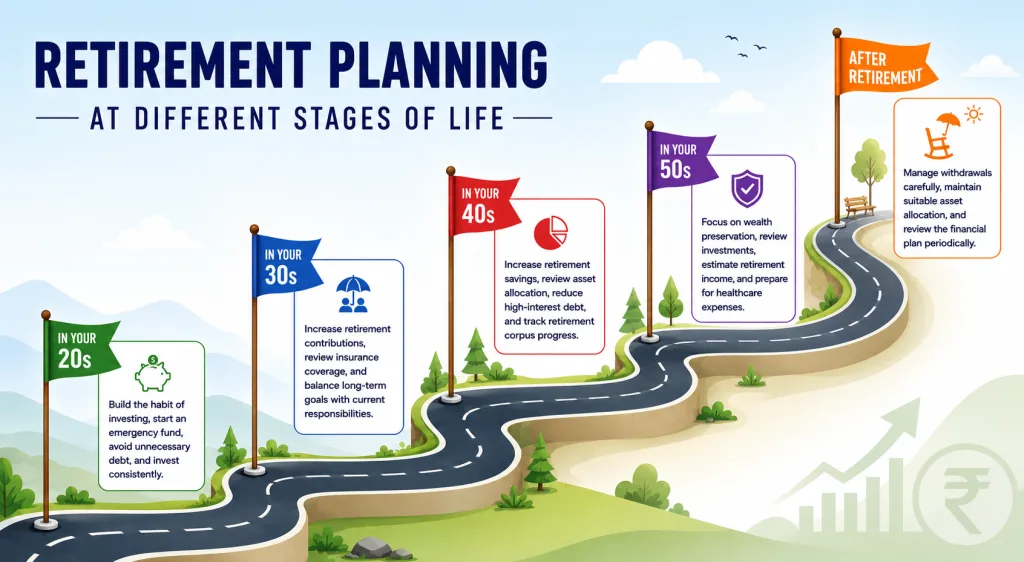
If you are in your twenties, you have the advantage of time and can gradually build your retirement savings. In your thirties, you can increase your investments as your income grows. In your forties and fifties, retirement planning becomes more focused on increasing your savings, reducing unnecessary debt, and balancing growth with stability.
However, even if you are starting late, it is never too late to begin. A disciplined investment approach can still help improve your financial security.
How Much Retirement Corpus Do You Need?
A retirement corpus is the total amount of money you need to support yourself after retirement. There is no single amount that suits everyone because every person’s lifestyle, expenses, and financial goals are different. Your required retirement corpus depends on your current monthly expenses, expected inflation, retirement age, life expectancy, and the returns you expect from your investments after retirement.
Suppose your current monthly expenses are ₹50,000 and you plan to retire after 25 years. Due to inflation, your monthly expenses at retirement could be much higher than they are today. You must also consider how many years you expect to live after retirement. These factors help estimate the amount of money required to maintain your lifestyle.
Retirement calculators can simplify this process by accounting for inflation, expected returns, and the number of years you plan to remain retired. Reviewing these calculations every few years ensures your retirement goal remains realistic.
Step-by-Step Retirement Planning Strategy
A successful retirement strategy is built gradually over time. Instead of focusing only on saving money, it involves creating a structured financial plan that adapts as your life and income change.
Step 1: Decide Your Retirement Age
Begin by deciding when you would like to retire. Your retirement age influences how many years you have to build your retirement corpus and how long your savings may need to last.
Step 2: Estimate Your Future Expenses
Calculate your current monthly expenses and consider how they may change in the future due to inflation, lifestyle choices, and healthcare needs. This helps you estimate the income you may require after retirement.
Step 3: Calculate Your Retirement Corpus
Once you know your expected expenses, estimate the total retirement corpus required to support those expenses throughout your retirement years. Reviewing this estimate periodically helps keep your retirement goals realistic.
Step 4: Choose Suitable Investments
Select investment options that match your age, financial goals, and risk tolerance. Younger investors often have a longer investment horizon and may choose growth-oriented investments, while those approaching retirement may gradually shift towards relatively stable investment options.
Step 5: Invest Regularly
Building a retirement corpus requires consistency. Investing regularly, whether monthly or quarterly, helps you stay disciplined and benefit from long-term wealth creation.

Step 6: Review Your Retirement Plan Every Year
Your income, expenses, financial goals, and market conditions may change over time. Reviewing your retirement plan annually allows you to adjust your investment strategy and remain aligned with your retirement goals.
Best Investment Options for Retirement in India
Choosing the right investments is one of the most important parts of retirement planning. Every investment option offers a different balance of risk, return, liquidity, and tax benefits. The following table compares some of the most commonly used retirement investment options in India:
| Investment Option | Risk Level | Return Potential | Liquidity | Suitable For |
|---|---|---|---|---|
| Employees’ Provident Fund (EPF) | Low | Moderate | Limited withdrawals | Salaried employees building long-term retirement savings |
| Public Provident Fund (PPF) | Low | Moderate | 15-year lock-in | Conservative investors looking for stable, long-term growth |
| National Pension System (NPS) | Moderate | Market-linked | Primarily available at retirement | Investors looking for a dedicated retirement product |
| Equity Mutual Funds | Moderate to High | High over the long term | High | Long-term wealth creation through market participation |
| Index Funds | Moderate | Market-linked | High | Passive investors seeking broad market exposure |
| Debt Mutual Funds | Low to Moderate | Moderate | High | Investors looking for stability and lower volatility |
| Fixed Deposits (FDs) | Low | Fixed | Depends on tenure | Capital preservation and predictable returns |
Common Retirement Planning Mistakes
Even people who save regularly can make mistakes that affect their retirement goals. Recognising these common mistakes can help you make better financial decisions.
Starting Too Late
One of the biggest mistakes is delaying retirement planning. The later you start, the less time your investments have to grow through compounding. Starting early allows even modest investments to build a larger retirement corpus over time.
Ignoring Inflation
Many people estimate their retirement needs based on today’s expenses without considering inflation. Since the cost of living generally increases over time, ignoring inflation may result in a retirement corpus that falls short of future needs.
Depending on a Single Investment
Relying only on EPF, fixed deposits, or any one investment option may limit your ability to build long-term wealth. A diversified portfolio can help balance growth opportunities and risk.
Underestimating Healthcare Costs
Healthcare expenses often rise with age. Failing to plan for these costs can reduce your retirement savings significantly. Including health insurance and medical expenses in your retirement plan is important.
Not Reviewing Your Retirement Plan
Retirement planning is an ongoing process. Salary increases, career changes, financial goals, and market conditions change over time. Reviewing your plan regularly helps ensure that you remain on track.
Retirement Planning at Different Stages of Life
Retirement Planning vs. Pension Plans
Although the two terms are often used interchangeably, they are not the same.
| Retirement Planning | Pension Plan |
|---|---|
| A complete financial strategy for life after retirement. | A financial product designed to provide retirement income. |
| Includes goal setting, savings, investing, insurance, tax planning, and portfolio reviews. | Focuses primarily on generating income after retirement. |
| May include mutual funds, EPF, PPF, NPS, fixed-income investments, and other assets. | Forms one part of an overall retirement strategy. |
| Helps create and manage your retirement corpus. | Helps provide income from the accumulated corpus. |
Tools That Can Help You Plan Your Retirement
- A retirement calculator estimates the retirement corpus you may need based on your age, expenses, expected inflation, and retirement period.
- A SIP calculator helps estimate how much you may need to invest regularly to achieve your retirement goal.
- An inflation calculator demonstrates how the purchasing power of money changes over time, highlighting why long-term investing is important.
Reviewing these calculations periodically helps you stay aligned with your retirement objectives.
Conclusion
Starting early gives your investments more time to grow, but it is never too late to begin. By estimating your retirement corpus, choosing suitable investment options, investing consistently, and reviewing your strategy regularly, you can work towards a financially secure retirement.
Rather than viewing retirement planning as a one-time task, think of it as an ongoing financial journey. The decisions you make today can have a lasting impact on your financial well-being in the years to come.
To know more about the importance of Retirement Planning you can watch the video below:
FAQs
1. Is NPS enough for retirement?
The National Pension System (NPS) is an effective retirement savings option, but it may not be sufficient on its own. Since retirement planning involves managing inflation, healthcare costs, and lifestyle expenses over several decades, you should combine NPS with EPF, PPF, mutual funds, and other investments to build a larger and more diversified retirement corpus.
2. Can mutual funds help in retirement planning?
Yes. Mutual funds, especially equity mutual funds, play an important role in retirement planning because they have the potential to generate long-term wealth. Investing regularly through SIPs for disciplined investing and get benefitted from compounding over time.
3. Which retirement plan is best in India?
Depending on your age, income, financial goals, and risk appetite, you should build a diversified retirement portfolio by combining EPF, PPF, NPS, mutual funds, and fixed-income investments rather than relying on a single product.
4. How do I calculate my retirement corpus?
To calculate your retirement corpus, estimate your current monthly expenses, expected retirement age, life expectancy, expected inflation, and the returns you expect from your investments. These factors help determine how much money you may need after retirement. Use a retirement calculator to simplify this process.