
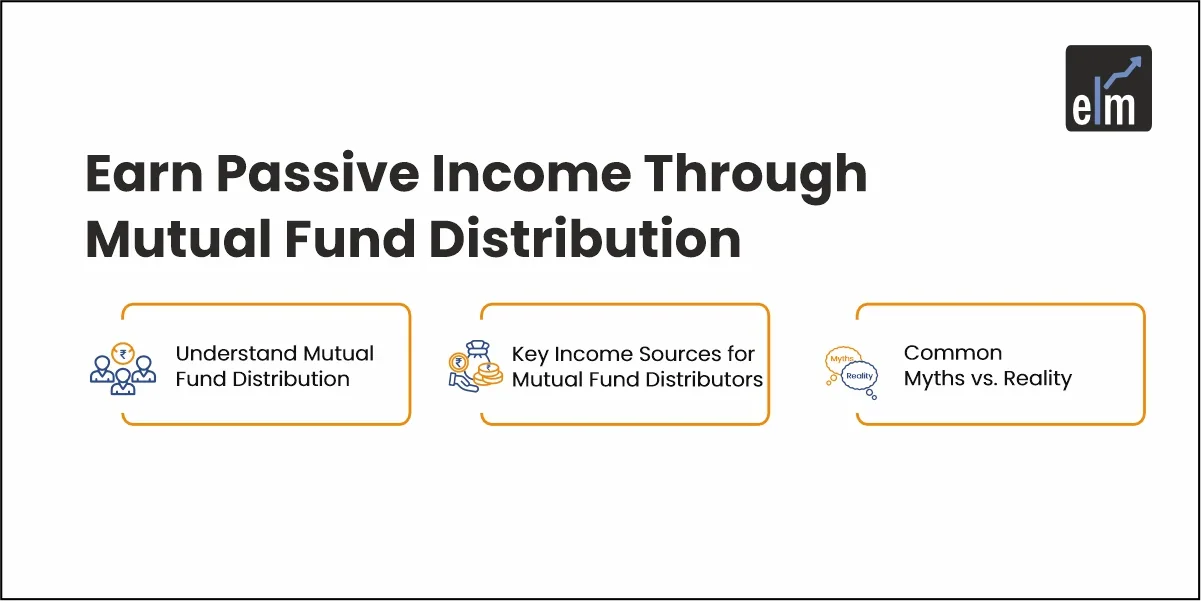

Building passive income is a goal many professionals, entrepreneurs, and finance enthusiasts aspire to. While traditional options like rental income or dividends are well known, becoming a mutual fund distributor has emerged as a powerful and scalable way to generate long-term, recurring income. With rising financial awareness and increasing participation in the markets, a mutual fund distributor today is uniquely positioned to benefit from this growing ecosystem. In this article, I’ll walk you through how the profession works, why it offers passive income potential, and how you can build a sustainable income stream over time.
Understanding Mutual Fund Distribution
What Is Mutual Fund Distribution?
Mutual fund distribution is the process of helping investors choose, invest in, and manage mutual fund portfolios. A mutual fund distributor (MFD) acts as a bridge between Asset Management Companies (AMCs) and investors, guiding clients based on their financial goals, risk appetite, and time horizon.
Distributors are compensated through commissions paid by AMCs. Because these commissions are built into the expense ratio of the “Regular” plans of mutual funds, the distributor provides a service that is remunerated by the fund house rather than through direct out-of-pocket fees from the investor.
Who Can Become a Mutual Fund Distributor?
Almost anyone with an interest in finance can become a mutual fund distributor. You don’t need a finance degree, but you must fulfill these regulatory requirements:
- NISM Certification: Pass the mandatory NISM Series V-A: Mutual Fund Distributors Certification Examination.
- AMFI Registration: Apply for an ARN (AMFI Registration Number). This is your legal license to practice.
- KYD Compliance: Complete the “Know Your Distributor” (KYD) process.
Why Mutual Fund Distribution Is Ideal for Passive Income
The Power of Trail Commissions
The primary reason mutual fund distribution qualifies as a passive income source is the trail commission model. Trail commission is the ongoing fee a distributor earns as long as the investor’s money remains invested in the fund. Unlike one-time sales commissions, trail income:
- Accumulates Daily: It is calculated as a percentage of the total Assets Under Management (AUM) you handle.
- Grows with the Market: As the Net Asset Value (NAV) of the funds grows, your commission grows proportionally, even without new investments.
- Compounding Effect: Over time, as SIPs accumulate and market values rise, the income stream snowballs.
Long-Term Nature of Investments
Mutual funds are designed for long-term wealth creation. Investors typically stay invested for 5–10 years or more, especially through Systematic Investment Plans (SIPs). This long holding period ensures a consistent, predictable commission flow.
Key Income Sources for Mutual Fund Distributors
1. Trail Commission
It is important to note that Upfront Commissions were banned by SEBI in 2018. Today, the industry follows a full-trial model. This means your income is directly tied to the retention of your clients. If a client stays invested for 10 years, you get paid every month for those 10 years.

2. Client Referrals
Satisfied investors often refer to family and friends. This “viral” growth allows you to expand your AUM (Assets Under Management) without significant marketing spend, further increasing your passive earnings.
How to Maximize Passive Income
- Focus on SIPs: SIPs create disciplined investing habits for the client and a “salary-like” predictable inflow for the distributor.
- Use Digital Platforms: Modern distribution is no longer paperwork-heavy. Platforms like Rupeezy allow for paperless onboarding, automated goal tracking, and digital transaction links, making the business highly scalable with minimal manual effort.
- Minimize “Churn”: Since income is trail-based, your goal is to keep the investor invested. Frequent switching of funds (churning) is discouraged by regulators and can hurt your long-term income.
Common Myths vs. Reality
- Myth: “I get paid a big bonus when a client first invests.”
- Reality: You earn nothing upfront. You earn as the client builds wealth over time.
- Myth: “Market falls will kill my income.”
- Reality: While AUM (and thus commission) may dip during a crash, SIPs continue to buy more units at lower prices. When the market recovers, your trail income often jumps significantly higher due to the increased unit count.
Final Thoughts
Mutual fund distribution is not a “get-rich-quick” scheme; it is a “get-rich-slow” business. It requires an initial investment of time to educate clients and build trust. However, once a solid base of AUM is established, it becomes one of the most stable and transparent forms of passive income available in the financial world.
By leveraging platforms like Rupeezy, which provide the necessary tech stack and research support, you can focus on building relationships while the technology handles the back-office operations.