

Key Takeaways
- Cash and Carry Arbitrage: A strategy where traders buy the stock in the spot market and sell it in futures when futures are overpriced, locking in a risk-free profit.
- Reverse Cash and Carry Arbitrage: Used when futures are underpriced. Traders borrow shares (via SLB), sell them in the spot market, and buy the same in futures to earn the price difference.
- Fair Pricing: Futures price is linked to spot price plus the cost of carry, which includes financing, brokerage, taxes, and other charges.
- Market Impact: Arbitrage opportunities are short-lived and help bring spot and futures prices back in balance.
- Trader Advantage: Requires quick execution, but when done right, offers almost risk-free returns.
Table of Contents
Imagine you’re at a bustling street market (or, you know, scrolling through your favorite trading app).
You see a banana being sold for $1 today. But wait, across the street, a sign says “Banana for future delivery (next month): $1.50!” And you know that factoring in your storage costs, that banana should really only be $1.20 next month. Your brain cells start firing: “Aha! An opportunity!”
This isn’t just about bananas, folks.
Welcome to the exhilarating (and surprisingly straightforward) world of Cash and Carry Arbitrage – a strategy that’s all about spotting those little financial “glitches in the Matrix” where an asset’s future price gets a bit ahead of itself.
It’s like finding a twenty-dollar bill on the sidewalk of the stock market – quick, grab it before someone else does!
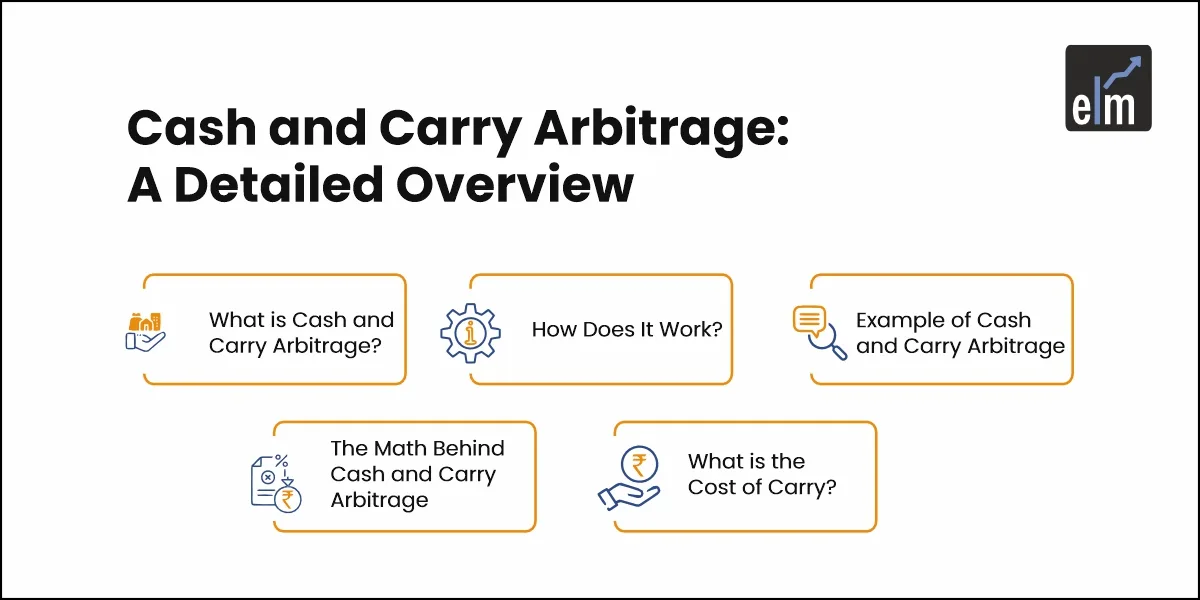
What is Cash and Carry Arbitrage?
Let’s talk brass tacks. At its core, Cash and Carry Arbitrage is a game of simultaneous moves. You’re looking for those golden moments when an asset’s future price is trading higher than its fair future price. When this happens, savvy traders don’t just sit there; they jump into action.
Picture this:
- You buy the underlying asset right now in the spot (cash) market. Think of it as grabbing that actual banana.
- At the exact same time, you sell a futures contract for that same asset, locking in that comparatively higher future price. This is like selling a promise to deliver that banana next month at $1.50.
The genius? You’ve essentially created a risk-free profit from the discrepancy between the current price, your costs to hold it, and the slightly inflated future price. The sources illustrate this with an example using SBI, where the spot price is ₹561.70, and a single lot consists of 1500 quantities.
The Math Behind Cash and Carry Arbitrage
Alright, time to roll up our sleeves and get into the nitty-gritty, because even in the world of financial magic, there’s always a formula. The secret sauce to knowing if a future price is truly “inflated” lies in calculating its Fair Future Price.
Think of it like this: If you buy something today and plan to sell it later, you’ve got to account for the cost of holding it. In finance, we call this the “Cost of Carry“.
The formula is elegantly simple: Fair Future Price = Spot Price + Cost of Carry
What goes into this “Cost of Carry”? While in the real world it can be a whole laundry list – transaction costs, brokerage, government taxes, stamp duty – our sources simplify it to primarily focus on the financing cost. If you buy shares in the cash market, you’re tying up capital, and that capital has an opportunity cost (what it could have earned elsewhere, like in a bank). For commodities, you’d also factor in warehousing charges and insurance.
Let’s revisit our SBI example with a 5% annual financing cost:
- Spot Price (current cash price) of SBI: ₹561.70.
- One lot: 1500 shares.
- Total cash outlay for one lot: ₹842,550 (561.70 * 1500).
- Annual Financing Cost: 5% of ₹842,550 = ₹42,127.50.
- Monthly Financing Cost (Cost of Carry for one month): ₹42,127.50 / 12 = ₹3,508.96.
Now, to get the Cost of Carry per share for one month: ₹3,508.96 / 1500 shares = ₹2.33 per share.
So, the Fair Future Price for a one-month contract (March example from source): ₹561.70 (Spot) + ₹2.33 (Cost of Carry per share) = ₹564.03.
If the actual March future price was, say, ₹563.30, that’s less than our fair price, so no Cash and Carry arbitrage there. However, for April, the Fair Future Price was calculated at ₹566.37, and the actual April future price was ₹566.50. Aha! A tiny difference, but enough for an arbitrageur to pounce, as the actual future price is slightly more than the fair price. Similarly for May, the fair future price was calculated as ₹568.716, but the actual May future price was ₹567.15.
What is the Cost of Carry?
Think of the “carry” as the rent you pay for holding an asset until you can sell it. With equities, it’s primarily the opportunity cost of tied-up funds. With commodities, it expands to warehousing, insurance, and handling. Even transaction charges and brokerage fall into this bucket.
When the stars (or rather, the prices) align and the Future Price > Fair Future Price, this is your cue for a Cash and Carry Arbitrage.
Here’s the game plan:
- Buy in Cash: You immediately buy 1500 quantities of SBI in the cash market at ₹561.70. You’ve now got the physical (or digital) shares.
- Sell Futures: Simultaneously, you sell the April futures contract for SBI at ₹566.50. You’ve essentially promised to deliver these shares on a future date at that pre-agreed price.
Your profit is the difference between the future selling price and your total cost (spot price + cost of carry). The source notes that as more people execute this strategy, the spot price of SBI will tend to rise, and the future price will tend to fall, closing the arbitrage gap. It’s a race against time and other smart traders!
Enter the “Reverse Cash and Carry Arbitrage”: The Upside Down World
What if the market decides to be a bit contrarian? What if the Future Price is less than the Fair Future Price? This isn’t a glitch; it’s a different kind of opportunity called Reverse Cash and Carry Arbitrage. It’s like finding a banana selling for $1 today, but the future contract is only $0.80, when you know it should be at least $1.20!
Our sources illustrate this scenario with the May futures contract for SBI. The Fair Future Price for May was calculated at ₹568.716, but the actual May future price was ₹567.15. Here, the future price is noticeably lower than its fair value.
So, how do you profit when the future looks undervalued? You go “reverse”:
- Sell in Cash (with a twist): You sell 1500 quantities of SBI in the cash market at ₹561.70. “Wait,” you might ask, “how can I sell something I don’t own?” Excellent question! This is where Securities Lending and Borrowing (SLB) comes in. You borrow the 1500 shares from someone who owns them, deliver them to the buyer, and pocket the cash (₹8.42 lakhs).
- Invest the Proceeds: You then invest those ₹8.42 lakhs in a bank Fixed Deposit (FD) for three months, earning interest.
- Buy Futures: At the same time, you buy the three-month (May) futures contract for SBI at ₹567.15. This is your promise to receive shares in the future.
When the May futures contract expires, you take delivery of the shares from your futures contract. You then use these shares to return the borrowed shares to their original owner. Your profit comes from the difference between the interest earned on your FD and the net cost of the futures trade.
Just like its “Cash and Carry” cousin, as more traders execute this “Reverse” strategy, the spot price will decrease, and the future price will increase, again bringing the market back to equilibrium.
When to Use This Strategy
Cash and Carry Arbitrage shines when:
- Futures are trading noticeably above the fair value.
- Your transaction and borrowing costs are low.
- You have sufficient liquidity to execute trades simultaneously.
Such opportunities typically arise in highly liquid securities or commodities where short-term demand-supply mismatches push futures higher than their logical price.
Risks and When to Avoid (Market Dynamics & Why It’s Tricky)
If these arbitrage opportunities sound like a license to print money, you’re not wrong… in theory. However, in today’s hyper-efficient markets, these “glitches” are fleeting and often razor-thin.
Exchanges like NISM actively work to ensure that price differences between cash and futures markets (after accounting for all costs like financing, transaction fees, etc.) are minimal.
This is precisely so that traders can’t easily make risk-free profits from simple price disparities. The very act of arbitrageurs exploiting these differences helps bring prices back into alignment, closing the window of opportunity for others.
Though often described as “risk-free,” arbitrage isn’t without its practical hurdles:
- Margins are razor-thin and vanish quickly.
- Transaction costs (brokerage, STT, taxes) can erase gains.
- Execution delays may result in one leg of the trade missing its price.
- Competition from faster, better-equipped traders closes the gap almost instantly.
So, while the concept of Cash and Carry and Reverse Cash and Carry Arbitrage is powerful for understanding market mechanics and identifying potential mispricings, actually executing them for significant, consistent profits requires speed, sophisticated tools, and often, substantial capital to make those tiny differences worthwhile.

It’s less about finding a treasure map and more about being the first one to spot a penny before anyone else does!
Final Thoughts
And there you have it, the fascinating world of arbitrage, where financial anomalies become profit opportunities. Whether it’s Cash and Carry Arbitrage (when future price > fair future price, so you buy spot and sell futures) or Reverse Cash and Carry Arbitrage (when future price < fair future price, leading you to sell spot via lending and buy futures), these strategies highlight the constant dance of prices in the market.
Frequently Asked Questions (FAQs)
Is Cash and Carry Arbitrage risk-free?
Theoretically yes, but in practice transaction fees, liquidity issues, and execution risks mean it’s never 100% free of risk.
Can retail investors use Cash and Carry Arbitrage?
Yes, but only with adequate capital and very low costs. Otherwise, the spread may not justify the effort.
What is the difference between Cash and Carry Arbitrage and Reverse Cash and Carry Arbitrage?
In Cash and Carry, traders buy in spot and sell futures when futures are overpriced. In Reverse Cash and Carry, they borrow shares, sell in spot, and buy futures when futures are underpriced.
Which markets are best for Cash and Carry Arbitrage?
Highly liquid equities and commodities, where volume and volatility create temporary inefficiencies between spot and futures prices.