

A sudden layoff can disrupt a person’s finances even when they have been earning a steady salary for years. Rent, home loan EMIs, groceries, and insurance premiums continue to demand attention, even after the monthly paycheck stops.
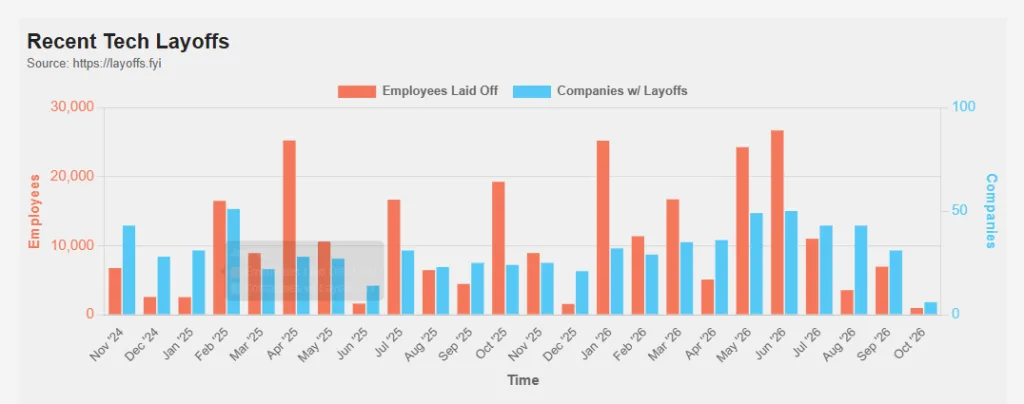
As per layoffs. fyi, recent tech layoffs as of 9th October are 131,687 tech employees and 318 tech companies.
An emergency fund helps you manage this uncertainty by covering essential expenses while you look for another job or deal with an unexpected bill. The commonly recommended target is three to six months of essential expenses, but the amount you need depends on your income stability, financial commitments, and dependants.
In this blog, we will discuss why an emergency fund in India matters, how much emergency fund you need, how to build it, and where to keep the money so it remains safe and accessible when you need it.
What Is an Emergency Fund?
It is money you set aside to cover unexpected expenses, such as a medical bill, sudden job loss, or urgent home or vehicle repair. It helps you manage these situations without taking a high-interest loan or selling your investments at an unfavourable time.
Unlike savings for a holiday or a new phone, it is reserved for genuine financial emergencies and should be kept somewhere you can access it when needed.
Why Do We Need an Emergency Fund?
- To manage job loss: Finding a new job can take time, but rent, EMIs, and other essential expenses continue even when your salary stops.
- To cover medical expenses: Your health insurance may not cover every treatment or expense, leaving you to pay some costs out of pocket.
- To handle unexpected expenses: Urgent repairs, family emergencies, or sudden travel can disrupt your monthly budget if you do not have savings set aside.
- To avoid high-interest debt: Having money available can reduce the need to rely on credit cards or personal loans during a financial emergency.
- To protect your long-term investments: You can avoid withdrawing money from investments at an unfavourable time or interrupting savings meant for goals such as retirement or buying a house.
How to Calculate Your Emergency Fund
To work out how much emergency fund you need, start with these simple steps:
- Add up your essential monthly expenses: Include rent or home loan EMIs, groceries, utilities, insurance premiums, school fees, and minimum debt payments. Exclude discretionary expenses such as dining out, shopping, and entertainment.
- Calculate your target amount: Multiply your total essential monthly expenses by three to six months to estimate how much you need to save.
- Adjust based on your needs: Consider your income stability, dependants, and financial commitments. If your income is irregular, aim for a larger buffer to cover a longer period without earnings.
For example: If your essential monthly expenses are ₹30,000, your calculation would be:

- Monthly essential expenses: ₹30,000
- For 3 months: ₹30,000 × 3 = ₹90,000
- For 6 months: ₹30,000 × 6 = ₹1,80,000
Therefore, your target would be ₹90,000 to ₹1,80,000, depending on your financial circumstances. You can also run the numbers through an emergency fund calculator to double-check your target.
How to Actually Build It
Building this safety net is easier when you treat it as a regular financial commitment rather than saving whatever is left at the end of the month. Build it with these three habits:
- Automate your savings: Set up a fixed transfer to a separate account as soon as your salary or income arrives. Start with an amount you can comfortably afford, such as ₹5,000 or ₹10,000 a month, and increase it as your income grows.
- Put extra income to use: Direct bonuses, tax refunds, or additional freelance earnings towards the fund instead of absorbing them into regular spending.
- Keep the fund separate: Use an account dedicated to emergencies rather than your everyday spending account. This helps reduce the temptation to dip into the money for routine expenses.
Where to Keep Your Emergency Fund
Now, the main question is where to save it. There are three common options.
Liquid Funds: For Short-Term Parking
- How they work: Liquid funds invest in short-term debt and money market instruments, making them an option for parking money you may need at short notice.
- Access to money: Some fund houses offer instant redemption, subject to scheme eligibility and limits. Under the commonly applicable instant redemption facility, the amount is capped at the lower of ₹50,000 or 90% of the eligible investment per day. Other redemptions typically settle on the next business day, subject to applicable rules and cut-off timings.
- Taxation: Gains from specified debt-oriented mutual funds acquired on or after 1 April 2023 are generally taxed at the investor’s applicable income tax slab rate under Section 50AA, subject to the relevant conditions.
- Exit load: Some liquid funds charge an exit load for redemptions during the first seven days. Check the scheme’s terms before investing.
- What to check: Before choosing among liquid funds, check the fund’s portfolio quality, expense ratio, exit load, redemption timelines and eligibility for instant redemption.
Sweep-In FD: For Automatic Savings
- How they work: A sweep-in FD links your savings account to a fixed deposit. When your balance exceeds a specified threshold, the surplus is transferred into an FD, according to your bank’s rules.
- Access to money: If your savings account balance falls short, the bank can automatically break the required portion of the FD to cover the shortfall.
- Interest implications: Depending on the bank’s terms, the interest earned on the withdrawn portion may be affected, while the remaining deposit continues earning interest.
- What to check: Sweep thresholds, deposit units, interest rates, premature withdrawal rules, and minimum balance requirements vary by bank. Review the terms of your specific account before setting up the facility.
High-Interest Savings Accounts: For Easy Access
- How they work: Some small finance banks and other banks offer higher savings account interest rates than many traditional savings accounts.
- Access to money: Funds can generally be accessed through transfers, debit cards, or UPI, without waiting for mutual fund redemption or breaking an FD.
- Interest rates: Rates vary by bank, account balance, and applicable conditions. Check the bank’s current rate and eligibility requirements before opening an account.
- Deposit safety: Eligible deposits at insured banks are covered by DICGC insurance up to ₹5 lakh per depositor per bank, including principal and interest, subject to the applicable rules.
- What to consider: Compare the interest rate, withdrawal limits, minimum balance requirements, digital banking facilities, and deposit insurance coverage before choosing an account.
Common Mistakes People Make With Their Emergency Fund
- Investing in equity: Keeping it in stocks or equity mutual funds defeats its purpose. Markets can fall unexpectedly, and you may be forced to sell your investments at a loss when an emergency arises.
- Using it for planned expenses: Avoid dipping into it for planned expenses such as vacations, weddings, or a new phone. These should be covered by separate savings so that the money remains available for genuine financial emergencies.
- Not replenishing the fund after use: Using it for a genuine emergency is exactly what it is meant for. However, once your financial situation stabilizes, start rebuilding the amount you have withdrawn to ensure you are prepared for the next unexpected expense.
Conclusion
The size of your emergency fund is a personal number, built from your own expenses and your own income stability, not a rule copied from a blog post. An emergency fund calculator can help you reach that number faster. Where you park it matters almost as much as how much you save, since the wrong choice can mean either losing access when you need it most or losing more to tax and low returns than necessary. Get both right, and the fund does the one job it exists for: sitting quietly, doing nothing, until the day it has to.
FAQs
1. Is a fixed deposit a good place to keep an emergency fund?
Yes. A sweep-in FD offers easy access to funds while earning FD interest. Regular FDs may involve penalties or delays for premature withdrawal.
2. Should I invest this money in mutual funds?
Liquid funds can be an option for short-term parking, but they carry some risk. Avoid equity and hybrid funds, as market fluctuations can reduce your savings when you need them.
3. How is an emergency fund different from a sinking fund?
It covers unexpected expenses, such as medical bills or job loss. A sinking fund covers planned expenses, such as vacations or annual insurance premiums.
4. Can I use this money for planned expenses?
It is best to avoid this. Set aside money separately for planned expenses so the money remains available for genuine emergencies.