

Key Takeaways
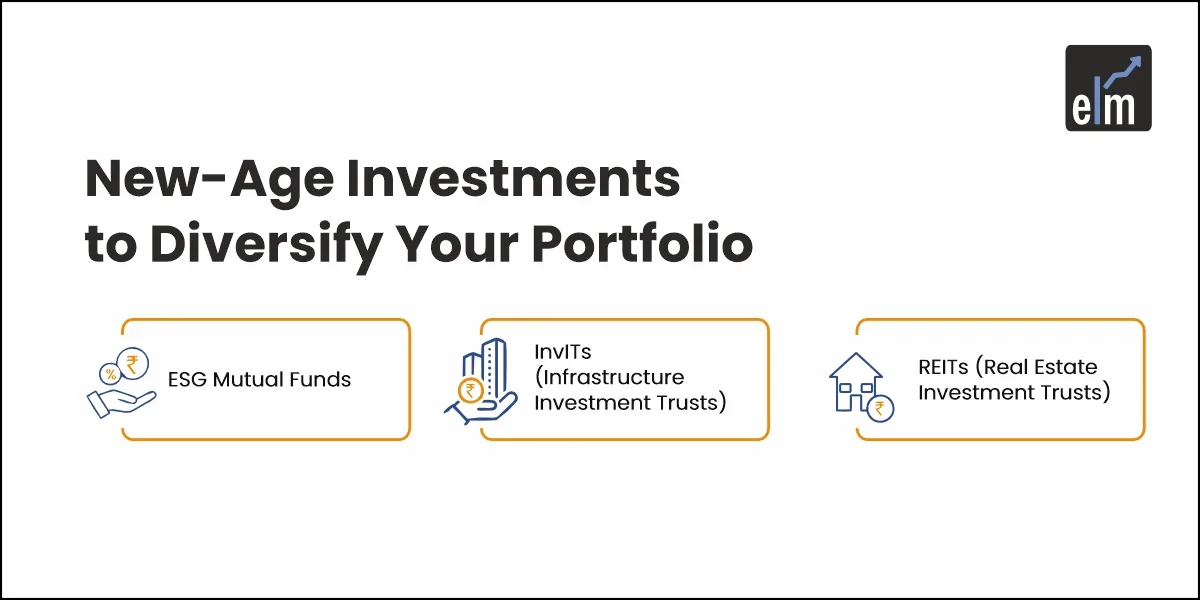
- New Age Investment Options: ESG mutual funds, InvITs, and REITs are alternative asset classes that add diversification, income visibility, and professional management beyond traditional equity and debt.
- ESG Mutual Funds: Focus on companies with strong environmental, social, and governance practices, but in India, the category is still evolving with limited history and standardisation.
- InvITs: Provide exposure to revenue-generating infrastructure assets with relatively stable cash flows, though they remain sensitive to interest rates, regulation, and liquidity.
- REITs: Offer affordable access to premium commercial real estate with steady rental income and potential capital appreciation, without owning physical property.
- Portfolio Role: These options work best as complements rather than core holdings, typically suited for a 5–10% allocation after building a strong equity and debt base.
There was a time when investing meant choosing between stocks, bonds, and maybe a fixed deposit if you were feeling adventurous. Those days are as outdated as flip phones.
Here’s something that’ll grab your attention: Global ESG mutual fund flows skyrocketed from $27 billion in 2016 to over $150 billion in 2019. That’s a 455% jump in just three years. And that’s only one corner of the new age investment pie that’s quietly reshaping portfolios across the world.
The investing world has changed. Returns still matter, of course, but today’s investors are also thinking about diversification, predictable income, and whether their money reflects the values they care about.
Read: Time-Saving Investment Strategies for Working Professionals
Let me break down three new age investment options that are genuinely changing how people build portfolios.
1. ESG Mutual Funds: Investing with a Conscience
ESG stands for Environmental, Social, and Governance. In simple terms, it’s a way of evaluating companies beyond just profits. Think of it as a report card that checks how responsibly a company treats the environment, its employees, and its shareholders, not just how much money it makes.
Why ESG is Getting Popular Now?
For a long time, profitability and sustainability were seen as opposites. Either a company made money, or it “did the right thing.” That line of thinking is fading fast. Climate risks now impact balance sheets. Governance failures can wipe out shareholder value overnight. And companies that ignore social responsibility often pay for it through regulation, reputational damage, or loss of consumer trust.
Investors aren’t ignoring returns, they’re just recognising that responsible businesses tend to be more resilient over the long run.
These funds evaluate companies using sophisticated scoring systems. Organizations like MSCI, Sustainalytics, and Morningstar rate companies on a scale based on how well they manage ESG risks.

The three pillars are:
Environmental (E): Carbon footprint, waste management, energy conservation. Is this company treating Mother Earth decently?
Social (S): Employee welfare, gender equality, pay parity. Are they good corporate citizens?
Governance (G): Board structure, ethical conduct, transparency. Can we trust these folks?
Here’s the interesting bit, research shows that companies with higher ESG scores often experience lower cost of capital and stronger long-term stock performance. Good ethics can actually mean good business. ESG investing in India is still maturing. The investable universe is limited, especially in mid and small-cap segments. SEBI issued disclosure norms for the top 1,000 listed companies in 2021, but we’re years away from standardized frameworks.
There’s also the risk of “greenwashing”. Companies appear environmentally friendly without substantial action.
Should You Invest?
Watch and wait. Let the category mature. ESG mutual funds can be meaningful once there’s more track record and clearer guidelines. For now, consider them as a future diversification option.
InvITs: Own a Piece of India’s Highways and Grids
Ever wanted to own a toll highway or a transmission line? InvITs let you do the next best thing. Buy listed units that own revenue-generating infrastructure.
What are InvITs?
Think of an InvIT as a mutual fund for infrastructure. Sponsors pool capital, buy completed projects (highways, power transmission, renewables) that are already earning money, and list units on the exchange. By regulation, most of the cash these assets generate must be passed to investors; that’s what makes them attractive for income.
How They Work
- A sponsor sets up the InvIT.
- Investors buy listed units on the exchange.
- The trust holds operational projects (typically a high share must be income-producing assets).
- Projects collect cash (tolls, transmission fees, power sale revenues).
- After running costs, the majority of cash flow is distributed to unit-holders, and often a large portion is paid out.
Many listed InvITs have historically offered distribution yields in the high single digits to low double digits (your 8-12% figure is a useful benchmark), which beats typical bank FDs, plus there’s room for capital gains if the assets appreciate.
What to Keep in Mind?
Interest-rate sensitivity: When rates climb, InvIT prices often fall. Borrowing costs for projects rise, and valuations get hit.
Concentration risk: A single InvIT might lean heavily on a few projects or one region, so one problem can hurt distributions.
Regulatory/policy risk: Changes in government rules, tariffs, or contracts can materially affect cash flows.
Liquidity risk: Many InvITs don’t trade heavily. Selling quickly at the price you want can be tough.
Who Should Consider InvITs?
Income-seekers who want regular distributions and are okay with some market and interest-rate volatility.
Investors looking to diversify into a different asset class, infrastructure behaves differently from equities and bonds.
Long-term investors who can tolerate occasional price swings and hold through rate cycles.
Not ideal for short-term traders or anyone who needs quick, guaranteed liquidity.
Who Should Invest?
This investment option suits income seekers and retirees wanting steady 8-12% payouts, or diversifiers with strong equity/debt portfolios. They’re not for people in the wealth accumulation phase needing growth.
3. REITs: Your Share of Commercial Real Estate
Owning commercial property in Mumbai or Bangalore requires serious capital. But Real Estate Investment Trusts let you own a slice of premium properties with just a few thousand rupees.
What Are REITs?
These are mutual funds for real estate. They operate income-generating commercial properties, office buildings, and shopping malls. India has five listed REITs. Four focus on offices, and one (Nexus Select Trust) operates malls. Embassy REIT, launched in 2017, remains the largest.
Why REITs Are Popular Now?
SEBI recently reclassified REIT as equity instruments. Previously, mutual funds could allocate only 10% to REITs. Now they’re treated as equity, meaning funds can invest significantly more. REITs can also enter index funds and major benchmarks. That means massive institutional demand is coming.
Post-COVID, this investment option has surged. Work-from-home is fading, office demand is recovering, and occupancy rates have climbed to 85-95%.
Embassy REIT: 87% occupancy, 5.6% dividend yield.
Mindspace REIT: 84% occupancy, 5.9% yield.
Brookfield India REIT: 88% occupancy, 6.7% yield.
Nexus Select (Mall): 97% occupancy, 5.4% yield.
Not bad for an asset class offering capital appreciation potential, too.
What to Look For?
Occupancy rates: Above 85% is healthy.
Rental yields: Premium locations command higher rates.
Debt levels: Lower debt means more distribution stability.
Lease duration: Longer leases (7-8 years) mean predictable income.
NAV vs. Market Price: Trading at a discount or premium?
Distributions are taxed based on nature dividend at slab rate, interest at slab rate, and capital repayment is tax-free until you recover the cost.
Capital gains: 20% short-term (under 12 months), 12.5% long-term (over 12 months) beyond ₹1.25 lakh exemption.
Should You Buy REITs?
REITs let you own a slice of commercial real estate without the usual headaches. No late-night tenant calls, no surprise maintenance bills, and no liquidity drama that comes with holding physical property. They’re professionally managed, regulated by SEBI, and add a useful layer of diversification. The steady 5-7% dividend yields are attractive, and you still get exposure to property appreciation.
My take? Treat REITs as a diversification tool, think 5-10% of your portfolio, not the centrepiece.
Bringing It Together
These “new age” options aren’t replacements for your core equity and debt holdings. They’re complements. Picture your portfolio as a balanced thali: roti and dal are your equities, and debt is essential. Adding paneer and raita makes the plate complete.
A practical allocation guide
• ESG mutual funds — wait for them to mature; consider 5-10% in a couple of years.
• InvITs — good for income-focused investors; 5-10% if you want regular distributions.
• REITs — most accessible of the three; 5-10% for real-estate exposure.
Final Thoughts
Markets evolve, and so should portfolios. These newer options offer diversification and professional management that wasn’t widely available a decade ago. But don’t rush in; make sure you’ve covered the basics first. Know your goals and how much risk you can stomach. Keep an emergency fund and insurance in place. Build a solid core of equity and debt.
Only then, sprinkle in alternatives for that extra edge.
There’s no single magic product. The goal is a portfolio that’s diversified, resilient, and actually aligned with what you want from money, not just what’s trending.
Also Read: 8 Strategies to Reduce Investment Risks
Frequently Asked Questions (FAQs)
1. Are new-age investments safe for retail investors?
New-age investments like ESG funds, InvITs, and REITs are regulated by SEBI, which adds a layer of safety for retail investors. However, “safe” doesn’t mean risk-free.
2. Do InvITs and REITs provide regular income?
Yes, both InvITs and REITs are designed to provide regular income. As per SEBI rules, they must distribute at least 90% of their net distributable cash flows to unit holders. This comes from toll collections, lease rentals, or transmission fees.
3. How are InvITs and REITs different from mutual funds?
Mutual funds invest in stocks or bonds, aiming mainly for capital appreciation. On the other hand, the mentioned investment options own physical, income-generating assets like highways, power grids, offices, and malls. They focus more on cash-flow distribution than on frequent trading gains. Unlike mutual funds, InvITs and REITs pass through most of their income to investors, making them more income-oriented than growth-focused.