
Elearnmarkets - Financial Market Learning
  • Courses
  • Webinars
  • Stories
  • Language
    • English
    • Hindi
    • Bengali
No Result
View All Result
Get Free Course
  • Basic Finance
  • Derivatives
    • Futures
    • Options
  • Financial Planning
  • Fundamental Analysis
  • Technical Analysis
  • Mutual Funds
  • Marketshala
  • Miscellaneous
Elearnmarkets - Learn Stock Market, trading, investing for Free
  • Courses
  • Webinars
  • Stories
  • Language
    • English
    • Hindi
    • Bengali
No Result
View All Result
Get Free Course
Elearnmarkets - Learn Stock Market, trading, investing for Free
No Result
View All Result
Home Basic Finance
Indexation in mutual funds

Indexation in mutual funds

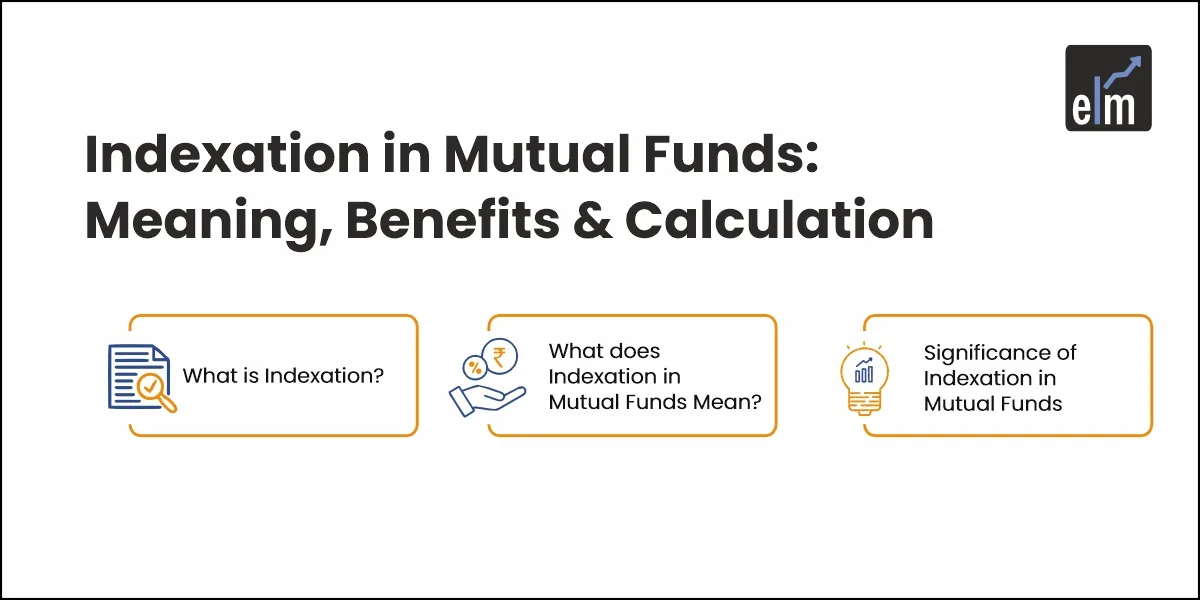
Indexation in Mutual Funds: Meaning, Benefits & Calculation

Vivek Bajaj by Vivek Bajaj
October 28, 2025
in Basic Finance, Mutual Funds
Reading Time: 7 mins read
0
97
VIEWS
Share on FacebookShare on XShare on WhatsApp

Key Takeaways

  • Indexation adjusts for inflation: It increases your investment’s purchase cost using the Cost Inflation Index (CII), ensuring you’re taxed only on real gains, not inflation-driven ones.
  • Indexation in Mutual Funds: Indexation was most beneficial for debt funds held over 3 years, helping reduce taxable capital gains and improving post-tax returns.
  • Changed tax rules: From 23 July 2024, LTCG is taxed at a flat 12.5% without indexation. Older investments (before this date) may still get the 20% with indexation benefit.
  • Timing matters: The benefit depends on when you bought and sold your units. Always check the financial year and the applicable CII before calculating gains.
  • Smart planning: Comparing both tax scenarios — 20% with indexation vs 12.5% without — can help you choose the most tax-efficient exit strategy.

Table Of Contents
  1. Key Takeaways
  2. What is Indexation?
  3. What does Indexation in Mutual Funds Mean?
  4. Significance of Indexation in Mutual Funds
  5. Recent Tax-law Changes
  6. Formula of Indexation
  7. Calculation of Indexation
  8. Benefits of Indexation in Mutual Funds
  9. Tips & Common Mistakes to Avoid
  10. Conclusion
  11. Frequently Asked Questions (FAQs)

Inflation is weird. It pumps up the numbers on your investment statements, but it can also pump up the tax bill, and nobody likes paying tax on money they didn’t really earn. That’s where Indexation comes in.

It adjusts your purchase price for inflation so you’re taxed only on the real profit, not the part that simply kept up with rising prices.

Quick example:

Suppose a toy seller bought a toy for ₹1,000 and sold it later for ₹1,700. Without indexation, the gain is ₹700.

But if inflation moved the cost index from 250 (buy year) to 300 (sell year), the indexed cost becomes 1,000 × (300/250) = 1,200. Now the taxable gain is 1,700 − 1,200 = ₹500. And at 20% tax, that’s ₹100 instead of ₹140. 

What is Indexation?

Indexation adjusts the cost of acquisition of an asset to reflect inflation using the government’s Cost Inflation Index (CII). Instead of taxing you on the straight arithmetic difference between sale price and purchase price, indexation increases the purchase price by the ratio of the CII in the year of sale to the CII in the year of purchase. Thereby taxing only the real gain. The official CII table is published by the Income Tax Department.

What does Indexation in Mutual Funds Mean?

Indexation in Mutual Funds historically mattered most for debt funds (treated as long-term if held more than 36 months) and other non-equity assets. When indexation in mutual funds applies, your Long-Term Capital Gain (LTCG) is:

Indexed Cost = Original Cost × (CII of year of sale / CII of year of purchase)
LTCG (with indexation) = Sale Price − Indexed Cost

That indexed gain is what gets taxed (under the tax regime that applies to your transaction — more on that below). 

Significance of Indexation in Mutual Funds

Indexation in mutual funds can materially reduce the taxable portion of a long-term gain and improve your post-tax returns. This is why debt funds used to be a tax-efficient way to park money for multi-year horizons. But the magnitude of the benefit depends on when you bought the units and when you sell them, because India’s capital-gains rules changed recently (dates matter). 

Recent Tax-law Changes

  • If a long-term capital asset is transferred on or before 22-07-2024, LTCG was taxable at 20% (with indexation where allowed).
  • For transfers on or after 23-07-2024, the Finance (No. 2) Act, 2024 introduced a uniform LTCG rate of 12.5%and removed indexation benefits for transfers on/after that date (with limited grandfathering in some cases). 
  • Separately, investments/units purchased on or after 1-Apr-2023 (especially in many debt funds) are taxed differently. New purchases often face slab-rate taxation or altered treatment, so the classic “20% with indexation after 3 years” benefit may not apply to them. Always map a unit’s purchase date and transfer (sale) date to the correct rule.

Formula of Indexation

Indexed Cost of Acquisition =
Original Purchase Price × (CII of Year of Sale / CII of Year of Purchase)

LTCG (with indexation) =
Sale Proceeds − Indexed Cost of Acquisition

(Use the Income Tax Department’s notified CII table for exact values.)

Calculation of Indexation

Scenario: You bought a debt fund in FY 2019–20 (CII = 289) with ₹5,000 (NAV ₹50 → 100 units). You sold the holding in FY 2022–23 (CII = 331) at NAV ₹200 (sale proceeds = 100 × ₹200 = ₹20,000). (CII values from the official table.)

  1. Original cost = ₹5,000.
  2. Indexed cost = 5,000 × (331 / 289) = 5,000 × 1.145 = ₹5,725 (approx).
  3. Indexed LTCG = 20,000 − 5,725 = ₹14,275.
  4. Tax (under older rules — sale happened before 23-07-2024): taxed at 20% on indexed LTCG (plus cess), so tax ≈ 20% × 14,275 ≈ ₹2,855.

Without indexation, you’d pay tax on the full nominal gain: 20,000 − 5,000 = ₹15,000 → tax 20% × 15,000 = ₹3,000. So indexation saved ₹145 in tax in this specific case, with potential for larger savings over longer holding periods or larger sums.

Important timing note: if the transfer had taken place on/after 23-07-2024, a different rule applies: a flat 12.5% LTCG without indexation may be levied, which can be either better or worse than the older indexed-20% depending on numbers. That’s why mapping dates matters. 

Benefits of Indexation in Mutual Funds

  • Lowers taxable gains by inflating the cost base to match inflation.
  • Rewards long holding periods – the longer you hold, the bigger the indexed cost can become.
  • Makes debt funds relatively tax-efficient (historically), especially versus short-term slab-taxed alternatives.
    But remember: post-2023/2024 rule changes mean the benefit is not universal – check dates before assuming wins. 

Tips & Common Mistakes to Avoid

  • Don’t assume indexation in mutual funds applies automatically. Check the purchase date (FY) and sale date. 
  • Use the FY CII – CII is notified by financial year, not calendar year.
  • Compute per lot if you invested in multiple tranches (SIPs/lumps). Weighted averages can mislead.
  • Run both scenarios (old indexed 20% vs new 12.5% non-indexed) if your sale date sits near the July-2024 cutoff — sometimes the “new” 12.5% is kinder, sometimes not. 
  • When in doubt, consult a CA for large transactions — the interplay of grandfathering, NRIs, joint holdings and property can be messy.

Conclusion

Indexation is a simple concept with potentially meaningful tax value: it helps ensure you’re taxed on real gains, not inflation. But India’s tax rules changed recently, and they are date-sensitive. So before you plan an exit from debt funds, map your buy date, sale date, and run the numbers under both regimes (indexed 20% vs new 12.5% without indexation) to pick the most tax-efficient move.

Frequently Asked Questions (FAQs)

1. Which mutual funds are eligible for indexation?

Traditionally, debt funds and other long-term non-equity assets (and property, gold, etc.) could use indexation in mutual funds for LTCG. Post-April 1, 2023, purchases and transfers from July 23, 2024, are subject to new rules. Check dates for your units.

2. Does indexation apply to short-term capital gains?

No. Indexation in mutual funds is used only for long-term capital gains where the law specifically allows it.

3. Can indexation save money on taxes?

Yes, often. The exact saving depends on the CII movement, holding period, and which tax regime (pre/post the July-2024 change) applies.

4. Is indexation only useful for debt funds?

No, it applies to any long-term capital asset where the law allows indexation (e.g., property, some gold sales). Historically, debt funds benefited the most among mutual funds, but applicability is now date-dependent.
ShareTweetSend
Previous Post

Sharpe Ratio: Meaning, Formula & Example

Next Post

How to Choose the Right Mutual Funds in India to Invest in 2025

Vivek Bajaj

Vivek Bajaj

Mr Vivek Bajaj has over 20 years of experience in Multi-Asset Trading, Momentum Investor and student of Mark Minervini. He is the co-founder of StockEdge and Elearnmarkets and is passionate about data, analytics, and technology. He serves on various exchange committees and has played a significant role in the evolution of India's derivative market. He has been a speaker at various colleges and higher institutions, including IIT and IIMs.

Related Posts

Equity Mutual Funds
Mutual Funds

What are Equity Mutual Funds? Types, Benefits & How They Work

December 5, 2025
14
Systematic Transfer Plan
Mutual Funds

Systematic Transfer Plan: What is STP in Mutual Funds? Benefits, Types & How It Works

November 27, 2025
48
Choose the Right Mutual Funds in India
Mutual Funds

How to Choose the Right Mutual Funds in India to Invest in 2025

November 7, 2025
204
Sharpe Ratio
Basic Finance

Sharpe Ratio: Meaning, Formula & Example

November 3, 2025
740

Leave a Reply Cancel reply

Your email address will not be published. Required fields are marked *

Disclaimer

Elearnmarkets (Kredent InfoEdge Pvt. Ltd.) is a SEBI-registered Research Analyst (RA) entity (SEBI Registration No.: INH300007493). The information provided in this article is for educational and informational purposes only and should not be considered as an offer to buy or sell any securities or investment products.

The stocks, securities, and investment instruments mentioned herein are not recommendations under SEBI (Research Analysts) Regulations, 2014. Readers are advised to conduct their own due diligence and seek independent financial advice before making any investment decisions.

Investments in securities markets are subject to market risks. Please read all related documents carefully before investing. Investing in Equity Shares,
Derivatives, Mutual Funds, or other instruments carry inherent risks, including potential loss of capital. Elearnmarkets (Kredent InfoEdge Pvt. Ltd.) does not provide any guarantee or assurance of returns on any investments. Past performance is not indicative of future performance.

Elearnmarkets Logo

Follow Us

Facebook-f X-twitter Instagram Linkedin-in Youtube Telegram

Register on Elearnmarkets

Continue your financial learning by creating your own account on Elearnmarkets.com

Register Free Account

Download App

Playstore logo
Download on app store

Categories

  • Basic Finance
  • Derivatives
  • Financial Planning
  • Fundamental Analysis
  • Technical Analysis
  • Mutual Funds
  • Miscellaneous

Popular On Elearnmarkets

  • Market Superheroes:
  • Vivek Bajaj
  • Chetan Panchamia
  • Ashish Kyal
  • Premal Parekh
  • Abhijit Paul
  • Jegan
  • Sivakumar Jayachadran
  • Jyoti Budhia
  • Vivek Gadodia
  • Vishal Mehta
  • Piyush Chaudhry
  • Santosh Pasi
  • Gomathi Shankar
  • Market Superheroes:
  • Vivek Bajaj
  • Chetan Panchamia
  • Ashish Kyal
  • Premal Parekh
  • Abhijit Paul
  • Jegan
  • Sivakumar Jayachadran
  • Jyoti Budhia
  • Vivek Gadodia
  • Vishal Mehta
  • Piyush Chaudhry
  • Santosh Pasi
  • Gomathi Shankar
  • Courses:​
  • Options Trading
  • Dow Theory
  • Momentum Trading
  • Stock Investing
  • Harmonic Chart Patterns
  • Algo Trading
  • Elliot Wave Theory
  • Advanced Excel
  • Cryptocurrency
  • NSE Certification Course
  • Courses:​
  • Options Trading
  • Dow Theory
  • Momentum Trading
  • Stock Investing
  • Harmonic Chart Patterns
  • Algo Trading
  • Elliot Wave Theory
  • Advanced Excel
  • Cryptocurrency
  • NSE Certification Course
  • Webinars:
  • Bank Nifty Scalping
  • Intraday Trading Strategies
  • Options Trading Strategies
  • Options selling
  • Price Action
  • Relative Strength
  • Tax Planning
  • Options Buying
  • Growth Stocks
  • Portfolio Management
  • Risk Management
  • Renko Charts
  • Crude Oil
  • Traders Psychology
  • Moving Average
  • Multibagger Stocks
  • Webinars:
  • Bank Nifty Scalping
  • Intraday Trading Strategies
  • Options Trading Strategies
  • Options selling
  • Price Action
  • Relative Strength
  • Tax Planning
  • Options Buying
  • Growth Stocks
  • Portfolio Management
  • Risk Management
  • Renko Charts
  • Crude Oil
  • Traders Psychology
  • Moving Average
  • Multibagger Stocks
  • Free Learning Modules:
  • Intraday Trading
  • Options Scalping
  • Swing Trading
  • Financial Modelling
  • RSI Indicator
  • Bollinger Bands
  • Pricing of Futures
  • Personal Finance
  • Initial Public Offerings (IPO)
  • Value Investing
  • Technical Indicators
  • Candlesticks
  • Chart Patterns
  • Option Greeks
  • ELSS Funds
  • Banking and Insurance
  • Real Estate
  • Gold
  • Free Learning Modules:
  • Intraday Trading
  • Options Scalping
  • Swing Trading
  • Financial Modelling
  • RSI Indicator
  • Bollinger Bands
  • Pricing of Futures
  • Personal Finance
  • Initial Public Offerings (IPO)
  • Value Investing
  • Technical Indicators
  • Candlesticks
  • Chart Patterns
  • Option Greeks
  • ELSS Funds
  • Banking and Insurance
  • Real Estate
  • Gold
  • Book Summaries:
  • Rich Dad Poor Dad
  • Psychology of Money
  • The Intelligent Investor
  • The Richest Man in Babylon
  • Think and Trade Like a Champion
  • Value Investing and Behavioural Finance
  • Trading in the Zone
  • Learn to Earn
  • Book Summaries:
  • Rich Dad Poor Dad
  • Psychology of Money
  • The Intelligent Investor
  • The Richest Man in Babylon
  • Think and Trade Like a Champion
  • Value Investing and Behavioural Finance
  • Trading in the Zone
  • Learn to Earn
  • Tools:
  • CAGR Calculator
  • SIP Calculator
  • eLearnOptions
  • Future Value Calculator
  • Present Value Calculator
  • Atal Pension Yojana
  • Cost of Delay Calculator
  • Become a Crorepati
  • Tools:
  • CAGR Calculator
  • SIP Calculator
  • eLearnOptions
  • Future Value Calculator
  • Present Value Calculator
  • Atal Pension Yojana
  • Cost of Delay Calculator
  • Become a Crorepati

© 2025 Elearnmarkets. All Rights Reserved

  • Visit Elearnmarkets
  • Courses
  • Webinars
  • Financial Guides
  • Get Free Counselling
  • Visit Elearnmarkets
  • Courses
  • Webinars
  • Financial Guides
  • Get Free Counselling

Download Our App

Deliver breaking news, insightful commentary, and exclusive reports. Targeting readers who rely on our platform to stay ahead.

Contact Benzinga
No Result
View All Result
  • Article Categories
    • Basic Finance
    • Derivatives
    • Financial Planning
    • Fundamental Analysis
    • Technical Analysis
    • ETFs & Mutual Funds
    • Marketshala
    • Miscellaneous
  • Language
    • Hindi
    • Bengali
    • English
  • Courses
  • Webinars
  • Stories
Get Free Course

© 2024 Elearnmarkets All Rights Reserved

Guide to Basics of Stock Investing
Learn to interpret the financial performance and health of a company.
Download Guide For FREE