
Elearnmarkets - Financial Market Learning
  • Courses
  • Webinars
  • Stories
  • Language
    • English
    • Hindi
    • Bengali
No Result
View All Result
Get Free Course
  • Basic Finance
  • Derivatives
    • Futures
    • Options
  • Financial Planning
  • Fundamental Analysis
  • Technical Analysis
  • Mutual Funds
  • Marketshala
  • Miscellaneous
Elearnmarkets - Learn Stock Market, trading, investing for Free
  • Courses
  • Webinars
  • Stories
  • Language
    • English
    • Hindi
    • Bengali
No Result
View All Result
Get Free Course
Elearnmarkets - Learn Stock Market, trading, investing for Free
No Result
View All Result
Home Technical Analysis Charts, Patterns & Indicators
Downside Tasuki Gap Candlestick pattern

Downside Tasuki Gap: Meaning, Formation & Guide

Vivek Bajaj by Vivek Bajaj
October 10, 2025
in Charts, Patterns & Indicators
Reading Time: 6 mins read
0
407
VIEWS
Share on FacebookShare on XShare on WhatsApp

Key Takeaways

  • Bearish Continuation Pattern: The Downside Tasuki Gap signals ongoing selling pressure in a downtrend.
  • Three-Candle Formation: It consists of two red candles followed by a small green candle that fails to fill the gap.
  • Indicates Weak Buyers: The pattern shows that buyers’ attempts to reverse the trend are unsuccessful.
  • Confirmation Needed: Use with other indicators like RSI, moving averages, and volume to validate signals.
  • Trading Insight: Recognizing this pattern can help identify short-selling or bearish opportunities in the market.
Table Of Contents
  1. Key Takeaways
  2. What is the Downside Tasuki Gap?
  3. What Does this Gap Tell Us?
  4. Formation of Downside Tasuki Gap
  5. Downside Tasuki Gap Example:
  6. How to Use it in StockEdge
  7. Conclusion
  8. Frequently Asked Questions (FAQs)

Candlestick patterns are one of the most useful tools for traders to understand market sentiment.

 They help identify who is in control – the bulls or the bears. Among various candlestick formations, the Downside Tasuki Gap is a bearish continuation pattern that signals ongoing selling pressure in the market.

Let’s understand the Downside Tasuki Gap pattern in detail, step by step.

What is the Downside Tasuki Gap?

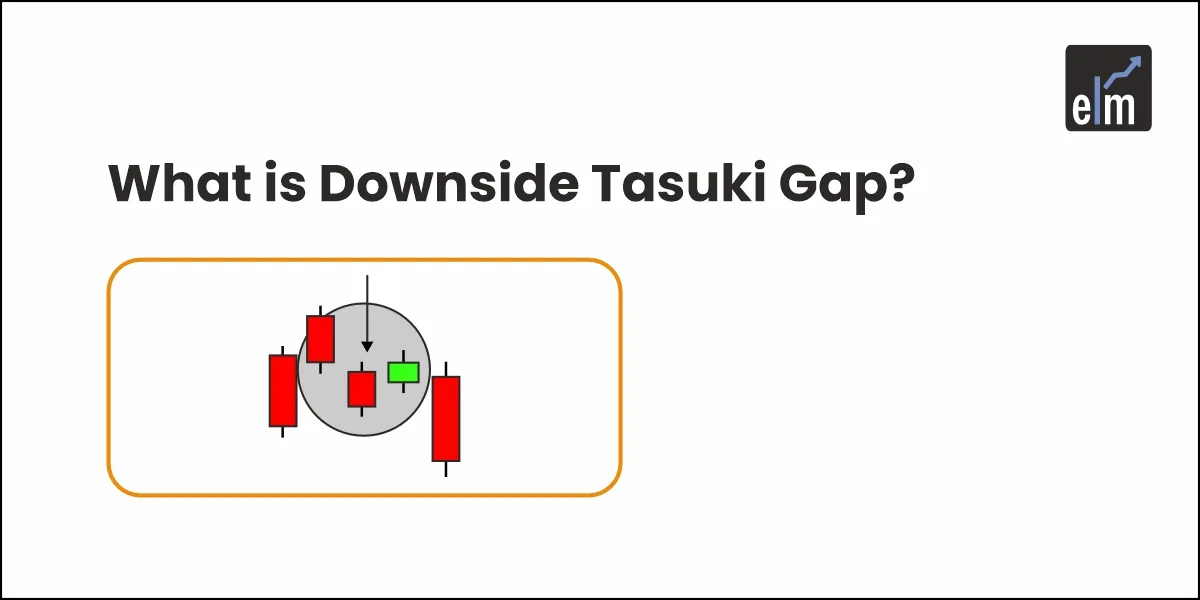
A Downside Tasuki Gap is a three-candle pattern that appears during a downtrend. It represents a temporary attempt by buyers to reverse the trend, which eventually fails.

In simpler words, Downside Tasuki Gap pattern tells us that the downward momentum is likely to continue after a short break.

It confirms that the bearish sentiment in the market remains strong.

What Does this Gap Tell Us?

The Downside Tasuki Gap is a continuation pattern, not a reversal signal. When it forms, it indicates that after a small upward pullback, sellers are likely to regain control and push the price lower again.

In technical terms, this pattern suggests that the gap created by strong selling pressure is not filled, which means the market still has enough bearish momentum to continue downward.

Formation of Downside Tasuki Gap

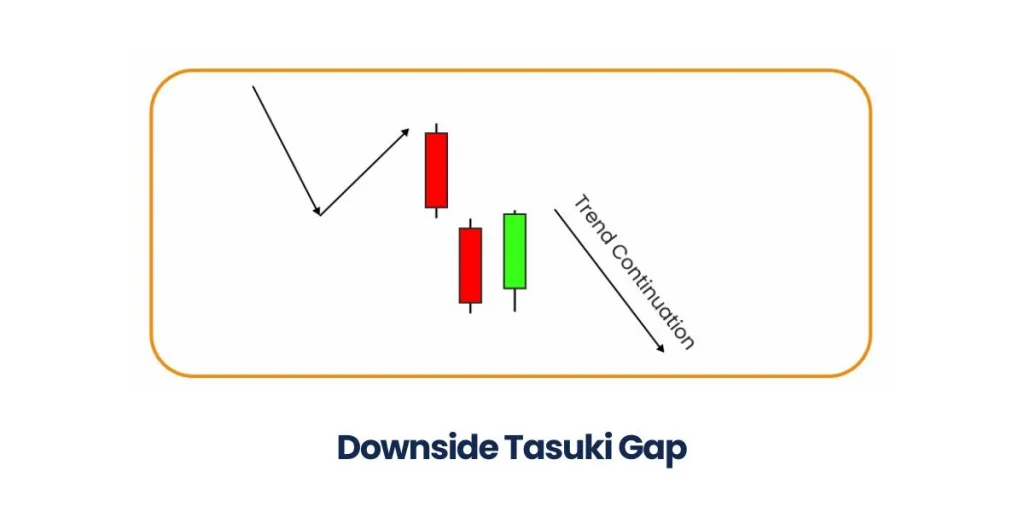
The Downside Tasuki Gap forms through three distinct candles:

  1. First Candle:
    A large bearish (red) candle appears, showing strong selling pressure.
  2. Second Candle:
    The next candle gaps down, opening below the first candle’s close and closing even lower. This gap-down movement confirms continued bearish sentiment.
  3. Third Candle:
    A small bullish (green) candle follows, which opens within the body of the second candle and moves slightly upward. However, it fails to fill the gap between the first and second candles. This incomplete gap-filling shows that buyers are weak, and the downtrend is likely to continue.

Once this pattern is complete, traders often expect prices to move lower in the coming sessions.

Downside Tasuki Gap Example:

Let’s take a simple example to understand it better.

Suppose a stock is trading around ₹120 and then falls sharply to ₹110 with a long red candle. The next day, it gaps down and opens at ₹108, closing further lower at ₹102 – forming another red candle.
Downside Tasuki Gap

On the third day, the stock opens at ₹104 and rises slightly to ₹106, forming a small green candle. However, it fails to close the gap between ₹110 and ₹108.

This three-day formation creates a Downside Tasuki Gap. It indicates that even though buyers tried to lift the price, the selling pressure remains strong, and the stock may continue falling.

How to Use it in StockEdge

You can easily identify the Downside Tasuki Gap pattern using the StockEdge App under the Candlestick Scans section.

Follow these steps:

  1. Open the StockEdge App.
  2. Go to Scans → Candlestick Patterns → Bearish Continuation Patterns.
  3. Select Downside Tasuki Gap.
  4. You’ll see a list of stocks where this pattern has appeared.
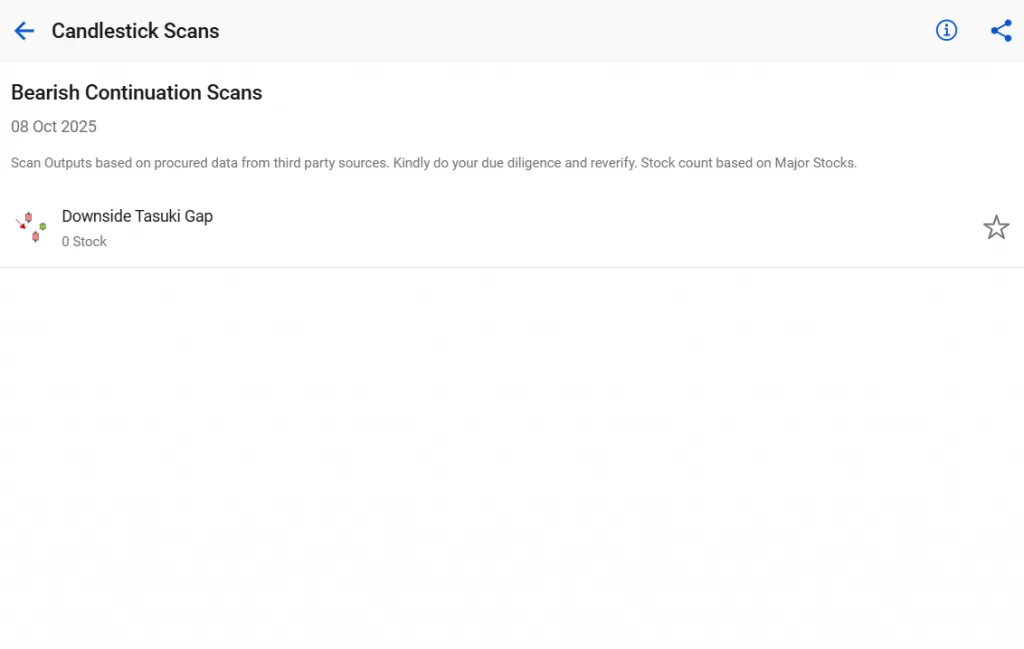
Downside Tasuki Gap

After identifying the pattern, check the overall trend and confirm it with other indicators such as RSI, Moving Averages, and volume. This increases the reliability of your analysis and reduces false signals.

Conclusion

The Downside Tasuki Gap is a useful bearish continuation pattern that helps traders confirm ongoing weakness in a stock. It typically forms in a downtrend and suggests that a brief upward movement by buyers is not strong enough to reverse the trend.

However, traders should not rely solely on this pattern. It’s best used in combination with other technical tools and indicators for confirmation.

Recognizing Downside Tasuki Gap pattern on time can help traders spot short-selling or bearish opportunities in the market.

For more candlestick patterns, check out our detailed blog on 35 Essential Candlestick Chart Patterns.

Frequently Asked Questions (FAQs)

What does Downside Tasuki Gap mean?

It is a bearish continuation pattern that indicates sellers are still dominant even after a small upward move. The downtrend is likely to continue.

How often does Downside Tasuki Gap appear?

It is not very common but tends to appear during strong downtrends. When it does, it provides a strong confirmation of continued bearish sentiment.

What is Upside Tasuki Gap?

The Upside Tasuki Gap is the bullish counterpart of this pattern. It forms during an uptrend, where a small bearish candle fails to fill the gap between two bullish candles, confirming that the uptrend is likely to continue.
ShareTweetSend
Previous Post

Amortisation: What It Is & How To Calculate?

Next Post

Sharpe Ratio: Meaning, Formula & Example

Vivek Bajaj

Vivek Bajaj

Mr Vivek Bajaj has over 20 years of experience in Multi-Asset Trading, Momentum Investor and student of Mark Minervini. He is the co-founder of StockEdge and Elearnmarkets and is passionate about data, analytics, and technology. He serves on various exchange committees and has played a significant role in the evolution of India's derivative market. He has been a speaker at various colleges and higher institutions, including IIT and IIMs.

Related Posts

7 powerful candlestick chart patterns
Technical Analysis

7 Powerful Continuation Candlestick Patterns

August 23, 2025
13.8k
macd
Technical Analysis

5 MACD Strategies For Stock Market Trading

February 15, 2025
34.1k
35 candlestick patterns
Charts, Patterns & Indicators

35 Essential Candlestick Chart Patterns Used By Smart Traders

October 22, 2025
2.5M
Understanding Bollinger Bands in Technical Analysis 1
Technical Analysis

Understanding Bollinger Bands in Technical Analysis

May 21, 2025
22.2k

Leave a Reply Cancel reply

Your email address will not be published. Required fields are marked *

Disclaimer

Elearnmarkets (Kredent InfoEdge Pvt. Ltd.) is a SEBI-registered Research Analyst (RA) entity (SEBI Registration No.: INH300007493). The information provided in this article is for educational and informational purposes only and should not be considered as an offer to buy or sell any securities or investment products.

The stocks, securities, and investment instruments mentioned herein are not recommendations under SEBI (Research Analysts) Regulations, 2014. Readers are advised to conduct their own due diligence and seek independent financial advice before making any investment decisions.

Investments in securities markets are subject to market risks. Please read all related documents carefully before investing. Investing in Equity Shares,
Derivatives, Mutual Funds, or other instruments carry inherent risks, including potential loss of capital. Elearnmarkets (Kredent InfoEdge Pvt. Ltd.) does not provide any guarantee or assurance of returns on any investments. Past performance is not indicative of future performance.

Elearnmarkets Logo

Follow Us

Facebook-f X-twitter Instagram Linkedin-in Youtube Telegram

Register on Elearnmarkets

Continue your financial learning by creating your own account on Elearnmarkets.com

Register Free Account

Download App

Playstore logo
Download on app store

Categories

  • Basic Finance
  • Derivatives
  • Financial Planning
  • Fundamental Analysis
  • Technical Analysis
  • Mutual Funds
  • Miscellaneous

Popular On Elearnmarkets

  • Market Superheroes:
  • Vivek Bajaj
  • Chetan Panchamia
  • Ashish Kyal
  • Premal Parekh
  • Abhijit Paul
  • Jegan
  • Sivakumar Jayachadran
  • Jyoti Budhia
  • Vivek Gadodia
  • Vishal Mehta
  • Piyush Chaudhry
  • Santosh Pasi
  • Gomathi Shankar
  • Market Superheroes:
  • Vivek Bajaj
  • Chetan Panchamia
  • Ashish Kyal
  • Premal Parekh
  • Abhijit Paul
  • Jegan
  • Sivakumar Jayachadran
  • Jyoti Budhia
  • Vivek Gadodia
  • Vishal Mehta
  • Piyush Chaudhry
  • Santosh Pasi
  • Gomathi Shankar
  • Courses:​
  • Options Trading
  • Dow Theory
  • Momentum Trading
  • Stock Investing
  • Harmonic Chart Patterns
  • Algo Trading
  • Elliot Wave Theory
  • Advanced Excel
  • Cryptocurrency
  • NSE Certification Course
  • Courses:​
  • Options Trading
  • Dow Theory
  • Momentum Trading
  • Stock Investing
  • Harmonic Chart Patterns
  • Algo Trading
  • Elliot Wave Theory
  • Advanced Excel
  • Cryptocurrency
  • NSE Certification Course
  • Webinars:
  • Bank Nifty Scalping
  • Intraday Trading Strategies
  • Options Trading Strategies
  • Options selling
  • Price Action
  • Relative Strength
  • Tax Planning
  • Options Buying
  • Growth Stocks
  • Portfolio Management
  • Risk Management
  • Renko Charts
  • Crude Oil
  • Traders Psychology
  • Moving Average
  • Multibagger Stocks
  • Webinars:
  • Bank Nifty Scalping
  • Intraday Trading Strategies
  • Options Trading Strategies
  • Options selling
  • Price Action
  • Relative Strength
  • Tax Planning
  • Options Buying
  • Growth Stocks
  • Portfolio Management
  • Risk Management
  • Renko Charts
  • Crude Oil
  • Traders Psychology
  • Moving Average
  • Multibagger Stocks
  • Free Learning Modules:
  • Intraday Trading
  • Options Scalping
  • Swing Trading
  • Financial Modelling
  • RSI Indicator
  • Bollinger Bands
  • Pricing of Futures
  • Personal Finance
  • Initial Public Offerings (IPO)
  • Value Investing
  • Technical Indicators
  • Candlesticks
  • Chart Patterns
  • Option Greeks
  • ELSS Funds
  • Banking and Insurance
  • Real Estate
  • Gold
  • Free Learning Modules:
  • Intraday Trading
  • Options Scalping
  • Swing Trading
  • Financial Modelling
  • RSI Indicator
  • Bollinger Bands
  • Pricing of Futures
  • Personal Finance
  • Initial Public Offerings (IPO)
  • Value Investing
  • Technical Indicators
  • Candlesticks
  • Chart Patterns
  • Option Greeks
  • ELSS Funds
  • Banking and Insurance
  • Real Estate
  • Gold
  • Book Summaries:
  • Rich Dad Poor Dad
  • Psychology of Money
  • The Intelligent Investor
  • The Richest Man in Babylon
  • Think and Trade Like a Champion
  • Value Investing and Behavioural Finance
  • Trading in the Zone
  • Learn to Earn
  • Book Summaries:
  • Rich Dad Poor Dad
  • Psychology of Money
  • The Intelligent Investor
  • The Richest Man in Babylon
  • Think and Trade Like a Champion
  • Value Investing and Behavioural Finance
  • Trading in the Zone
  • Learn to Earn
  • Tools:
  • CAGR Calculator
  • SIP Calculator
  • eLearnOptions
  • Future Value Calculator
  • Present Value Calculator
  • Atal Pension Yojana
  • Cost of Delay Calculator
  • Become a Crorepati
  • Tools:
  • CAGR Calculator
  • SIP Calculator
  • eLearnOptions
  • Future Value Calculator
  • Present Value Calculator
  • Atal Pension Yojana
  • Cost of Delay Calculator
  • Become a Crorepati

© 2025 Elearnmarkets. All Rights Reserved

  • Visit Elearnmarkets
  • Courses
  • Webinars
  • Financial Guides
  • Get Free Counselling
  • Visit Elearnmarkets
  • Courses
  • Webinars
  • Financial Guides
  • Get Free Counselling

Download Our App

Deliver breaking news, insightful commentary, and exclusive reports. Targeting readers who rely on our platform to stay ahead.

Contact Benzinga
No Result
View All Result
  • Article Categories
    • Basic Finance
    • Derivatives
    • Financial Planning
    • Fundamental Analysis
    • Technical Analysis
    • ETFs & Mutual Funds
    • Marketshala
    • Miscellaneous
  • Language
    • Hindi
    • Bengali
    • English
  • Courses
  • Webinars
  • Stories
Get Free Course

© 2024 Elearnmarkets All Rights Reserved

Guidebook On Chart Patterns
Take Your Trading To The Next Level With Strategies Shared In This Ebook
Download Guide For FREE