

Key Takeaways
- Amortisation Meaning: It is the method of spreading the cost of intangible assets like patents, licences, or software over their useful life.
- Types: It includes book for accounts, tax as per tax rules, and loan for EMI repayments.
- Calculation: Commonly done using the straight-line method: Capitalised cost ÷ Useful life = Annual amortisation expense.
- Importance: Smoothens profits, keeps balance sheets accurate, supports tax planning, and helps investors understand non-cash expenses.
- Amortisation vs Depreciation: Amortisation applies to intangible assets, while depreciation covers tangible assets like machinery or vehicles.
Imagine buying a Netflix subscription for 12 months.
You wouldn’t count the entire payment as an expense in January and pretend February through December were free, that would be nonsense.
Instead, you spread the cost over each month you actually watch shows. That’s basically amortisation, but for businesses: it’s spreading the cost of an intangible asset, like a patent or software license, over the years it actually helps the company make money.
- Key Takeaways
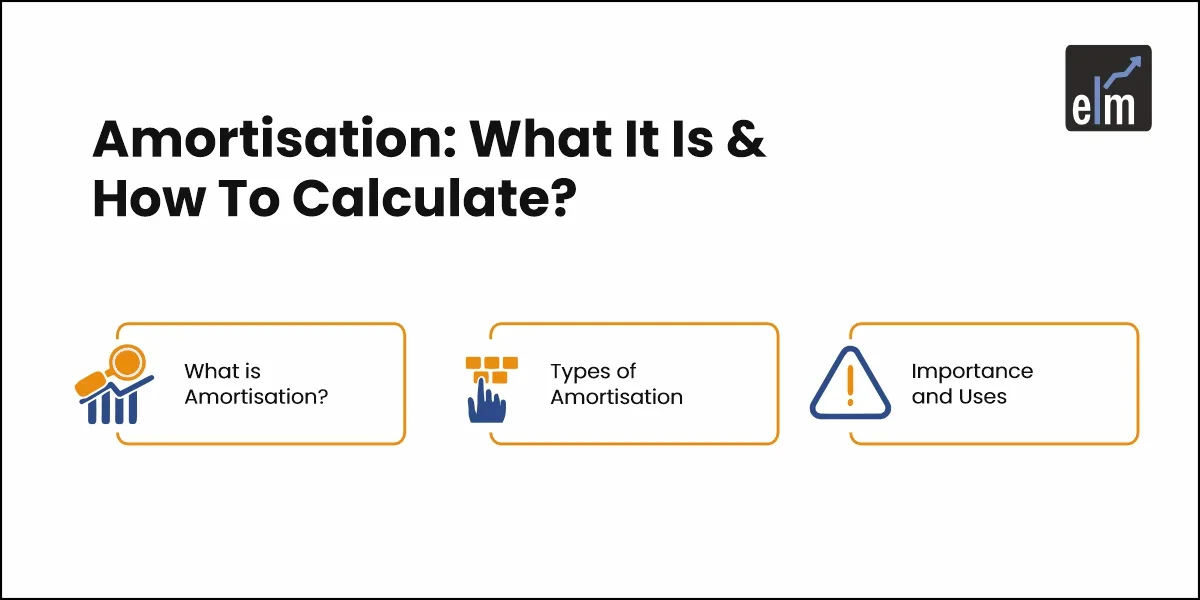
- What is Amortisation?
- Types of Amortisation
- Importance and Uses
- How is Amortisation Calculated?
- Real-world, practical examples (so this isn’t just dusty theory)
- Difference Between Amortisation and Depreciation
- Tax rules: the thing that changes your cash taxes
- Common Pitfalls & Checklist
- Conclusion
- Frequently Asked Questions (FAQs)
What is Amortisation?
It is the accounting method for writing down the cost of intangible assets (patents, licences, customer lists, certain software, etc.) over the period those assets produce value. It follows the accounting “matching principle”: recognise expenses in the same periods that the associated revenue is generated.
(Important: a different concept, loan amortisation, deals with splitting EMIs between interest and principal. Same verb, different animal.)
Types of Amortisation
- Book (accounting) amortisation: The expense you book in your profit & loss to match the intangible’s benefit.
- Tax amortisation: Rules set by tax authorities that sometimes force different useful lives or start dates than your books. (book ≠ tax.)
- Loan amortisation: How repayments chip away at a loan’s balance (not our focus here).
Importance and Uses
- Smooths earnings: Prevents one-time purchases from wrecking a single month’s profit.
- Balance-sheet hygiene: Reduces the carrying value of intangibles over time.
- Tax planning: Different tax rules can accelerate or defer deductions, affecting cash taxes.
- Investor metrics: Because it- is non-cash, some metrics (like EBITDA) exclude it, important when you want apples-to-apples comparisons.
How is Amortisation Calculated?
Most firms use the straight-line method for finite-life intangibles.
Formula (straight-line):
Annual amortisation expense = Capitalised cost ÷ Estimated useful life
What’s “capitalised cost”?
- Purchase price for the intangible (cash, stock, other consideration)
- Direct costs to acquire/defend it (legal fees, registration)
- Not routine R&D or operating expenses (these are usually expensed when incurred unless specific rules allow capitalization).
Quick step-by-step example (numbers you can follow):
Company SunNext buys a patent:
- Purchase price to inventor: ₹180,000
- Patent registration fee: ₹20,000
- Legal defence fees (successful defence): ₹50,000
Capitalised cost (digit-by-digit):
180,000 + 20,000 = 200,000
200,000 + 50,000 = ₹250,000
If legal/contractual life (or the useful life you estimate) = 20 years, then:
Annual amortisation = 250,000 ÷ 20 = ₹12,500 per year
Journal entry each year (typical):
- Debit: Expense ₹12,500
- Credit: Accumulated (or directly reduce the intangible) ₹12,500
If tax rules force a different useful life, the tax amortisation changes the deductible amount and creates temporary book-tax differences (more on that below).
(Need a spreadsheet? I can make a downloadable schedule that auto-calculates book vs tax lines.)

Real-world, practical examples (so this isn’t just dusty theory)
- Tata acquiring Jaguar Land Rover
When Tata Motors acquired JLR, part of the purchase price was allocated to brand value, technology, and licences. These were amortised in the books over their useful lives. - Indian IT companies
Companies like Infosys or TCS capitalise certain software products, customer contracts, and intellectual property acquired during M&A. Their annual reports disclose amortisation of these intangibles, which directly impacts operating profit.
Why this matters for you (founder, investor, or finance person): When a company buys IP, the near-term P&L often shows an elevation. Investors and analysts watch these lines because they’re predictable non-cash expenses that still change reported earnings.
Difference Between Amortisation and Depreciation
- Amortisation = intangibles (patents, licences).
- Depreciation = tangibles (machines, vehicles).
- Salvage value: Depreciation often considers a salvage value; it usually writes off the full capitalised amount.
- Goodwill: Under U.S. GAAP and IFRS, acquired goodwill is not amortised. It’s tested for impairment instead, meaning goodwill behaves differently on the P&L.
Tax rules: the thing that changes your cash taxes
In many tax systems (notably the U.S. tax code), certain acquired intangibles known as Section 197 intangibles must be amortised over 15 years for tax deductions, even if your accounting useful life is different. That legal rule can push a tax deduction later or earlier relative to your books and create deferred tax entries. If your company is an Indian company or in another jurisdiction, local rules differ. Always check local tax guidance.
Common Pitfalls & Checklist
- Don’t capitalise routine R&D costs (unless the tax code or accounting standards explicitly allow it).
- Use the shorter of economic life vs legal life if uncertain.
- Keep separate schedules for book and tax.
- Document assumptions and keep invoices for acquisition-related costs (auditors and tax authorities will ask).
- Remember, indefinite-life intangibles (like some goodwill) are not amortised, they’re impairment-tested.
Conclusion
This concept can be called bookkeeping with taste: it keeps your P&L honest, spreads the cost of intangible advantages over the time they actually contribute value, and crucially plays with tax rules in ways that change cash flow. Learn to capitalize correctly, pick a sensible, useful life, and keep tidy schedules. Do that, and your intangibles will sing, not scream, on the books.
Also Read: 15 Best Tax Saving Schemes in India
Frequently Asked Questions (FAQs)
What is an example of amortisation?
A company buys a software licence for ₹300,000 with a useful life of 3 years → straight-line amortisation = ₹100,000 per year. For tax, the licence may qualify as an intangible asset with a 25% depreciation rate.
Is amortisation an asset or expense?
It is an expense (appears on the income statement). The underlying intangible asset is on the balance sheet and is reduced over time by amortisation.
Is amortisation the same as paying an EMI?
No. EMI amortisation splits loan payments into interest and principal. Accounting amortisation spreads the cost of an intangible asset over its useful life. Same idea (spreading), different context.