


Key Takeaways
- Financial Market: A platform where stocks, bonds, commodities, currencies, and derivatives are traded, connecting buyers and sellers.
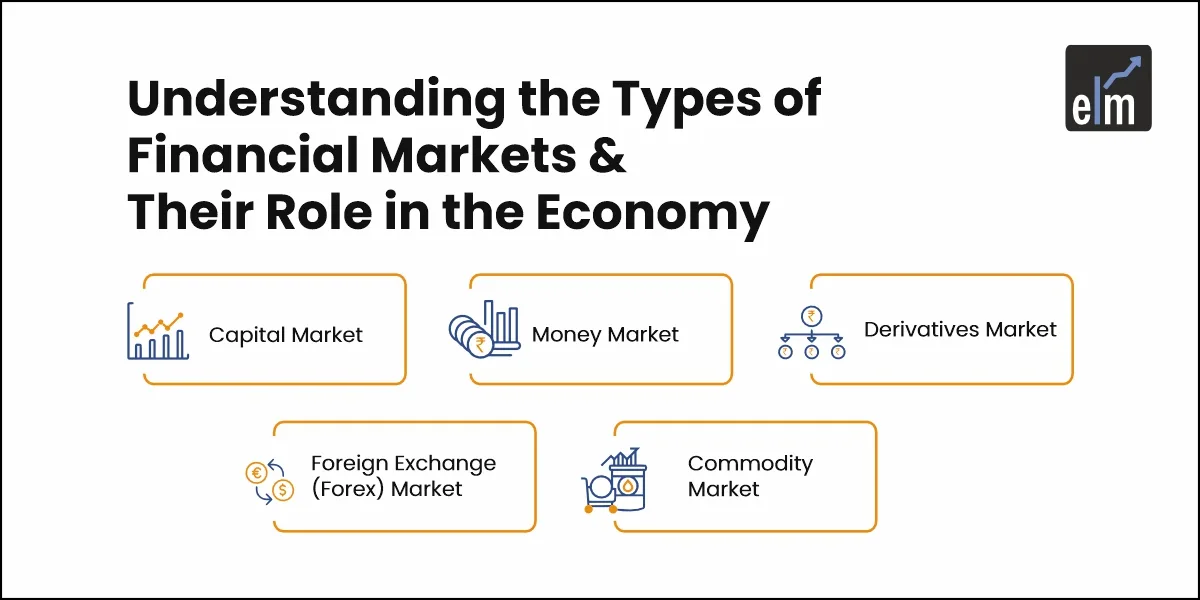
- Types of Financial Markets: Major categories include capital market, money market, derivatives market, forex market, and commodity market.
- Importance: They enable capital formation, price discovery, liquidity, and risk management for the economy.
- Economic Role: A strong financial market system supports growth, investment, and efficient allocation of resources.
Table of Contents
Financial markets are the plumbing system of an economy: invisible pipes, valves and pumps that keep money moving from savers to borrowers, from ideas to businesses, and from small traders to global institutions.
If you want to invest, build wealth, or simply understand why markets wobble, knowing the types of financial markets and how they interact is the first, very useful step.
What Are Financial Markets?
Financial markets are organised venues, physical or digital, where financial instruments (stocks, bonds, currencies, derivatives, commodities) are bought and sold.
Their job is threefold: match buyers with sellers, price risk and assets, and move capital from where it sits idle to where it can be used productively.
Quick example: when you buy a mutual fund or a share, you’re not just following a ticker, you’re participating in a system that helps a company raise money, or lets another investor exit a position. That’s the magic.
Importance of Financial Markets in the Economy
- Capital formation: Companies raise funds to expand, hire, and innovate.
- Price discovery: Markets help find fair prices through supply-demand signals.
- Liquidity: Investors can convert assets into cash (mostly) quickly.
- Risk transfer: Derivatives and insurance-like instruments let people manage risk.
- Information flow: Prices reflect news, expectations, and macro data as a live feed of economic sentiment.
A healthier, deeper market usually means cheaper capital for companies, wider opportunities for savers, and more efficient allocation of resources across the economy.
Types of Financial Markets
Capital Market
This is where long-term funding instruments trade equity (shares) and debt (bonds). Companies list on stock exchanges to raise equity; governments and corporations issue bonds to borrow. For many retail investors, the capital market is the most familiar face of the financial system among the other types of financial markets.
- India snapshot: India’s exchanges (led by the NSE) oversee trillions in market value. The National Stock Exchange’s market capitalisation was around ₹440.92 lakh crore (≈ $5.03 trillion) as per the exchange’s market snapshot in August 2025.
Money Market
Short-term instruments, treasury bills, commercial paper, and certificates of deposit live here. They’re where governments and firms manage liquidity for weeks to months. Money markets are one of the types of financial markets that keep short-term rates stable and are central to banking liquidity management.
Derivatives Market
Among the types of financial markets, the derivatives market helps in hedging, speculation, and arbitrage through futures, options, and swaps. They don’t always involve delivery of the underlying asset; many are settled in cash. Derivatives amplify leverage and risk management, powerful tools when used wisely, dangerous when misused.
Foreign Exchange (Forex) Market
Currencies are traded 24/7 across global platforms. Forex markets, these types of financial markets, determine exchange rates and enable trade and investment flows across borders. For exporters, importers, and multinational firms, Forex markets are essential for managing currency risk.
Commodity Market
Agricultural products, metals, and energy commodities trade on specialised exchanges. Farmers, miners, refiners, and traders use these types of financial markets to hedge price risk. For consumers, commodity prices eventually filter into inflation and daily life (fuel, food prices, etc.).
How These Markets Work Together
All types of financial markets are interconnected. A shock in the forex market (currency depreciation) raises the cost of imported fuel, which can feed into inflation, prompting central bank rate changes. Rate moves ripple into money markets (short-term rates), which affect bond yields in the capital market and valuations in equity markets. Derivatives add leverage and speed to that transmission. It’s an ecosystem: move one element and others react.
Why You Should Know This as an Investor
Because knowledge is the difference between being lucky and being consistent. Knowing the types of financial markets helps you:
- Choose suitable entry points and instruments (bonds vs stocks vs commodities).
- Manage risk (use diversification, basic hedging).
- Read market signals (liquidity, yield curves, FX stress).
- Understand regulatory safety nets and where to look for credible information.
A small, practical example: if you’re nervous about near-term volatility, shifting some allocation from small-cap equity (capital market) into short-term debt funds (money market instruments) can be a sensible defensive move simple, and context-aware.

Riya, 28, opened a demat account during a market rally, like many young Indians. Demat trends show India crossed the 20-crore (200 million) demat-account mark in 2025, driven strongly by under-30 investors. That statistic signals rising retail participation is good for liquidity and awareness, but remember: total accounts ≠ unique investors (many people hold multiple accounts). Treat those numbers as context, not a guarantee of returns.
Final Thoughts
Markets are tools, not temples. Learn the types of financial markets, use them to align with your goals, and keep a long-term lens. If you’re starting, focus on process (consistent investing, cost control, basic asset allocation) rather than chasing daily headlines. The plumbing works best when you understand where each pipe leads.
Frequently Asked Questions (FAQs)
How can I start investing in financial markets in India?
Open a demat + trading account with a registered broker (KYC required).
Decide your first instrument: start simple index funds/ETFs or a diversified mutual fund.
Learn basic risk management (stop-loss, position sizing) and invest SIP-style for discipline.
Use credible data and platforms (exchange sites, SEBI guidance). If unsure, start with low-cost passive funds.
Who are the Participants of the Financial Markets?
Retail investors, institutional investors (mutual funds, pension funds, insurance companies), brokers, market makers, exchanges, depositories, regulators, corporations, and the central bank. Each plays different roles, from liquidity provision to oversight.
Which financial market is best for beginners to invest?
Most beginners do well with the capital market through diversified mutual funds or ETFs (index funds). They offer exposure to equities while spreading risk. Money-market funds are good for capital preservation and liquidity.
Are commodity markets risky for beginners?
Yes, commodities can be volatile, affected by weather, geopolitics, supply constraints, and demand shocks. If you’re inspired by commodity stories, start with commodity-index funds or ETFs (if available) rather than futures, and educate yourself on seasonality and roll costs.
Which is the apex body that regulates our capital markets?
The Securities and Exchange Board of India (SEBI) is the primary regulator for the securities market in India, tasked with investor protection and market development. For specific rules and updates, SEBI’s website is the authoritative source.