

If your annual July ritual involves sitting amidst a mountain of investment proofs, squinting at legal jargon that hasn’t changed since the 1960s, and trying to figure out if Section 80C is still your friend, you aren’t alone.
Most of us have spent years treating tax season like a dreaded final exam we didn’t study for. We calculate, we recalculate, and we usually end up with a headache before we’ve even logged into the portal.
But there is a massive shift coming. India is finally hitting the “refresh” button on its tax code.
After over sixty years of being patched together with endless amendments and confusing provisos, the Income Tax Act of 1961 is being retired. In its place comes the new Income Tax Act 2025.
The new Income Tax Act is set to take full effect from April 1, 2026, and while tax reform usually sounds like dry government talk, this one is actually designed to make our lives significantly less complicated.
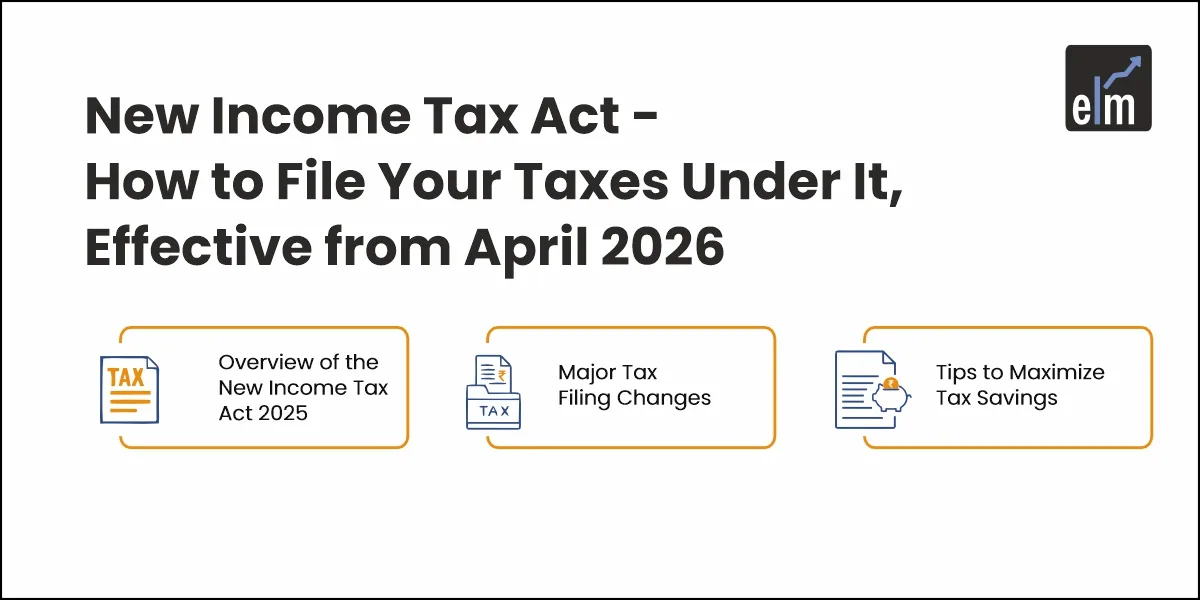
Overview of the New Income Tax Act 2025
The problem with the old system was that it had become a bit like a house that had been renovated fifty times by fifty different owners. Nothing matched, the wiring was a mess, and you needed a professional guide just to find the light switch.
By the time it reached its final years, the 1961 Income Tax Act had ballooned to over 800 sections and nearly 50 chapters. The 2025 version of Income Tax Act is essentially a massive decluttering project. It slashes that down to about 536 sections and organizes them in a way that actually makes sense for the digital age. The goal is to move away from a system where you need a PhD in law to understand your own earnings and toward one where compliance feels more like a standard digital transaction.
One of the most welcome “quality of life” updates in this new Income Tax Act is the death of the “Assessment Year.” For decades, we’ve had to perform mental gymnastics to remember that the money we earn this year is filed in the “Assessment Year,” which is always one year ahead. It was a relic of a pre-digital era that served little purpose other than causing filing errors.
Starting in 2026, the 2025 Income Tax Act introduces the straightforward concept of the “Tax Year.” If you earn your salary or trading profits in 2026, you are simply filing for Tax Year 2026. It’s a small change, but it’s a huge relief for anyone who has ever stared at a form wondering which year they were supposed to select in the dropdown menu.
Tax Regime Changes
While the structural overhaul happens in April 2026, the government has already started the “money” side of this transition through the Finance Act 2025. This is where things get interesting for your bank account right now.
There’s often a bit of confusion here; people think they have to wait until 2026 to see any benefits, but the reality is that the new Income Tax slabs and the massive rebate hike are already in play for the current financial year. The government is essentially nudging us toward the New Tax Regime by making it the “path of least resistance.”
Under these current rules, the first ₹4 lakh of your income is entirely tax-free. From there, it moves in 5% increments up to ₹12 lakh, and then begins to scale more sharply.
The real ‘magic number’ for most young professionals and mid-career earners now is ₹12 lakh. Thanks to the revised Section 87A rebate, which has been bumped up to ₹60,000, anyone earning up to ₹12 lakh in the New Regime effectively pays zero tax.
When you add the standard deduction, which has been increased to ₹75,000 for salaried employees, you can actually earn upwards of ₹12.75 lakh and still not owe a single rupee to the department.
This is a massive departure from the old regime, where you’d be hunting for life insurance receipts and school fee bills just to bring your taxable income down to the ₹5 lakh threshold. The new philosophy seems to be – we’ll give you a higher tax-free limit if you stop making us track a dozen different deductions.
Filing Your Return Under the New Income Tax Act 2025
Choosing between the Old and New regimes used to be a complex calculation, but for most people, the math is now leaning heavily one way.

Unless you are paying a massive home loan interest and have significant other investments that total more than ₹3.5 to ₹4 lakh in deductions, the New Regime is likely your winner. It is about the ‘administrative peace of mind.’
You no longer have to worry if your HR department accepted your rent receipts or if your ELSS statement is in the right format. You just report your income, take your standard deduction, and move on with your life.
Digital Assets and New Provisions
For the modern investor, the new Income Tax Act 2025 also brings a clearer, albeit strict, framework for digital assets. If you’ve spent time navigating the world of crypto or NFTs, you know the tax rules have felt a bit like the Wild West.
The new Income Tax Act finally categorizes Virtual Digital Assets (VDAs) as “property.”
This doesn’t mean the tax is going away; you’re still looking at a flat 30% on gains with no way to offset losses, but it does mean the legal standing of these assets is now solidified. It makes things like estate planning and capital gains calculations much more straightforward.
The 1% TDS on every transaction remains, which is the government’s way of saying they are watching every move on the blockchain.
If you’re trading digital assets, the best advice now is to keep a meticulous digital paper trail, because the tax department’s ability to reconcile your trades with your filings is becoming near-instantaneous.
This leads into one of the more talked-about parts of the 2025 Income Tax Act: the enhanced digital search and seizure powers. There’s been a lot of chatter about the tax department reading your WhatsApps, and while that sounds like a privacy nightmare, it’s important to put it in context.
These powers aren’t for routine checks or because you forgot to report a small dividend. They are specifically for formal search operations where there is strong evidence of massive tax evasion or hidden offshore assets. In those rare cases, authorities now have the legal backing to access cloud storage and encrypted messages.
For the average, compliant taxpayer, it’s a non-issue, but it signals a broader shift; the tax department has officially entered the 21st century. They know that in 2026, hidden money isn’t kept in a suitcase under a bed; it’s kept in a digital wallet or an encrypted folder.
The transition also brings some great news for government employees and those looking at long-term retirement planning.
Read: Why is Retirement Planning Important?
The implementation of the Unified Pension Scheme (UPS) in April 2025 has been seamlessly integrated into the tax code. It now mirrors the benefits of the NPS, meaning your contributions are deductible and a huge chunk of your final corpus, up to 60%, is tax-free when you retire.
The goal here is clearly to create a unified, simplified social security net that doesn’t penalize you for wanting to save for the future.
How to Prepare Now
As we move toward the July 2026 filing period, which will be the last one under the old 1961 Act rules and then into the first New Income Tax Act filing in 2027, the interface of tax in India is going to look very different. We are moving toward a “Faceless” system where your interactions with the department happen through a screen, not in a dusty office.
The ITR forms expected in May 2026 are rumored to be significantly more user-friendly, with more pre-filled data than ever before. Your bank interest, stock dividends, and even some high-value spends will likely already be there when you log in.
The best way to prepare for this shift isn’t to panic-read the whole 500-section Act, but to get your digital house in order. Start using the Annual Information Statement (AIS) on the tax portal regularly. It’s like a credit score for your taxes, showing you exactly what the government already knows about your finances.
If you see something wrong there, fix it now rather than waiting for filing season. If you’re a freelancer or have business income, keep an eye on Form 10-IEA if you want to switch regimes, as the deadlines are getting stricter.
In the end, the Income Tax Act 2025 is a reflection of a changing India. It’s an admission that the old ways were too slow, too complex, and too prone to error. By simplifying the language, aligning the years, and leaning into digital transparency, the government is trying to turn tax from a “gotcha” game into a standard part of adulting.
Whether you’re a software engineer in Mumbai, a trader in Kolkata, or a small business owner in Delhi, the message is the same. The system is getting simpler, but it’s also getting smarter.
The days of hiding behind “clerical errors” or “confusing jargon” are ending, but in exchange, we’re getting a system that actually respects our time and our sanity.
Frequently Asked Questions (FAQs)
1. What is the Income Tax Act?
The Income Tax Act is the primary legislation that governs how income tax works in India. For over sixty years, we’ve been using the 1961 version, which had become incredibly cluttered with more than 800 sections. The new Income Tax Act 2025 is essentially a streamlined replacement, cutting it down to about 536 sections and making the whole thing far easier to understand and navigate.
2. When will the Income Tax Act 2025 be applicable?
The Act takes full effect from April 1, 2026. However, don’t think you have to wait that long to see changes. The government has already rolled out the tax slab benefits and rebate hikes through the Finance Act 2025, so you’re already benefiting this year. Your last filing under the old 1961 rules will be in July 2026, and starting in 2027, you’ll be filing under the new framework.
3. Are there new forms to file under the new act?
Yes, but the good news is they’re expected to be much simpler. The new ITR forms are rumored to launch around May 2026 and will have significantly more pre-filled data, think bank interest, dividends, and even some major expenses already populated when you log in. The whole process is being redesigned to be more digital-first and user-friendly, so it should feel less like decoding legal documents and more like a standard online transaction.