

Key Takeaways
- Growth Option: Profits are reinvested, boosting your investment value over time through compounding. Ideal for long-term wealth creation.
- Dividend Option: Offers regular income from profits, which may be paid as cash or reinvested. Suitable for income-focused investors.
- Tax Treatment: Growth option may lead to higher capital gains tax on redemption, while dividends are taxed in the investor’s hands.
- Risk Factor: Dividend payouts are not guaranteed and depend on the fund’s performance and surplus availability.
Table of Contents
Mutual funds provide an easy means to collect your savings and have professional managers invest in a diversified portfolio of equities, debt securities, and money-market instruments.
At the core of every scheme in a mutual fund is a basic decision: would you like your returns to remain invested and grow over the years, or would you rather get regular cash receipts?
The two main choices you’ll find are Growth and Dividend (IDCW). Here, we shall understand what each choice entails, how they differ from each other, and which could be best suited to your specific goals and situation.
What Is a Growth Mutual Fund?
When you choose the Growth option, all earnings made by the fund, either in the form of dividends received by underlying stocks or capital gains through the sale of assets, are reinvested back into the scheme automatically.
This reinvestment increases your units’ Net Asset Value (NAV), and your investment can harness the compounding effect.
Your returns are greatly amplified by these reinvested dividends over the long term (usually five years or more), much in the same way that releasing snowflakes down a mountainside will create a snowball that gets bigger as it rolls down the slope.
Growth funds are particularly ideal for investors with long-term objectives, retirement planning, higher education for a child, or purchasing a home, where they can allow their money to remain idle during market fluctuations.
What Are Dividend Mutual Funds?
Dividend mutual funds, technically known as Income Distribution cum Capital Withdrawal (IDCW) schemes, go about things differently.
Rather than reinvesting the entire profit, the fund sprinkles some of its accumulated earnings among the investors at regular intervals in the form of dividends.
These dividends are paid to you in cash, offering you a regular income without having to sell any units. Once a dividend is paid out, the NAV of the fund will drop by about the amount paid out, indicating that the assets of the fund have reduced by that payout.
Even if you still want to compound your returns, most schemes also have an IDCW Reinvestment option where it will apply those dividends to purchase more units on your behalf. This blended method can provide income as well as growth, based on your choices.
Benefits of Investing in Growth Mutual Funds
Growth funds are best at creating wealth in the long run. By rolling over all gains, they take advantage of compounding: earnings produce more earnings, leading to an exponential growth pattern over time.
Since no money is taken out of the fund prior to redemption, greater capital remains working, typically meaning higher total returns than for dividend vehicles.
Taxation on the growth fund is postponed until you retire your units.
In equity growth funds, short-term capital gains (redemptions within 12 months) are taxed at a rate of 20% and long-term capital gains (redemptions after 12 months) are charged 12.5% tax on gains over ₹1.25 lakh in a financial year.
Debt-growth funds are also similar, with gains on units held for less than 36 months being charged at your income-tax slab rate and gains on units held above 36 months charged at 20% after indexation.
This tax deferral will cause your investment to compound better.
Read Also: A Guide on Growth Mutual Funds
Advantages of Investing in Dividend (IDCW) Mutual Funds
Dividend funds are attractive to investors who want regular income without withdrawing from their capital.
Retirees, for instance, tend to use IDCW payments to fund everyday expenses.
Having dividends credited to your bank account can also serve as a psychological comfort, reminding you that your investment is paying off.
While dividend payments do reduce the NAV of the fund, opting for the IDCW Reinvestment option allows you to automatically recover those payments as new units, effectively preserving the compounding process.
Latest tax amendments ensure that all dividends are taxed at the hands of the investor at their respective slab rate, and any dividend income over ₹5,000 in a year attracts a 10% TDS (20% if PAN is not provided).
Types of IDCW Options
IDCW schemes typically provide three frequencies of payout: monthly, quarterly, and yearly. Monthly IDCW plans pay smaller sums more frequently, assisting in fulfilling everyday needs.
Quarterly IDCW finds a balance between frequency and durability, while yearly IDCW aggregates your payouts into one large sum annually, usually the choice for those looking to reinvest dividends or plan taxes judiciously.
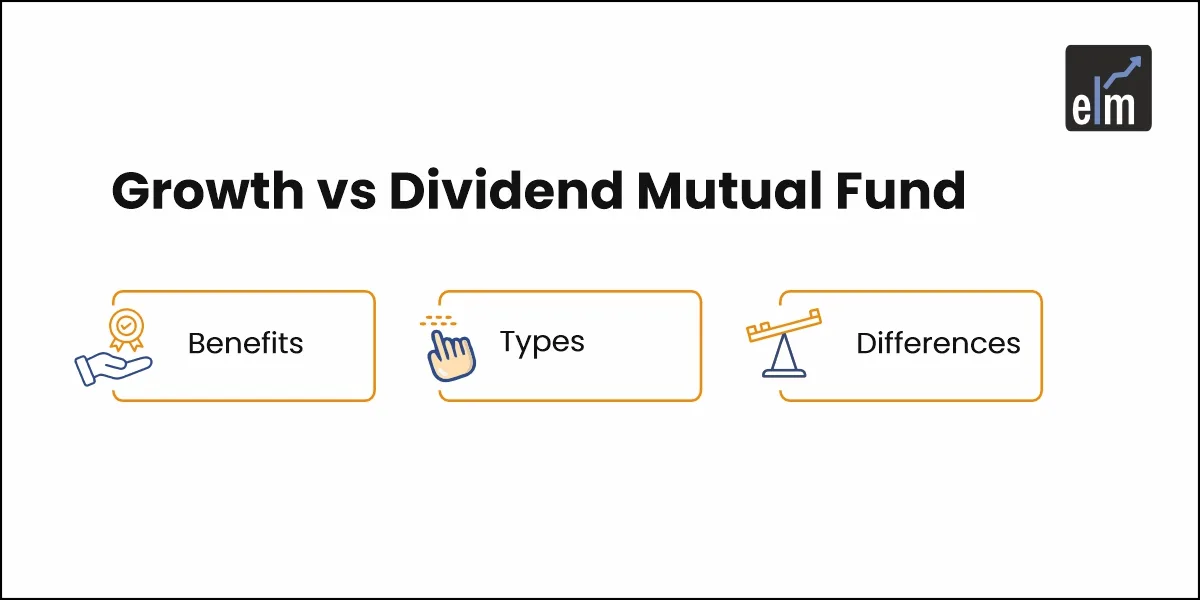
Differences Between Growth and Dividend Funds
Growth and dividend options vary largely in terms of how they handle profits and their effect on NAV.
In growth funds, earnings reinvested continuously move NAV higher, while dividend funds cause NAV to fall whenever a payment is made, only to bounce back.
Over an extended enough interval, growth funds tend to provide higher overall returns due to more capital being kept invested.
Taxation also differs: growth funds only trigger capital-gains tax on redemption, while dividend funds compel investors to tax payouts in the year of receipt along with withholding according to TDS regulations.
How Taxation Differs in Both?
In the current tax regime, equity funds sold within 12 months are charged short-term capital gains tax at 20%, and profits over 12 months are charged 12.5% on amounts over ₹1.25 lakh per annum.
In debt funds, gains on units held for less than 36 months are taxed as per your income-tax slab, and units held for more are taxed at 20% after indexation.
Dividend earnings from any mutual fund are included in your overall taxable income and taxed as per your slab; distributions exceeding ₹5,000 per year incur a 10% TDS deduction at source (going up to 20% if no PAN is submitted).
Growth vs Dividend Mutual Funds: Which Is Better?
The decision between Growth and Dividend rests on your financial plan. If you have a long-term horizon for building wealth and can stomach market fluctuations, Growth schemes will likely do better due to constant compounding and tax deferment.
However, if you need predictable income, say, to pay monthly bills in retirement, or if knowing regular payments brings comfort, dividend schemes would suit you better.
That is ultimately the way it is: no single solution; it depends on your time horizon, cash-flow requirements, and tax priorities.
Who Should Invest in Growth and Dividend Funds?
Growth funds tend to suit younger investors and mid-career professionals who are building their financial corpus for milestones well into the future.
Dividend funds often fit retirees, semi-retired individuals, or anyone who values predictable income streams.
If you’re uncertain, consider a mix of both: allocating a portion to Growth for high compound returns, and another to Dividend for periodic cash flow.
Are there funds in which I can have both growth and dividend?
Yes. Hybrid or balanced funds combine equity, debt, and dividend-paying stocks to provide a mix of NAV appreciation and regular payouts.
Schemes such as Equity-Income schemes or Dynamic Asset Allocation schemes keep changing their proportion to seek both growth and income, providing benefits to investors seeking the best of both worlds without managing multiple plans.
Conclusion
Growth and Dividend mutual funds both have their different benefits.
Growth funds are the wealth creators in the long run, whereas Dividend funds provide consistent returns and mental peace. By matching your decision with your objective, be it creating a retirement corpus, financing education, or providing monthly liquidity, you can benefit from the correct strategy to achieve your financial goals.
And if you’re looking for balance, hybrid funds are ready to blend growth potential with dividend payment, allowing you to make your financial journey with confidence.
And remember to always research on your own from a SEBI-registered analysis app before investing.
Frequently Asked Questions (FAQs)
Is growth or IDCW better?
There isn’t a one-size-fits-all “better”. Growth funds tend to generate higher returns over the long run through compounding and tax deferral, whereas IDCW funds are best for those who want regular payouts. Your objectives and cash-flow needs should dictate your decision.

Which Mutual Fund is ideal for Dividends?
Search for schemes that are categorized as “Equity-Income” or “Dividend Yield” funds, and see their IDCW frequency. Funds that have a consistent track record of quarterly or monthly disbursals in large-cap or multi-cap categories tend to do well.
Which MF offers monthly dividends?
Most liquid and ultra-short-term debt funds provide monthly IDCW choices. A few large-cap equity funds also have monthly dividend schemes. Always check the specific payout frequency in the offer document of the fund.