
Elearnmarkets - Financial Market Learning
  • Courses
  • Webinars
  • Stories
  • Language
    • English
    • Hindi
    • Bengali
No Result
View All Result
Get Free Course
  • Basic Finance
  • Derivatives
    • Futures
    • Options
  • Financial Planning
  • Fundamental Analysis
  • Technical Analysis
  • Mutual Funds
  • Marketshala
  • Miscellaneous
Elearnmarkets - Learn Stock Market, trading, investing for Free
  • Courses
  • Webinars
  • Stories
  • Language
    • English
    • Hindi
    • Bengali
No Result
View All Result
Get Free Course
Elearnmarkets - Learn Stock Market, trading, investing for Free
No Result
View All Result
Home Technical Analysis Trading Terms, Rules & Strategies
Greed and Fear Index

Greed and Fear Index: Definition, Function, and Benefits

Vivek Bajaj by Vivek Bajaj
September 11, 2025
in Trading Terms, Rules & Strategies
Reading Time: 8 mins read
0
729
VIEWS
Share on FacebookShare on XShare on WhatsApp

Key Takeaways

  • Greed and Fear Index: A sentiment gauge that scores market mood from 0 (extreme fear) to 100 (extreme greed), giving a quick read on crowd psychology.
  • Indicators Used: Combines signals like momentum, breadth, options activity, volatility, safe-haven demand, and credit spreads into one number.
  • Trading Use: Works best as a short-term context tool to refine entries/exits, not as a standalone buy/sell signal.
  • Investor Insight: Extreme fear can highlight potential buying zones, while extreme greed may warn of overheated conditions.
  • Limitations: It is backward-looking and US-centric (in CNN’s version), so traders should pair it with fundamentals and local indicators.

Table of Contents

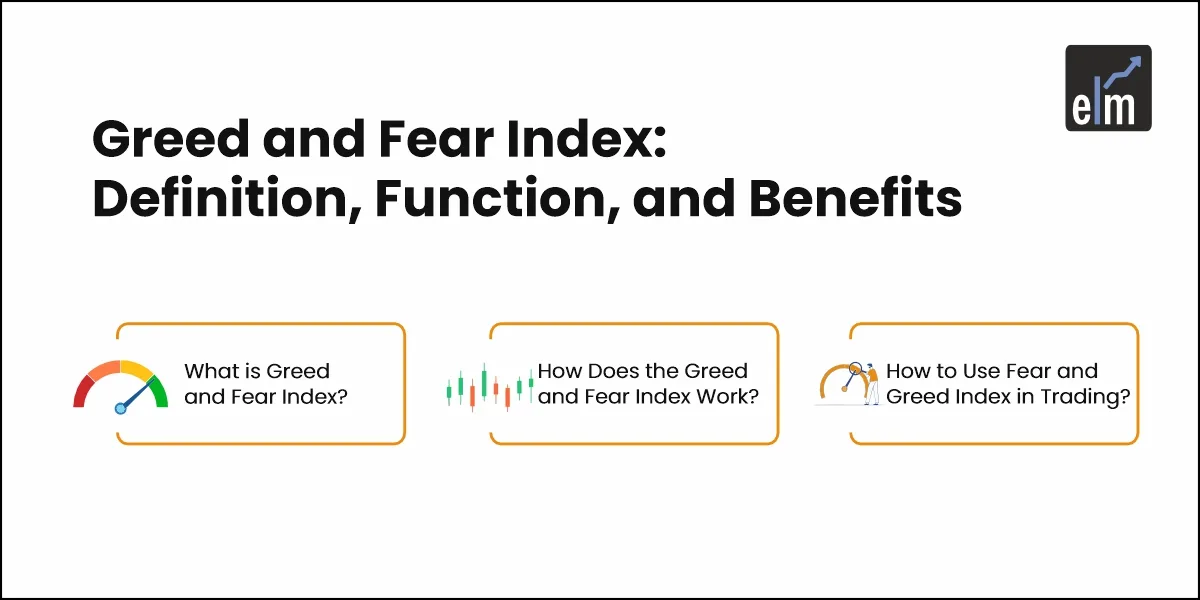
  • What is Greed and Fear Index?
  • How Does the Greed and Fear Index Work?
    • The Seven Pillars (simple)
  • How to Use Fear and Greed Index in Trading?
    • Market Timing
    • Best Timeframes and Markets
  • Benefits of Using the Greed and Fear Index
  • What are the Limitations of Greed and Fear Index?
  • Conclusion
  • Frequently Asked Questions (FAQs)

“Be fearful when others are greedy and be greedy when others are fearful.” – Warren Buffett

These lines are not just random quotes from a Billionaire’s PR agency, this is an actual market phenomenon. You’ve felt it, that queasy rush when your phone buzzes with bad headlines and everyone seems to be selling. 

On March 12, 2020, global markets tore lower (the Dow plunged nearly 10% that day), a panic that shows up as “extreme fear” on Greed and Fear sentiment meters.

India felt the shock too: the Nifty slid roughly 7.9% and the Sensex lost about 2,919 points, while India VIX shot up as traders scrambled for safety.

The Greed and Fear Index tries to capture moments like that, one simple number that tells you whether the market room is calm, nervous, or partying too hard. 

This article will show what that number means, how it’s made, and how you can use it without letting the crowd run your money.

What is Greed and Fear Index?

The Greed and Fear Index is a sentiment gauge that converts several market signals into a score from 0 (Extreme Fear) to 100 (Extreme Greed). 

Scores around 50 are neutral. Low scores suggest risk-aversion (which can create buying opportunities); high scores suggest excess optimism (which can warn of overheating). The index is a snapshot of investor emotion, not a replacement for research.

How Does the Greed and Fear Index Work?

Most popular versions (like CNN’s) combine seven equally weighted market indicators into a single number for their Greed and Fear Index to work. 

In plain English, the seven pillars look at price action, breadth, options activity, volatility, and credit risk, all filtered to show whether the crowd is leaning cautious or greedy. Sources that track the crypto world build similar indices but swap in social and on-chain signals for fundamentals. 

The Seven Pillars (simple)

  1. Market Momentum — Is the benchmark above its long-term moving average? (Above = optimism.)
  2. Price Strength — More 52-week highs than lows = bullish heat.
  3. Breadth (Volume) — Are advancing stocks/volumes beating decliners? Broad participation = healthier rally.
  4. Put/Call Ratio — More puts = hedging / worry; more calls = risk appetite.
  5. Volatility (VIX) — Rising implied volatility usually signals fear.
  6. Safe-haven Demand — If bonds outperform stocks lately, people seek safety.
  7. Junk Bond Demand (credit spreads) — Tight spreads = risk-taking; wide spreads = caution.

How to Use Fear and Greed Index in Trading?

Market Timing

  • Use it as context, not a switch. Extreme readings can highlight potential opportunities or risks, but they shouldn’t be the sole reason to buy or sell. Pair the index with valuation checks, company fundamentals, or your trading plan.
  • Scale in/out. In extreme fear, consider scaling into high-quality positions rather than going all-in. In extreme greed, trim speculative bets. 

Best Timeframes and Markets

  • Short-term signal: Research shows the index tends to be more helpful over short horizons (days to a few weeks) than as a long-term timing tool. Traders often use it to refine entries/exits rather than to rework lifetime allocations.
  • Market fit: The original CNN index is US-market centric (built off S&P and US market data). For crypto, an alternative.me’s crypto Fear and Greed Index uses volatility, volume, social media, and search trends tailored to Bitcoin and crypto behavior. Use the version that matches the market you trade.

Benefits of Using the Greed and Fear Index

  • Fast sentiment snapshot: One glance tells you whether the crowd is cautious or euphoric.
  • Behavioral check: Helps you spot when your own emotions might be crowd-driven (fear or FOMO).
  • Complementary tool: Works well alongside VIX, breadth measures, valuation screens, and on-chain metrics for crypto.
  • Risk awareness: Extreme readings have historically coincided with volatile market phases, alerting traders to tighten risk controls. 

What are the Limitations of Greed and Fear Index?

  • Not predictive on its own: The index explains market mood, but it’s not a guaranteed timing signal. Studies show mixed predictive power and time-varying usefulness. Treat it as one input among many.
  • Backward-looking components: Some indicators lag (they reflect very recent history), so the meter can shift after prices have already moved.
  • US focus (for CNN version): The CNN index is built from US data; global or India-specific sentiment may differ. Blend it with local indicators (India VIX, Nifty breadth, FII flows) for India-centric decisions.
  • Crypto noise: Crypto indices rely heavily on social metrics and search trends; that makes them faster but also noisier and prone to hype cycles.

Conclusion

The Greed and Fear Index is a compact, useful gauge that converts crowd emotion into a single, easy-to-read score. Use it to understand the market’s mood, check your own instincts, and add context to trades, but never as a lone signal. Combine it with fundamentals, risk management, and a plan that fits your goals.
Frequently Asked Questions (FAQs)

What is the idea of Fear and Greed Index?

It’s a numerical meter (0–100) that summarizes investor sentiment: low values show fear, high values show greed. So that extreme crowd emotions can create mispriced opportunities or risks.

How is the Greed Fear Index calculated?

Popular versions average several indicators (price momentum, highs vs lows, breadth, put/call ratio, VIX, bond vs stock performance, and junk bond spreads), each normalized and equally weighted into one score. Crypto versions use different inputs like volatility, volume, social media, and search trends.

What does extreme fear in the index mean?

Extreme Fear (very low score) means investors are heavily risk-averse, prices may be depressed by emotion. Some investors see this as a buying opportunity, but you must check fundamentals first.

What does extreme greed in the index mean?

Extreme Greed (very high score) signals strong optimism and possible overpricing. It’s often a cue to trim risky bets, take profits, or raise cash for safer entries.

ShareTweetSend
Previous Post

Cash and Carry Arbitrage: A Detailed Overview

Next Post

Monopoly Market: Definition, Types & Impact on Market

Vivek Bajaj

Vivek Bajaj

Mr Vivek Bajaj has over 20 years of experience in Multi-Asset Trading, Momentum Investor and student of Mark Minervini. He is the co-founder of StockEdge and Elearnmarkets and is passionate about data, analytics, and technology. He serves on various exchange committees and has played a significant role in the evolution of India's derivative market. He has been a speaker at various colleges and higher institutions, including IIT and IIMs.

Related Posts

Dabba Trading
Trading Terms, Rules & Strategies

Reality About Dabba Trading: Risks and Insights

August 8, 2025
653
scalping vs swing trading
Technical Analysis

Scalping vs Swing Trading: Understanding the Difference

January 31, 2025
1.2k
How To Implement Factor Investing Strategies in Your Portfolio 1
Trading Terms, Rules & Strategies

How To Implement Factor Investing Strategies in Your Portfolio

February 25, 2025
452
High-Frequency Trading (HFT) Explained - Market Dynamics and Risks 2
Trading Terms, Rules & Strategies

High-Frequency Trading (HFT) Explained – Market Dynamics and Risks

December 21, 2023
1.4k

Leave a Reply Cancel reply

Your email address will not be published. Required fields are marked *

Disclaimer

Elearnmarkets (Kredent InfoEdge Pvt. Ltd.) is a SEBI-registered Research Analyst (RA) entity (SEBI Registration No.: INH300007493). The information provided in this article is for educational and informational purposes only and should not be considered as an offer to buy or sell any securities or investment products.

The stocks, securities, and investment instruments mentioned herein are not recommendations under SEBI (Research Analysts) Regulations, 2014. Readers are advised to conduct their own due diligence and seek independent financial advice before making any investment decisions.

Investments in securities markets are subject to market risks. Please read all related documents carefully before investing. Investing in Equity Shares,
Derivatives, Mutual Funds, or other instruments carry inherent risks, including potential loss of capital. Elearnmarkets (Kredent InfoEdge Pvt. Ltd.) does not provide any guarantee or assurance of returns on any investments. Past performance is not indicative of future performance.

Elearnmarkets Logo

Follow Us

Facebook-f X-twitter Instagram Linkedin-in Youtube Telegram

Register on Elearnmarkets

Continue your financial learning by creating your own account on Elearnmarkets.com

Register Free Account

Download App

Playstore logo
Download on app store

Categories

  • Basic Finance
  • Derivatives
  • Financial Planning
  • Fundamental Analysis
  • Technical Analysis
  • Mutual Funds
  • Miscellaneous

Popular On Elearnmarkets

  • Market Superheroes:
  • Vivek Bajaj
  • Chetan Panchamia
  • Ashish Kyal
  • Premal Parekh
  • Abhijit Paul
  • Jegan
  • Sivakumar Jayachadran
  • Jyoti Budhia
  • Vivek Gadodia
  • Vishal Mehta
  • Piyush Chaudhry
  • Santosh Pasi
  • Gomathi Shankar
  • Market Superheroes:
  • Vivek Bajaj
  • Chetan Panchamia
  • Ashish Kyal
  • Premal Parekh
  • Abhijit Paul
  • Jegan
  • Sivakumar Jayachadran
  • Jyoti Budhia
  • Vivek Gadodia
  • Vishal Mehta
  • Piyush Chaudhry
  • Santosh Pasi
  • Gomathi Shankar
  • Courses:​
  • Options Trading
  • Dow Theory
  • Momentum Trading
  • Stock Investing
  • Harmonic Chart Patterns
  • Algo Trading
  • Elliot Wave Theory
  • Advanced Excel
  • Cryptocurrency
  • NSE Certification Course
  • Courses:​
  • Options Trading
  • Dow Theory
  • Momentum Trading
  • Stock Investing
  • Harmonic Chart Patterns
  • Algo Trading
  • Elliot Wave Theory
  • Advanced Excel
  • Cryptocurrency
  • NSE Certification Course
  • Webinars:
  • Bank Nifty Scalping
  • Intraday Trading Strategies
  • Options Trading Strategies
  • Options selling
  • Price Action
  • Relative Strength
  • Tax Planning
  • Options Buying
  • Growth Stocks
  • Portfolio Management
  • Risk Management
  • Renko Charts
  • Crude Oil
  • Traders Psychology
  • Moving Average
  • Multibagger Stocks
  • Webinars:
  • Bank Nifty Scalping
  • Intraday Trading Strategies
  • Options Trading Strategies
  • Options selling
  • Price Action
  • Relative Strength
  • Tax Planning
  • Options Buying
  • Growth Stocks
  • Portfolio Management
  • Risk Management
  • Renko Charts
  • Crude Oil
  • Traders Psychology
  • Moving Average
  • Multibagger Stocks
  • Free Learning Modules:
  • Intraday Trading
  • Options Scalping
  • Swing Trading
  • Financial Modelling
  • RSI Indicator
  • Bollinger Bands
  • Pricing of Futures
  • Personal Finance
  • Initial Public Offerings (IPO)
  • Value Investing
  • Technical Indicators
  • Candlesticks
  • Chart Patterns
  • Option Greeks
  • ELSS Funds
  • Banking and Insurance
  • Real Estate
  • Gold
  • Free Learning Modules:
  • Intraday Trading
  • Options Scalping
  • Swing Trading
  • Financial Modelling
  • RSI Indicator
  • Bollinger Bands
  • Pricing of Futures
  • Personal Finance
  • Initial Public Offerings (IPO)
  • Value Investing
  • Technical Indicators
  • Candlesticks
  • Chart Patterns
  • Option Greeks
  • ELSS Funds
  • Banking and Insurance
  • Real Estate
  • Gold
  • Book Summaries:
  • Rich Dad Poor Dad
  • Psychology of Money
  • The Intelligent Investor
  • The Richest Man in Babylon
  • Think and Trade Like a Champion
  • Value Investing and Behavioural Finance
  • Trading in the Zone
  • Learn to Earn
  • Book Summaries:
  • Rich Dad Poor Dad
  • Psychology of Money
  • The Intelligent Investor
  • The Richest Man in Babylon
  • Think and Trade Like a Champion
  • Value Investing and Behavioural Finance
  • Trading in the Zone
  • Learn to Earn
  • Tools:
  • CAGR Calculator
  • SIP Calculator
  • eLearnOptions
  • Future Value Calculator
  • Present Value Calculator
  • Atal Pension Yojana
  • Cost of Delay Calculator
  • Become a Crorepati
  • Tools:
  • CAGR Calculator
  • SIP Calculator
  • eLearnOptions
  • Future Value Calculator
  • Present Value Calculator
  • Atal Pension Yojana
  • Cost of Delay Calculator
  • Become a Crorepati

© 2025 Elearnmarkets. All Rights Reserved

  • Visit Elearnmarkets
  • Courses
  • Webinars
  • Financial Guides
  • Get Free Counselling
  • Visit Elearnmarkets
  • Courses
  • Webinars
  • Financial Guides
  • Get Free Counselling

Download Our App

Deliver breaking news, insightful commentary, and exclusive reports. Targeting readers who rely on our platform to stay ahead.

Contact Benzinga
No Result
View All Result
  • Article Categories
    • Basic Finance
    • Derivatives
    • Financial Planning
    • Fundamental Analysis
    • Technical Analysis
    • ETFs & Mutual Funds
    • Marketshala
    • Miscellaneous
  • Language
    • Hindi
    • Bengali
    • English
  • Courses
  • Webinars
  • Stories
Get Free Course

© 2024 Elearnmarkets All Rights Reserved